
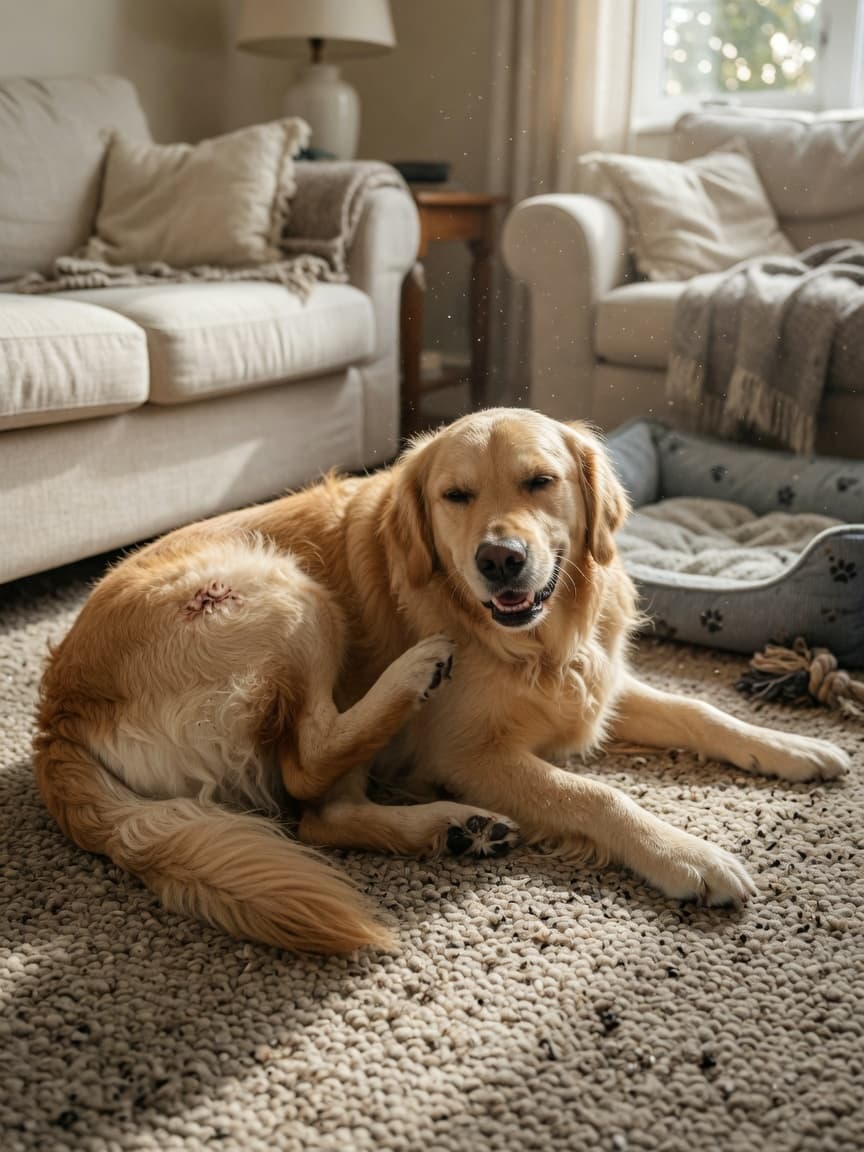
Why Most Flea Treatments Fail
Many pet owners treat their dog or cat for fleas and assume the problem is solved. A few weeks later, the scratching returns — and the frustration begins all over again. The reason is straightforward: when you only treat the animal, you are targeting just 5% of the infestation. The other 95% — eggs, larvae, and pupae — are living in your carpets, soft furnishings, bedding, and floor crevices. Without tackling all four life stages, you are fighting a losing battle.
This guide walks through the complete flea life cycle, explains the biology behind each stage, and outlines an evidence-based approach to breaking the cycle for good — both on your pet and throughout your home.
The Four Stages of the Flea Life Cycle
The cat flea, Ctenocephalides felis, is by far the most prevalent flea species affecting both cats and dogs across Europe. Despite its name, it readily infests dogs, rabbits, and occasionally humans. Understanding its four developmental stages is the foundation of effective control, as recommended by ESCCAP (European Scientific Counsel Companion Animal Parasites) guideline GL3.
Stage 1: Eggs
Adult female fleas begin laying eggs within 24 to 48 hours of their first blood meal. A single female can produce up to 50 eggs per day. Eggs are smooth, white, and roughly 0.5 mm in length — barely visible to the naked eye. They are not sticky, so they fall readily from the host animal into the environment: bedding, carpets, gaps between floorboards, and furniture. Under warm, humid conditions (around 27°C and 70% humidity), eggs hatch within two to five days.
Stage 2: Larvae
Flea larvae are small, worm-like, and negatively phototactic — meaning they actively avoid light and burrow deep into carpet fibres and crevices. They feed on organic debris and, crucially, on the dried blood-rich faeces (sometimes called "flea dirt") shed by adult fleas. Larval development takes one to two weeks under favourable conditions but can extend considerably in cooler or drier environments. This is the stage most vulnerable to household insecticides.
Stage 3: Pupae
The larva eventually spins a sticky, silken cocoon — the pupal stage — which is the most resilient part of the flea life cycle. The cocoon actively collects debris, making it almost invisible in carpeting. Critically, pupae are highly resistant to insecticides and can remain dormant for months, waiting for triggers such as vibration, warmth, and the presence of carbon dioxide from a passing host. This is why you may notice a sudden flea surge after returning from holiday: dormant pupae detect your presence and hatch en masse.
Stage 4: Adults
Once stimulated to emerge, an adult flea seeks a host within seconds. Adults are wingless but powerful jumpers, capable of leaping up to 33 cm. They must feed on blood to survive and reproduce. The entire life cycle from egg to adult can take as little as two to three weeks in ideal summer conditions, or stretch to six to eight months in cooler weather. This variation means infestations can persist year-round in centrally heated homes regardless of season.
Treating Your Pet: Choosing the Right Product
Effective on-pet treatment kills adult fleas quickly and, in some cases, sterilises eggs or kills larvae that come into contact with treated fur. Several EU-licensed products are available.
- Bravecto (fluralaner) — an oral chew or spot-on for dogs and cats providing up to 12 weeks of protection against fleas and ticks. Its long duration makes it an excellent choice for consistent coverage.
- NexGard (afoxolaner) — a monthly oral chew for dogs that kills fleas rapidly, often within hours of administration.
- Advocate (imidacloprid/moxidectin) — a monthly spot-on for dogs and cats that also addresses lungworm and intestinal parasites alongside flea control.
- Frontline (fipronil) — a widely available spot-on that disrupts flea nervous systems; useful as a cost-effective maintenance option.
- Seresto collar — releases imidacloprid and flumethrin continuously for up to eight months, providing sustained protection without monthly applications.
Always use products licensed for your specific species and weight category. Never apply dog-specific products to cats — certain ingredients, including permethrin, are toxic to felines.
Treating the Home Environment
On-pet treatment alone will not resolve an established infestation. You must tackle the environmental reservoir simultaneously.
Household Sprays
Purpose-formulated household insecticide sprays are highly effective when applied correctly. Products such as Indorex Defence Household Flea Spray and RIP Fleas contain a combination of a quick-kill adulticide (typically permethrin) and an insect growth regulator (IGR) such as pyriproxyfen or methoprene. The IGR disrupts larval development and renders eggs non-viable for months after a single treatment. Apply to all soft furnishings, carpets, skirting boards, and beneath furniture — paying particular attention to areas where your pet rests. Allow the room to ventilate before allowing pets and people back in.
Vacuuming
Regular, thorough vacuuming is not optional — it is an active part of flea control. Vacuuming removes eggs, larvae, and flea dirt from carpets, and the vibration also stimulates dormant pupae to hatch, exposing them to any residual insecticide you have applied. Aim to vacuum all carpeted areas and upholstery at least every two to three days during an active infestation, and dispose of the vacuum bag or empty the canister outdoors immediately after each session. Washing pet bedding at 60°C weekly will destroy all life stages present.
How Long Does It Take to Clear an Infestation?
Even with a rigorous combined approach — treating all pets in the household and applying a quality household spray — you should expect to see some adult fleas for up to three months. This is because those resistant pupal cocoons will continue hatching over this period. Persistence is essential. If all pets receive continuous, uninterrupted preventive treatment and the environment has been treated, the emerging adults will be killed before they can reproduce, and the infestation will eventually collapse.
Year-Round Prevention: The ESCCAP Recommendation
ESCCAP GL3 recommends that flea prevention be maintained year-round for pets in Europe, not just during warmer months. Modern centrally heated homes provide ideal conditions for flea survival throughout winter. Regular, on-schedule treatment of all household pets — even those that rarely go outdoors — is the most reliable way to prevent reinfestation.
Online retailers such as Zooplus stock a comprehensive range of veterinary-approved flea treatments and household sprays at competitive prices, making it straightforward to keep a consistent supply. Always consult your vet if you are uncertain which product is most appropriate for your pet's individual health needs or lifestyle.
Summary
- 95% of a flea infestation is in the environment, not on the pet.
- Ctenocephalides felis is the dominant flea species across Europe.
- The life cycle spans two to eight weeks depending on temperature and humidity.
- Treat all household pets simultaneously with a licensed product.
- Use a household spray containing an insect growth regulator on all soft furnishings and carpets.
- Vacuum every two to three days and wash bedding at 60°C weekly.
- Expect residual adult flea activity for up to three months after treatment begins.
- Maintain year-round prevention as per ESCCAP GL3 guidance.