

Which Flea Species Affects Your Dog?
Many dog owners assume their pet has "dog fleas," but the reality is more surprising. The cat flea, Ctenocephalides felis, is by far the most common flea species found on dogs in the UK and across Europe. The actual dog flea, Ctenocephalides canis, does exist but is encountered far less frequently. The distinction matters little in terms of treatment, but it does explain why households with both cats and dogs are particularly vulnerable — the cat flea readily infests both species and their shared environment.
The Flea Life Cycle: Why 95% of the Problem Is in Your Home
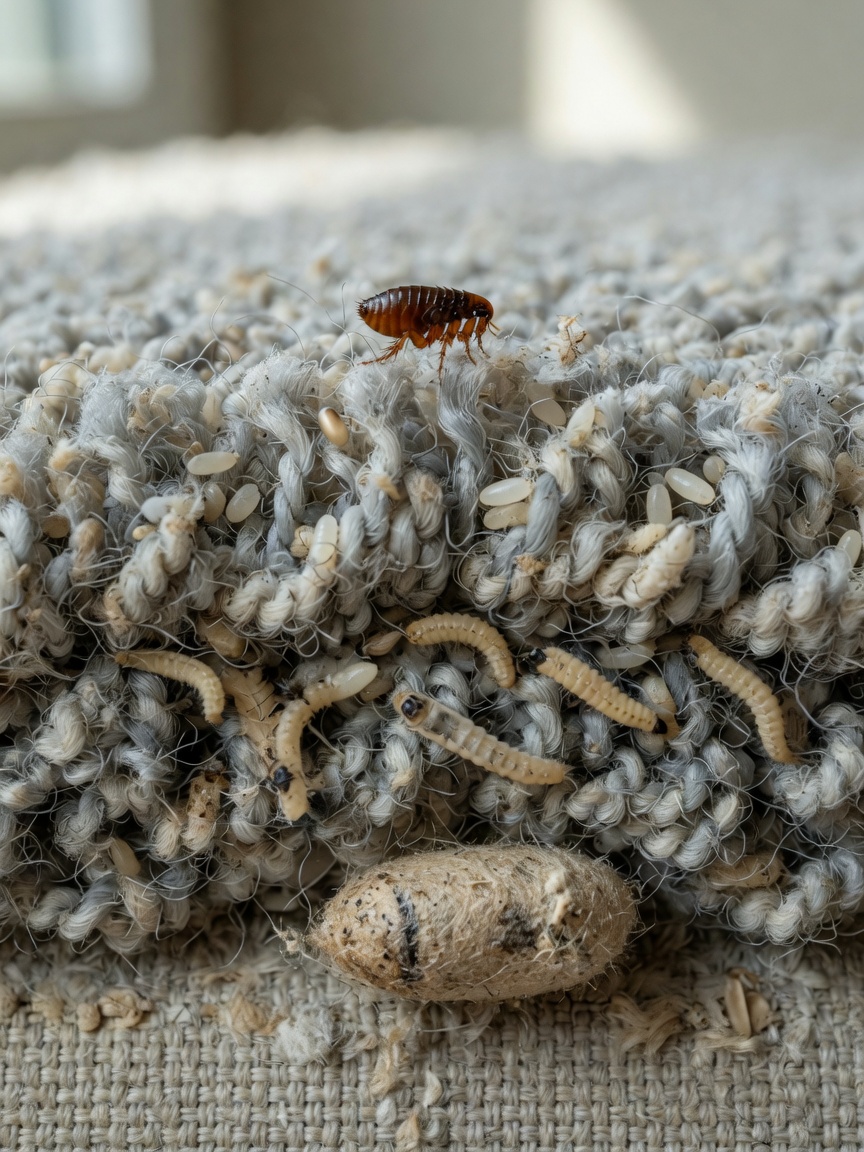
Understanding the flea life cycle is essential to understanding why so many flea treatments fail. Adult fleas — the ones you see crawling on your dog and biting you — represent only approximately 5% of the total flea population in an infested household. The other 95% consists of eggs, larvae, and pupae living in your carpets, furniture, bedding, and floorboards.
Adult female fleas lay eggs rapidly after feeding — up to 50 eggs per day. These eggs are not sticky and fall off the pet into the environment, scattering throughout your home wherever your dog spends time. Larvae hatch from the eggs and move away from light, burrowing into carpet fibres and under skirting boards where they feed on organic debris including flea faeces. They then form pupae, which are encased in a sticky, protective cocoon. Pupae can remain dormant for many months — even up to a year — and are highly resistant to insecticides. They hatch in response to warmth and vibration — such as footsteps — which is why flea infestations can suddenly appear to explode, and why a house left empty can seem fine until you return and vibration triggers mass hatching.
This life cycle makes clear why treating the pet alone is entirely insufficient to resolve a flea infestation. You must treat the environment simultaneously and repeatedly.
How to Spot a Flea Infestation
The signs of flea infestation are not always immediately obvious, particularly in dogs with dense or dark coats. Look for the following:
- Scratching, biting, or licking at the skin, particularly at the base of the tail, the abdomen, and the inner thighs
- Hair loss, particularly in a pattern around the lower back and tail base
- Flea dirt — tiny black or dark brown specks in the coat. To confirm these are flea faeces rather than environmental dirt, collect some on a damp piece of white paper. Flea dirt, which is digested blood, will produce a reddish-brown smear when wet. Regular dirt will not.
- Tapeworm segments — small, white, rice-grain-shaped segments around the anus or in the faeces, indicating Dipylidium caninum infection. Fleas are an intermediate host for this tapeworm — dogs become infected by swallowing fleas during grooming. If you see tapeworm segments, treat for fleas and speak to your vet about tapeworm treatment.
- Humans in the household being bitten, particularly on the ankles and lower legs
ESCCAP GL3 Guidelines on Flea Control
ESCCAP — the European Scientific Counsel Companion Animal Parasites — provides guidance on flea control through their GL3 guideline. Key recommendations include treating all pets in the household simultaneously, selecting products appropriate to the species, and combining pet treatment with thorough environmental decontamination. Year-round prevention is recommended in the UK and across most of Europe, because central heating maintains indoor temperatures that allow fleas to remain active and reproduce throughout the year.
Flea Prevention Products for Dogs
A range of effective flea prevention and treatment products is available. Your vet is best placed to advise on the most appropriate option for your dog based on age, weight, health status, and the other parasites you need to cover.
Spot-on treatments applied between the shoulder blades remain widely used. Frontline Plus (fipronil and S-methoprene) kills adult fleas and contains an insect growth regulator (IGR) that prevents eggs and larvae from developing. Advantage (imidacloprid) kills fleas on contact before they bite. Advocate (imidacloprid and moxidectin) covers fleas alongside lungworm, heartworm, and certain intestinal worms, but does not cover ticks.
Oral products including Bravecto (fluralaner, effective for up to 3 months), NexGard (afoxolaner, monthly), and Comfortis (spinosad, monthly) are highly effective and convenient, particularly for dogs that swim or are bathed frequently. These products require a veterinary prescription in the UK.
The Seresto collar provides long-acting protection against both fleas and ticks through slow release of imidacloprid and flumethrin, lasting up to 8 months.
Treating the Environment: Essential and Often Neglected

No flea control programme is complete without treating the home. Environmental treatment should be carried out at the same time as treating all pets in the household.
Begin by vacuuming thoroughly — all carpets, rugs, upholstered furniture, along skirting boards, and in any gaps in floorboards. The vibration of vacuuming stimulates pupae to hatch, making them vulnerable to insecticide treatment immediately afterwards. Empty the vacuum cleaner contents into a sealed bag and dispose of outside the home.
Wash all pet bedding at 60°C. This temperature kills all flea life stages. Regular washing of bedding is an important ongoing preventive measure.
Apply a household flea spray containing an insect growth regulator — look for S-methoprene or pyriproxyfen on the label. IGRs prevent flea eggs and larvae from developing into adults, breaking the life cycle. Spray all carpets, furniture, and along skirting boards. Pay attention to the areas where your dog rests most frequently. Follow the product's instructions regarding ventilation and keeping pets and children out of treated rooms until dry.
Repeat environmental treatment as directed — a single treatment rarely eliminates all pupae given their resistance to insecticides and their ability to remain dormant.
Treat All Pets Simultaneously
If you have multiple pets — including cats — all must be treated at the same time. Treating only the dog while the cat remains untreated (or vice versa) means the untreated animal continues to act as a host and source of eggs, perpetuating the infestation.
Flea Allergy Dermatitis
Some dogs develop an allergic reaction to flea saliva. In dogs with flea allergy dermatitis, even a single flea bite can trigger an intense inflammatory response, causing severe itching, redness, self-trauma, secondary bacterial skin infections, and significant discomfort. These dogs may have no visible fleas at all, as they groom them off, leading owners to mistakenly rule out fleas as the cause. Strict year-round flea prevention is essential for any dog with flea allergy dermatitis, as occasional lapses in prevention can trigger severe flare-ups. If your dog has unexplained skin disease, discuss the possibility of flea allergy with your vet.
A Critical Warning: Never Use Dog Flea Products on Cats
Permethrin, a synthetic pyrethroid insecticide found in many dog flea products, is acutely toxic to cats. Even small amounts — including indirect exposure from a dog that has recently been treated — can cause tremors, seizures, and death in cats. Always check the label of any flea product to ensure it is licensed for the species you are treating. If you have cats in your household, ensure that any dog flea product you use is safe for use in a multi-cat household. Seek veterinary advice if you are unsure.