
Dogs and Babies: Safe Introduction Guide for New Parents
By Julia Wrenfield, Pet Wellness Researcher — June 25, 2026
- Golden rule: No dog and baby should ever be left unsupervised — not even "safe" dogs
- Best window to prepare: Months before the baby arrives
- Most important skill: Reading your dog's body language for early stress signals
- Risk factor: Dogs who have shown any prior guarding or fear behavior need professional assessment before baby arrives
- The goal: Dog and baby each safe, positive relationship built gradually
Bringing a newborn home to a household that includes a dog is a moment that fills many new parents with a mixture of joy and anxiety. The anxiety is understandable — but with preparation, the vast majority of family dogs and babies not only coexist safely but form deep and enduring bonds. The preparation must happen before the baby arrives, the introduction must be handled thoughtfully, and supervision must be uncompromising. This guide covers each phase in detail.
Preparation: Before Baby Arrives
Obedience Foundation
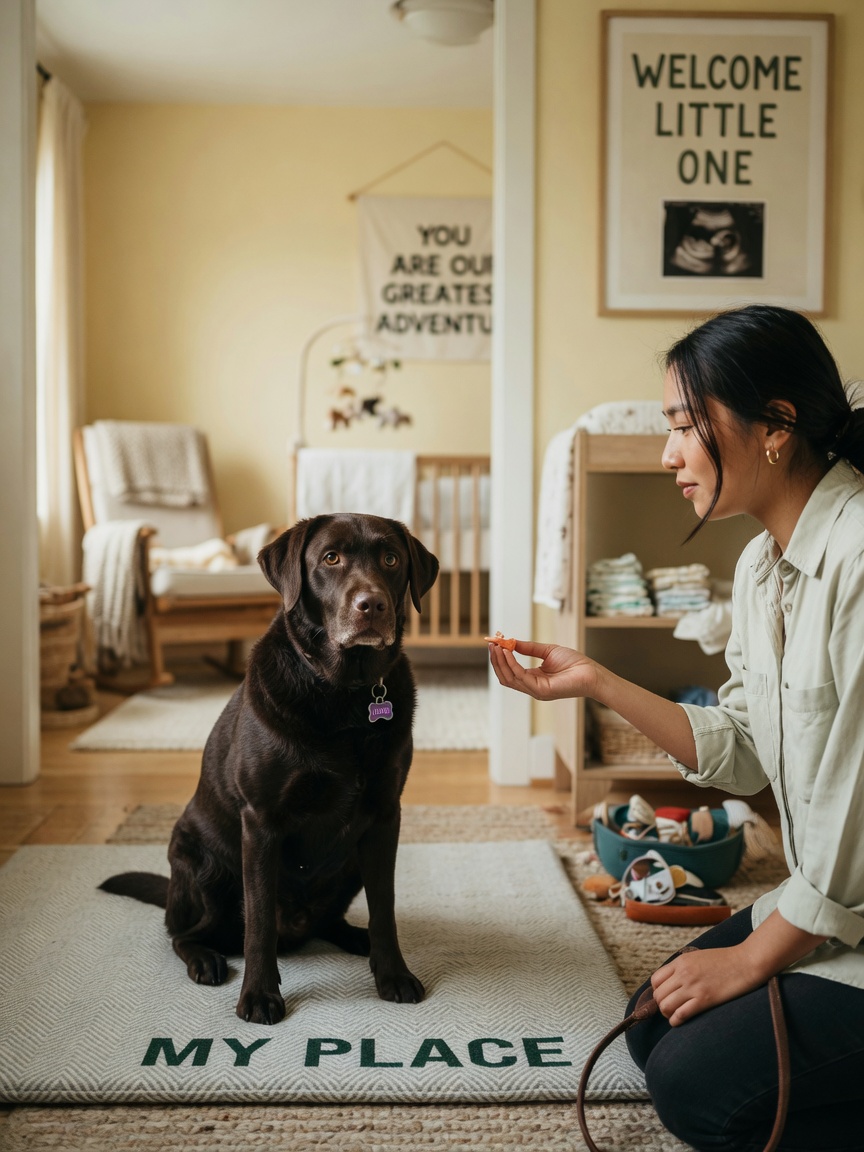
A dog who responds reliably to basic cues — sit, stay, go to your place, leave it, off — is dramatically easier to manage with a baby in the home. If your dog's training is shaky, the months before the baby's arrival are the time to invest in it. Enroll in a positive reinforcement class, work daily on cues, and specifically practice "go to your place" (the dog goes to a designated mat or bed on cue and stays there). This cue becomes invaluable for managing the dog during diaper changes, feeding, and other hands-full moments.
Gradual Lifestyle Preparation
A dog who currently sleeps in the bedroom will experience a significant disruption when a baby sleeps there, cries, and takes over the space. Begin adjusting the dog's routines gradually months before the birth:
- If the dog will no longer be allowed in certain rooms, establish this before the baby arrives.
- Practice variations in walk times and feeding schedules so the dog is not rigidly dependent on exact timing.
- Spend time with the dog in the nursery room while it is set up — allow investigation of baby furniture, change table, and equipment.
Introducing Baby Sounds and Smells
Play recordings of baby crying at low volume during positive activities (mealtime, play sessions). Gradually increase volume over weeks. This desensitizes the dog to the novel and potentially startling sound before it becomes a constant reality. Allow the dog to sniff baby items — blankets, clothing, the change table — well before the baby's arrival.
Professional Assessment for Concerning Behavior
If your dog has shown any resource guarding, fear-based responses, or aggression toward children or strangers, a consultation with a certified behavior consultant before the baby arrives is essential — not optional. This is not the time to hope for the best. A professional assessment gives you a realistic picture and a specific plan.
The First Introduction: The Day You Bring Baby Home
Before You Enter the House
Have a family member or friend greet the dog first — give the dog an opportunity to burn off energy with a walk or play session before the introduction. The dog should be in a calm baseline state, not excited and over-threshold, when they first encounter the baby.
The Initial Meeting
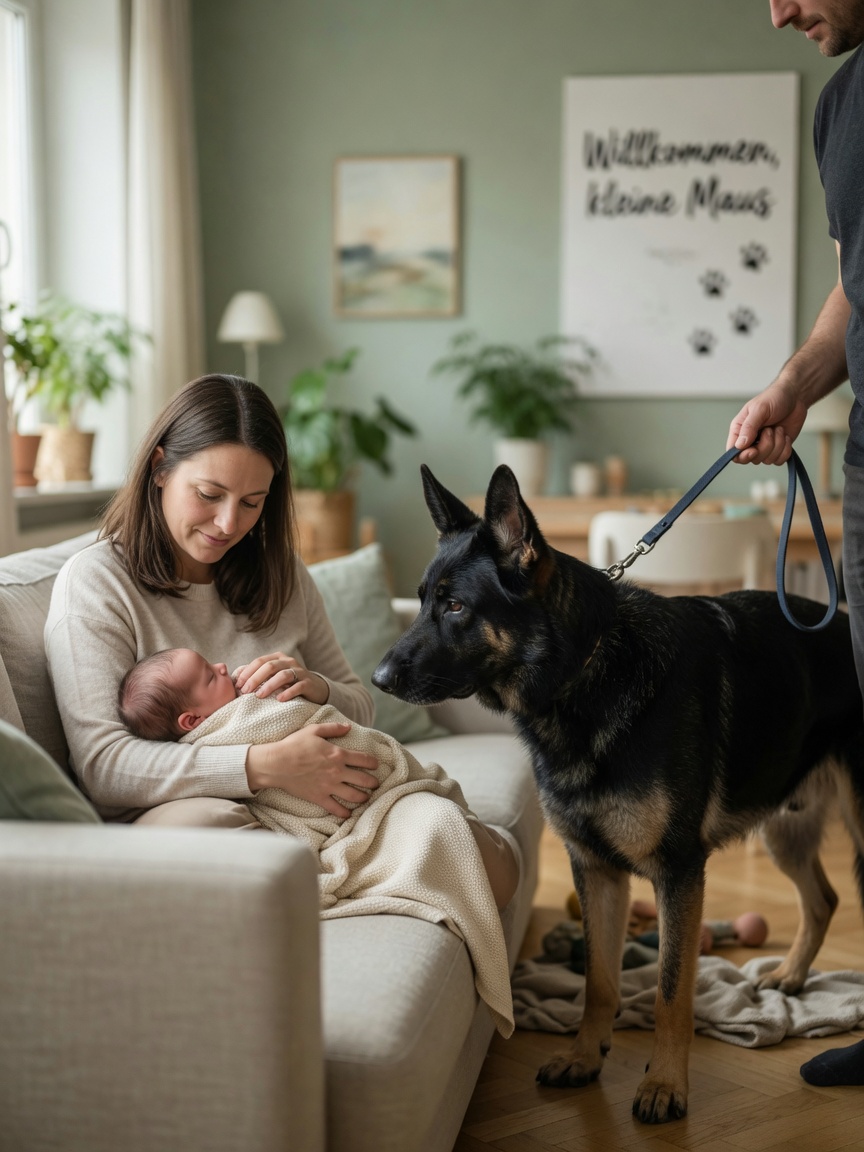
- The non-holding parent should bring the dog on a loose leash (not tight — tension transmits up the leash and increases arousal).
- The parent holding the baby should remain seated and calm.
- Allow the dog to approach at their own pace. Do not force the dog toward the baby or hold the baby toward the dog.
- Let the dog sniff from a comfortable distance. Watch body language closely.
- Mark calm behavior with a quiet "good" and deliver treats. Keep the first interaction brief — a minute or two.
- End on a calm note. Give the dog a chew or puzzle toy in another room.
There is no need to "introduce" them fully in one session. Multiple brief, positive exposures over the first week are better than one extended session.
Safe Management During Early Months
Separation as the Default
In the early months, when supervision cannot be 100% active, physical separation must be the default. Baby gates, playpens (for the baby or to create a dog-free zone), and closed doors are your tools. This is not a punishment for the dog — it is a safety system that protects both the dog and the baby and reduces stress on both.
Maintaining the Dog's Routine and Relationship
A common mistake is inadvertently "excluding" the dog from positive family interactions once the baby arrives. The dog begins to associate the baby with loss of positive experiences. Actively work against this: allow the dog to be near you during calm feeding or rocking sessions (on a stay), deliver treats or affection to the dog during baby-focused activities, and maintain regular exercise and enrichment for the dog throughout the newborn period.
Supervision Rules: Never Negotiable
- No dog and baby are ever left alone together — even for 30 seconds while you answer the door. This applies regardless of how gentle the dog is. This is a hard rule with no exceptions.
- Active supervision means watching the dog's body language, not glancing at your phone while both are in the room.
- As the baby develops — begins crawling, pulling up, grabbing — the supervision intensity must increase, not decrease. A dog who tolerates a static baby may be overwhelmed by a mobile one.
Reading Dog Body Language: Warning Signals Table
| Signal | What It Means | Your Response |
|---|---|---|
| Yawning, lip licking, whale eye | Mild stress — dog is uncomfortable | Calmly create distance; give dog a break |
| Turning or walking away | Dog seeking space — respect this | Let the dog move away; do not follow |
| Body freezing / stillness | Very high stress — escalation imminent | Remove baby immediately and calmly |
| Hard stare at baby | Fixed attention — possible predatory or threat response | Remove baby, separate, seek professional help |
| Growling | Explicit warning — do NOT punish | Remove baby immediately; consult a behaviorist |
| Tail wagging | Note: tail wagging alone does not mean "safe" — read full body | Look for overall loose, relaxed body posture too |
Danger Signs That Require Immediate Action
Separate dog and baby immediately and consult a veterinary behaviorist or certified behavior consultant if you observe any of the following:
- The dog growls at or snaps near the baby
- The dog shows a fixed, intense stare at the baby (particularly when the baby is moving)
- The dog guards areas near the baby against other family members
- The dog's body language consistently shows high stress in the baby's presence even after weeks of calm introductions
These signs do not automatically mean the dog must leave the family, but they do mean professional help is needed before the situation escalates. Early intervention produces far better outcomes than waiting for a bite to occur.
As Baby Grows: Ongoing Safety
The risk landscape changes as babies become mobile, vocal, and interested in interacting with the dog. Teach children, as soon as they are old enough, the following rules: never approach a dog who is eating, chewing, or sleeping; never reach over or hug a dog from above; always ask an adult before approaching any dog. These lessons are far more effective than relying solely on the dog's tolerance.
- Prepare the dog months before the baby arrives: sounds, smells, routine changes, obedience reinforcement.
- The first introduction should be calm, brief, and positively reinforced — never forced.
- No dog and baby are ever left alone together — this rule has no exceptions.
- Learn to read your dog's stress signals early — intervention before escalation keeps both dog and baby safe.
- Growling is a warning — never punish it; remove the baby calmly and seek professional guidance.
References
- Reisner IR, Shofer FS, Nance ML. (2007). Behavioral assessment of child-directed canine aggression. Injury Prevention, 13(5), 348–351. PMID: 17916886
- Shepherd K. (2009). Ladder of Aggression. In: Horwitz DF, Mills DS (eds). BSAVA Manual of Canine and Feline Behavioural Medicine (2nd ed). British Small Animal Veterinary Association.
- Overall KL, Love M. (2001). Dog bites to humans — demography, epidemiology, injury, and risk. Journal of the American Veterinary Medical Association, 218(12), 1923–1934. PMID: 11417748