

Dog Vaccination Requirements for International Travel
Key Takeaways
- Rabies vaccination is required by the vast majority of countries for imported dogs; in most cases the vaccine must be administered at least 21 days before travel if it is the animal's first dose.
- High-biosecurity destinations — including Australia, New Zealand, Japan, and the UK — require a rabies titre (antibody) test and impose mandatory waiting periods of several months after a satisfactory result.
- An official health certificate signed by an accredited veterinarian and endorsed by the relevant government authority (USDA-APHIS, CFIA, DEFRA, etc.) is required for nearly all international dog movements.
- Planning should begin four to six months before the intended travel date — or longer for destinations with titre-test requirements.
- EU Regulation 576/2013 governs the non-commercial movement of pets into and within the EU, establishing uniform requirements for the EU Pet Passport system.
Why Vaccination Requirements Exist for Travelling Dogs
International movement of dogs carries genuine biosecurity risks. Rabies remains endemic in large parts of Africa, Asia, and Latin America, and a single undetected case could devastate the wildlife or domestic animal populations of a country that has achieved rabies-free status. Similarly, diseases such as brucellosis, leishmaniasis, and certain tick-borne conditions are tightly controlled at borders. Vaccination requirements, health certificates, and titre testing are the primary tools governments use to manage these risks — and the rules vary considerably depending on where your dog is coming from, where it is going, and whether it has prior vaccination history.
Rabies Vaccination: The Universal Baseline
Rabies vaccination is the single most universally required health measure for travelling dogs. Nearly every country that permits dog importation requires proof of a valid rabies vaccine. Several critical rules apply regardless of destination:
- First vaccination waiting period: If a dog has never previously been vaccinated against rabies, most destinations require the vaccine to be administered at least 21 days before entry. A dog that received its first-ever rabies shot the day before departure will not be considered compliant, even if the certificate appears valid on its face.
- Booster continuity: Many countries require that the dog's vaccination history show no lapse in coverage — meaning booster shots must have been administered before the previous dose expired. A gap in the record may reset the dog to "first vaccination" status, triggering the 21-day wait again.
- Microchip before vaccine: Crucially, the ISO-standard 15-digit microchip must be implanted before the rabies vaccine is administered, or the vaccination will not be considered linked to the correct animal. This is a common, costly mistake: if you chip your dog after vaccinating, you may need to restart the vaccination countdown.
Rabies Titre Test: When and Why It Is Required
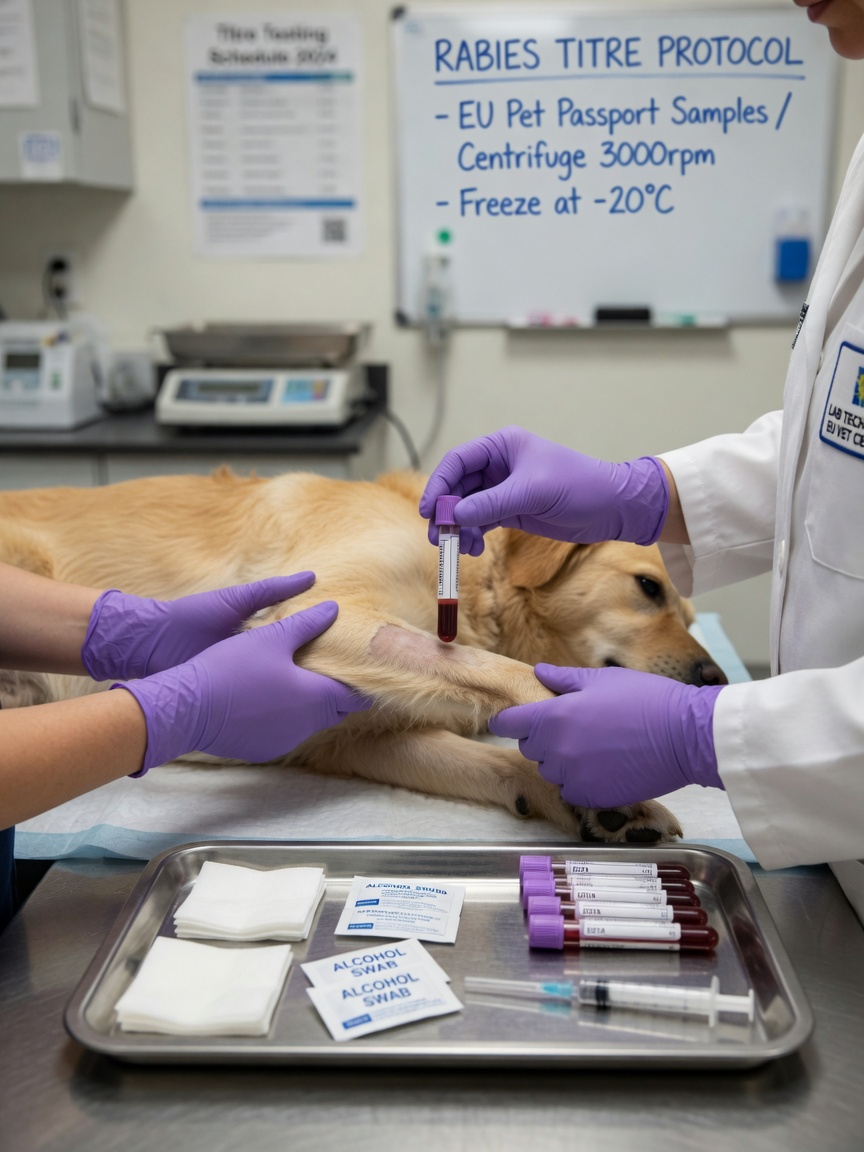
Several countries with rabies-free status require a Rabies Neutralising Antibody Titre Test (RNATT) — sometimes called a titre test or FAVN test — to verify that a vaccinated dog has mounted sufficient immunity before entry is permitted. A satisfactory result is defined as a titre of at least 0.5 IU/mL of serum.
Countries currently requiring a titre test include:
- Australia and New Zealand: Both maintain some of the world's strictest biosecurity regimes. After a satisfactory titre test, dogs must complete mandatory quarantine periods (up to 10 days for Australia; typically 10 days for New Zealand depending on origin country). Processing times at approved laboratories and the wait for results can add weeks to planning.
- Japan: Japan requires two rabies vaccinations administered more than 30 days apart, then a titre test, and then a 180-day waiting period from the date of the blood draw before the dog can enter Japan. This means a total lead time of at least 8 months from initial vaccination for a previously unvaccinated dog — planning cannot be left to the last minute.
- United Kingdom: Since Brexit, dogs entering the UK from outside Great Britain require a titre test if travelling from a country not on the UK's "listed" status. Dogs from EU listed countries entering via approved routes still use the EU pet passport system for the Irish/Northern Ireland land border; dogs entering Great Britain from most non-listed countries require a titre test result and a minimum three-month wait after satisfactory results.
- United Arab Emirates: Dogs entering the UAE must be vaccinated against rabies, and the Emirates generally accept standard health certificates from accredited vets; titre tests are not universally mandated but may be required for certain origin countries.
The titre test must be carried out at an EU-approved laboratory (or equivalent); in the United States, the Kansas State University Rabies Laboratory and the Auburn University College of Veterinary Medicine are USDA-recognised for this purpose.
Core Vaccines Beyond Rabies
In addition to rabies, many destinations recommend or require evidence of core canine vaccines. The DAPP/DA2PP combination (covering Distemper, Adenovirus/Hepatitis, Parvovirus, and Parainfluenza) is considered core by the World Small Animal Veterinary Association (WSAVA) and is frequently listed in health certificate requirements. Australia and New Zealand generally require proof of current core vaccines alongside rabies documentation. The UAE requires vaccinations against distemper, parvovirus, hepatitis, and leptospirosis in addition to rabies. Even where not strictly mandated, keeping core vaccines current is sound veterinary practice and will simplify the health certificate process.
Country-by-Country Spotlight
United States (entering from abroad): The U.S. Centers for Disease Control and Prevention (CDC) updated dog import requirements in 2023. Dogs arriving in the United States are subject to rules based on the country where they were last located (not their country of origin). Dogs travelling from countries where rabies is not controlled face additional requirements, including proof of U.S.-issued vaccination, serological testing, and reservation at a CDC-approved facility. Dogs from "dog-screwworm free" countries face fewer hurdles. USDA-APHIS also has separate requirements for dogs that were in the U.S., exported, and are being returned. Always check the current CDC importation page before travel as rules change.
Australia: Dogs must be microchipped, vaccinated against rabies, titre-tested with a satisfactory result, and must arrive from an approved country. Mandatory post-arrival quarantine at the Mickleham facility in Victoria applies. Advance booking of quarantine is required and must be arranged months in advance. The total process from first vaccination to permitted entry can exceed one year if the dog has not previously been vaccinated.
Japan: As noted, Japan imposes a minimum 180-day wait from titre test blood draw. Two vaccinations given more than 30 days apart are required before the blood draw. Documentation must be submitted to Japan's Animal Quarantine Service and pre-approved before travel. Incomplete documentation results in immediate quarantine at the owner's expense or return of the animal.
UAE: The UAE requires a valid rabies vaccine (administered at least 30 days before arrival and not more than one year before), core vaccines, internal and external parasite treatment within 14 days of travel, a health certificate from an accredited vet, and an import permit from the UAE Ministry of Climate Change and Environment obtained in advance. The pet must travel as manifest cargo or excess baggage on approved airlines.
Health Certificates: USDA-APHIS and EU Requirements
An official health certificate is required for virtually all international dog movements. The certificate must be:
- Completed by a licensed, government-accredited veterinarian who has examined the dog.
- Endorsed by the relevant national authority — in the United States, this means endorsement by a USDA-APHIS Veterinary Services office (either in person or via their eEndorsement system). In EU countries, the competent authority of the member state endorses the certificate.
- Issued within the timeframe specified by the destination country — commonly 10 days before travel, though this varies.
The EU uses the harmonised health certificate format prescribed in EU Regulation 576/2013 and its implementing regulations for non-commercial movement of cats, dogs, and ferrets. This regulation establishes the EU Pet Passport system, which serves as both identification document and health record for pets moving between EU member states and entering the EU from third countries with listed status. The EU Pet Passport must be issued by an official veterinarian and records microchip details, rabies vaccination history, and titre test results where applicable.
Timeline: Start Planning Four to Six Months Out
For most destinations, a four-to-six month planning window is the minimum for a dog without prior vaccination history. For Japan, the UK (from non-listed countries), or Australia, eight to twelve months or more is necessary. Start by consulting your country of origin's agricultural ministry and the destination country's embassy or animal import authority for the most current requirements. Then work backwards from your intended travel date: book a vet appointment immediately for microchipping and initial vaccination, and identify the approved laboratory for any titre testing required.
References & Sources
- United States Department of Agriculture Animal and Plant Health Inspection Service (USDA-APHIS). Bringing Dogs into the United States. Available at: https://www.aphis.usda.gov/pet-travel/bringing-dogs-into-the-us
- European Parliament and Council. Regulation (EU) No 576/2013 of 12 June 2013 on the non-commercial movement of pet animals. Official Journal of the European Union, L 178, 28.6.2013, pp. 1–26. Available at: https://eur-lex.europa.eu/legal-content/EN/TXT/?uri=CELEX:32013R0576