
What Is Clicker Training and Why Does It Work?
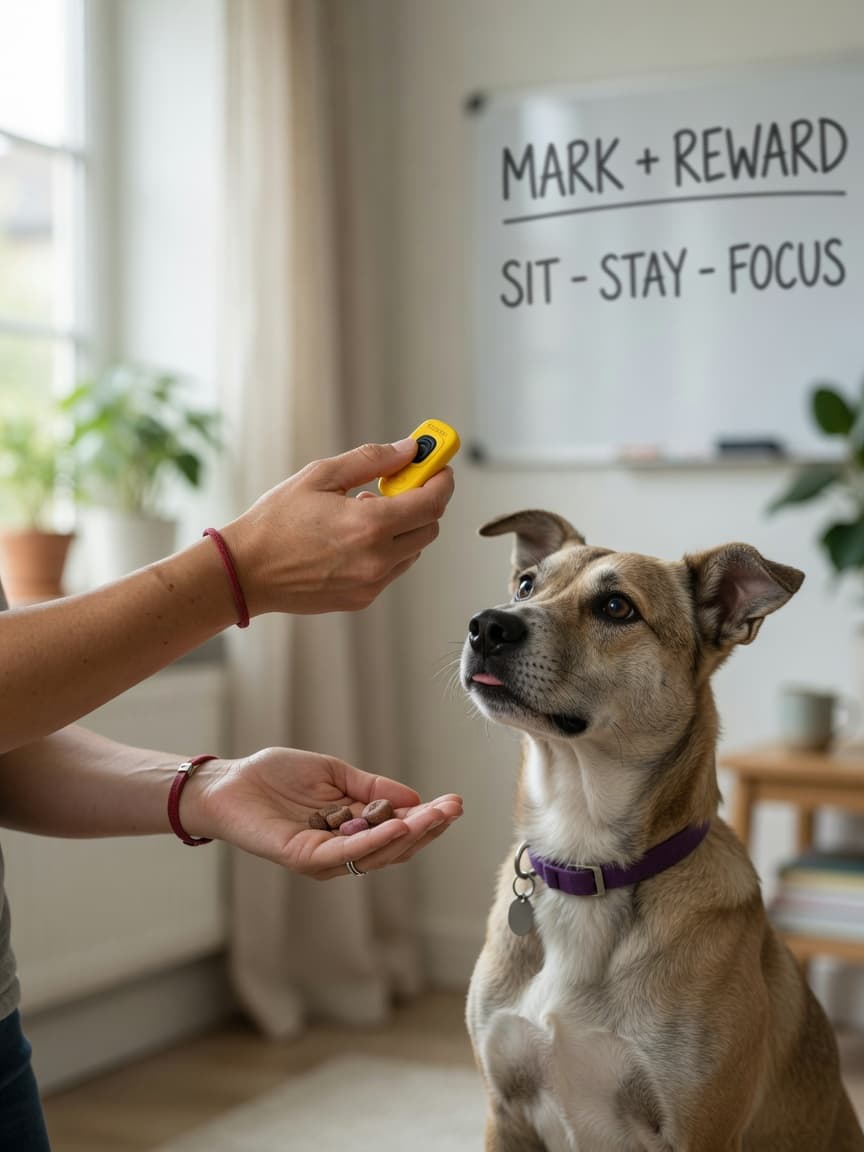
Clicker training is a reward-based training method that uses a small handheld device — the clicker — to mark the precise moment a dog performs a desired behaviour. The click sound acts as a conditioned reinforcer, a signal that communicates to your dog: "That exact thing you just did has earned you a reward." Because of its consistency and precision, clicker training has become one of the most widely recommended techniques by professional bodies including the Association of Pet Behaviour Counsellors (APBC), the Certification Council for Professional Dog Trainers (CCPDT), and the Pet Professional Guild (PPG).
The science underpinning clicker training is operant conditioning, a branch of behavioural science first described by B.F. Skinner. In practical terms, when a behaviour is followed by a pleasant consequence — a treat, praise, or play — that behaviour is more likely to be repeated. The clicker bridges the gap between the behaviour and the reward, giving your dog crystal-clear information about what they did correctly.
The LIMA Hierarchy and Positive Reinforcement
Responsible dog trainers follow the LIMA principle — Least Intrusive, Minimally Aversive — when choosing training techniques. Clicker training sits firmly at the top of the LIMA hierarchy, relying on positive reinforcement before any other approach is considered. Organisations such as the PPG and the COAPE Association of Pet Behaviourists and Trainers advocate for this approach because it strengthens the human-animal bond and produces lasting, reliable results without the welfare risks associated with punishment-based methods.
- Positive reinforcement: adding something pleasant to increase a behaviour
- Negative punishment: removing something pleasant to decrease a behaviour
- Negative reinforcement: removing something unpleasant to increase a behaviour
- Positive punishment: adding something unpleasant to decrease a behaviour
Clicker training focuses almost exclusively on positive reinforcement, making it one of the safest and most humane options available.
How to Charge the Clicker
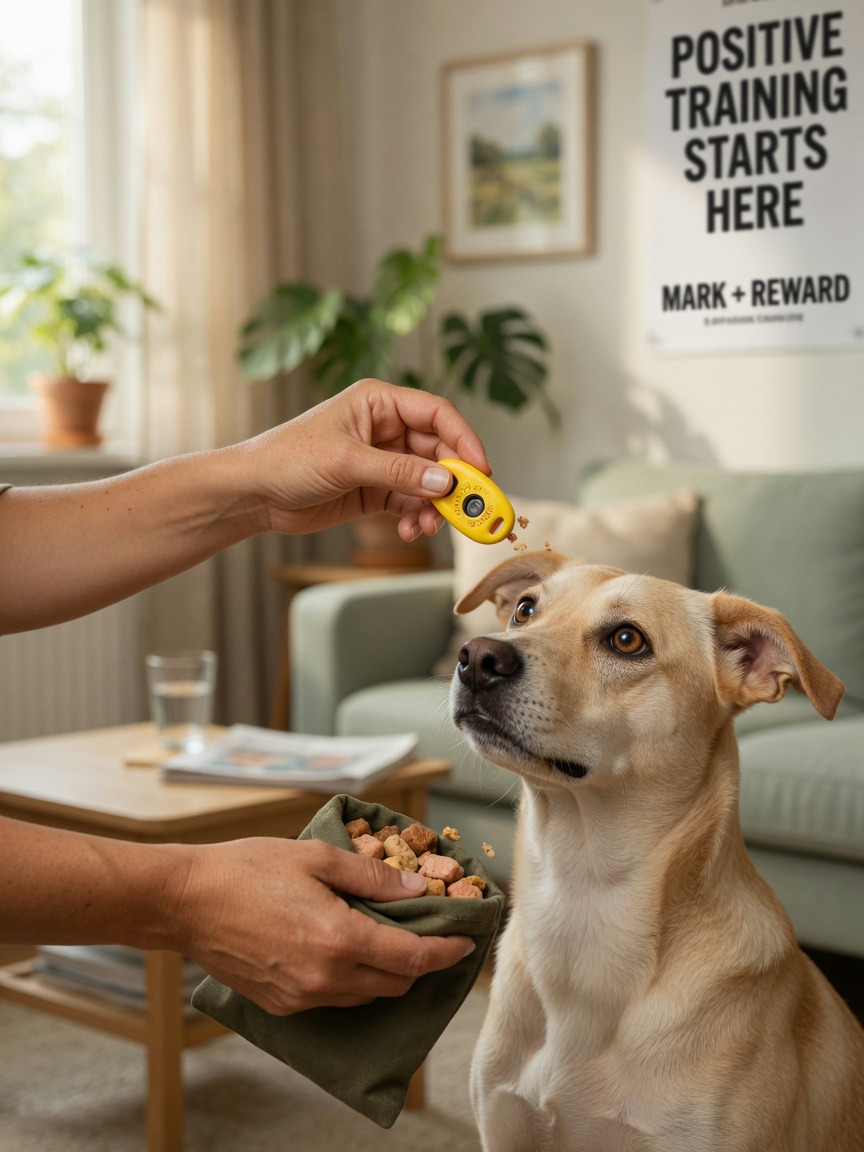
Before the clicker means anything to your dog, you need to "charge" it — that is, build the association between the click sound and a reward. This is classical conditioning at work.
- Choose small, high-value treats your dog loves. Soft treats work well because they are eaten quickly.
- In a calm environment with no distractions, click once and immediately deliver a treat. Repeat 10–20 times in short sessions.
- Vary the timing slightly — sometimes click, then treat after one second; sometimes deliver it faster. This prevents your dog from only responding to the treat appearing.
- After a few sessions, you will notice your dog look at you or perk up the moment they hear the click. This is confirmation the clicker is charged.
You can find quality clickers and treat pouches at Zooplus, which stocks a wide range of training accessories suitable for dogs of all sizes and experience levels.
Timing and Rate of Reinforcement
Two factors make the difference between clicker training that works brilliantly and clicker training that confuses your dog: timing and rate of reinforcement.
Timing: The click must occur within approximately one second of the desired behaviour. If your dog sits and you click two seconds later, you may inadvertently mark them sniffing the floor or standing back up. Practise clicking a bouncing ball, pressing play on a video, or tapping along to music to sharpen your timing before working with your dog.
Rate of reinforcement: In early training, reward frequently — aim for a reinforcement rate of around 80% or above during a session. This means your dog should be succeeding and earning rewards most of the time. If your dog is failing more than 20% of the time, the task is too difficult. Make it easier by going back a step.
Luring vs Shaping
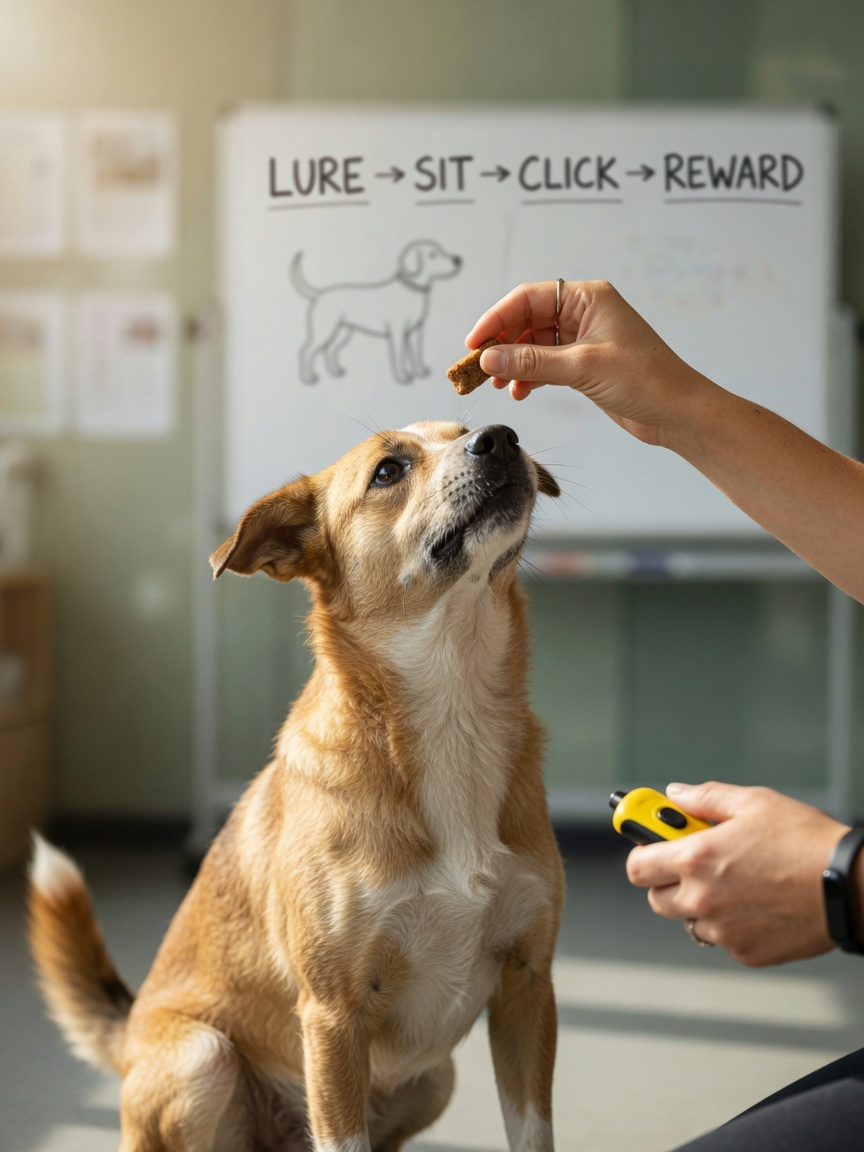
There are two main ways to get a behaviour from your dog so that you can mark and reward it.
Luring
Luring involves using a treat held in your hand to guide your dog into position. For example, holding a treat near your dog's nose and slowly moving it upward will encourage them to sit. Luring is fast and effective for teaching new behaviours, but it is important to fade the lure quickly — within three to five repetitions — so your dog is not dependent on the treat in your hand to perform the behaviour.
Shaping
Shaping involves clicking and rewarding successive approximations towards a goal behaviour. Rather than guiding your dog into position, you wait for them to offer small steps in the right direction and reinforce each one. Shaping builds problem-solving confidence and produces behaviours that are exceptionally strong because the dog has actively figured them out. It requires more patience from the trainer but is worth the investment for complex behaviours.
Step-by-Step: Teaching Your First Clicker Behaviour
- Charge the clicker as described above over two or three sessions.
- Choose a simple first behaviour — "sit" is ideal.
- Hold a treat near your dog's nose and slowly raise it over their head. Most dogs will naturally rock back into a sit.
- The instant their bottom touches the floor, click and treat.
- Repeat five to ten times, then take a short break.
- After five repetitions, begin adding your verbal cue ("sit") just before you lure, so the word becomes associated with the action.
- Begin fading the lure by pretending to hold a treat and rewarding from your other hand after the click.
Common Clicker Training Mistakes to Avoid
- Clicking multiple times — the click is a single precise event. Double-clicking confuses your dog.
- Using the clicker to get your dog's attention — the clicker is a marker, not a recall tool.
- Clicking without treating — every click must be followed by a reward, or the clicker loses its value.
- Training when your dog is tired or full — short sessions of five to ten minutes when your dog is alert and hungry produce the best results.
- Moving too fast — always set your dog up to succeed by working at their pace.
Where to Buy Clicker Training Equipment
Getting started with clicker training does not require much equipment, but having the right tools makes a real difference. A reliable clicker with a comfortable button, a well-fitting treat pouch, and a variety of high-value treats are the essentials. Zooplus stocks a broad selection of clickers, treat pouches, and training treats, often at competitive prices, making it a convenient one-stop option for owners setting up their training kit.
Further Support and Professional Guidance
If you are struggling with clicker training or working through a specific behavioural issue, seeking help from a qualified professional is always a sensible step. Look for practitioners accredited by the APBC, COAPE, or PPG, all of whom require members to use only force-free, science-based methods. These organisations publish directories of accredited professionals on their websites, making it straightforward to find someone local to you.
Clicker training is a rewarding journey for both dog and owner. With consistent, short sessions and a generous rate of reinforcement, most dogs begin to show rapid progress within just a few days. The precision of the marker, combined with the clarity of positive reinforcement, makes clicker training one of the most powerful tools available to any dog owner.