
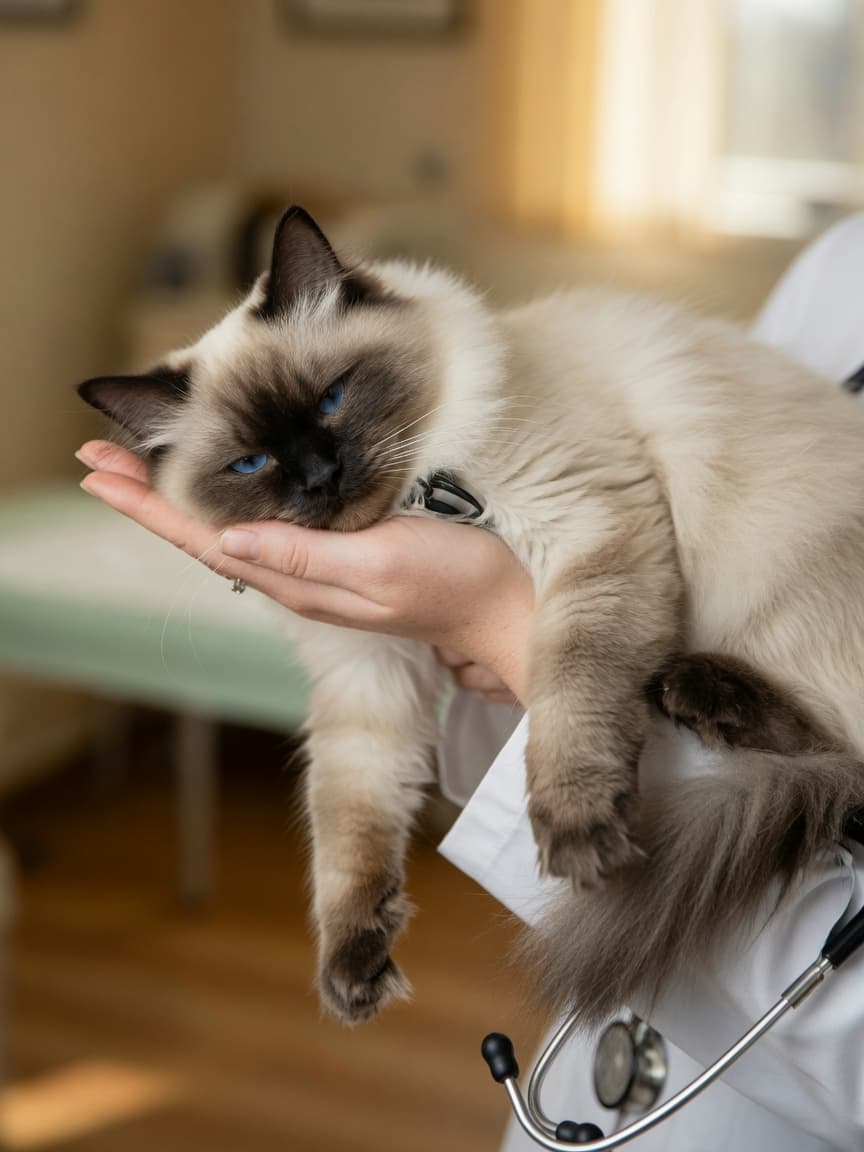
Ragdoll-Katze Gesundheit: HCM, Floppy-Cat-Syndrom & Lebenserwartung
- Lebenserwartung: 12–17 Jahre
- Gewicht: 4–9 kg (eine der größten Hauskatzenrassen)
- Hauptrisiken: Hypertrophe Kardiomyopathie (HCM), Floppy-Cat-Syndrom, Übergewicht
- Empfohlenes Screening: Jährliche Echokardiographie ab dem 2. Lebensjahr
- DNA-Test verfügbar: MYBPC3-Mutation für HCM
Ragdoll-Katzen sind berühmt für ihr sanftes Temperament, ihre seidenartig blauen Augen und ihre bezaubernde Gewohnheit, schlaff zusammenzusinken, wenn man sie aufhebt — genau das Merkmal, das der Rasse ihren Namen gab. Doch unter dieser ruhigen Fassade verbergen sich ernsthafte Gesundheitsvulnerabilitäten, die jeder Ragdoll-Halter verstehen muss. Von einer Herzerkrankung, die lautlos zuschlagen kann, bis zu einem neurologischen Syndrom, das plötzliche Muskelschwäche verursacht — proaktive Gesundheitsverwaltung ist nicht optional, sondern absolut notwendig, um Ihrer Ragdoll zu helfen, das obere Ende ihrer 12–17 Jahre Lebenserwartung zu erreichen.
Hypertrophe Kardiomyopathie (HCM): Der stille Killer
Die hypertrophe Kardiomyopathie ist die häufigste Herzerkrankung bei Katzen, und Ragdolls tragen eine überproportional hohe Last. HCM führt zu einer abnormalen Verdickung der Wände der linken Herzkammer, wodurch die Fähigkeit des Herzens, Blut wirksam zu pumpen, beeinträchtigt wird. Mit der Zeit führt dies zu Herzinsuffizienz, Blutgerinnseln (aortale Thromboembolie) und plötzlichem Herztod.
Bei Ragdolls wurde eine spezifische Mutation im MYBPC3-Gen — das gleiche Gen, das in die HCM beim Menschen verwickelt ist — als bedeutsamer Risikofaktor identifiziert. Katzen, die eine oder zwei Kopien dieser Mutation tragen, haben ein erhöhtes Lebensrisiko, die Krankheit zu entwickeln, wobei die Mutation allein nicht garantiert, dass die Krankheit auftritt. DNA-Tests können feststellen, ob Ihre Katze die Variante trägt, und seriöse Züchter testen ihre Zuchtkatzen vor der Paarung.
Entscheidend ist, dass HCM oft asymptomatisch bleibt, bis es fortgeschritten ist. Viele Katzen zeigen keine äußeren Zeichen, bis sie zusammenbrechen oder plötzlich auftretende Atemprobleme entwickeln. Dies ist der Grund, warum jährliche Echokardiographien — Ultraschallaufnahmen des Herzens — der Goldstandard für die Überwachung sind. Veterinäre Kardiologen empfehlen, mit echokardiographischem Screening ab dem 2. Lebensjahr zu beginnen und alle 12–24 Monate zu wiederholen. Bei früh diagnostizierten Katzen kann mit Medikamenten wie Atenolol oder Clopidogrel die Symptomatik kontrolliert und das Thromboserisiko vermindert werden.
Floppy-Cat-Syndrom (Hypotonie)
Das Floppy-Cat-Syndrom, formal als eine Form der generalisierten Muskelschwäche oder Hypotonie beschrieben, ist eine Erkrankung, die nahezu ausschließlich bei Ragdolls auftritt. Betroffene Katzen zeigen Episoden von Muskelschlaffheit — sie können ihren Kopf nicht hochhalten, normal gehen oder ihre Körperhaltung beibehalten. Episoden können durch Stress, Aufregung ausgelöst werden oder scheinbar spontan auftreten.
Die zugrunde liegende Ursache ist nicht vollständig geklärt, wird aber angenommen, dass sie eine hereditäre neuromuskuläre Störung beinhaltet. Einige Forscher haben sie mit Thiamin- (Vitamin B1-) Mangel in bestimmten Linien verknüpft, was bedeutet, dass die Ernährung eine Rolle spielt. Rohfütterung oder stark verarbeitete Lebensmittel mit niedrigen Thiaminwerten können Episoden verschärfen oder sogar auslösen. Sicherzustellen, dass Ihre Ragdoll eine komplette, ausgewogene Ernährung erhält — idealerweise ein hochwertiges Handelsprodukt mit verifizierten Thiaminwerten — ist eine einfache Vorbeugungsmaßnahme. Wenn Ihre Katze wiederholte Episoden von Schlaffheit erlebt, ist eine tierärztliche neurologische Untersuchung notwendig, um andere Ursachen auszuschließen.
Übergewicht und Gelenkgesundheit
Ragdolls sind naturgemäß große, etwas träge Katzen. Ihr sanftes Temperament und ihre Haushaltsgewohnheiten machen sie anfällig für Gewichtszunahme, besonders nach der Kastration. Übergewicht beschleunigt den Verschleiß der Gelenke, belastet das Herz und verschärft eine bereits bestehende HCM. Eine gesunde erwachsene Ragdoll sollte zwischen 4 und 9 kg wiegen, wobei Männchen typischerweise größer sind als Weibchen.
Portionenkontrolle, Futterautomaten zur Verlangsamung der Futteraufnahme und interaktive Spielsitzungen von mindestens 15 Minuten zweimal täglich helfen bei der Gewichtskontrolle. Für Ragdolls, die Steifheit oder Widerwille zum Springen zeigen — frühe Zeichen von Gelenkbeschwerden — erkunden manche Halter natürliche Ergänzungsunterstützung. Candid Tails CBD-Öl, speziell für Katzen formuliert, wurde von Haltern verwendet, um Wohlbefinden und Beruhigung bei Katzen mit leichten Gelenkbeschwerden zu unterstützen. Wie bei jedem Ergänzungsmittel sollten Sie immer Ihren Tierarzt konsultieren, bevor Sie beginnen, um sicherzustellen, dass es für den Gesundheitszustand Ihrer einzelnen Katze geeignet ist.
Zahnerkrankungen
Zahnfleischerkrankungen sind das häufigste Gesundheitsproblem bei erwachsenen Katzen aller Rassen, und Ragdolls sind da keine Ausnahme. Bakterien sammeln sich entlang des Zahnfleischrandes an und bilden Belag, der zu Zahnstein verhärtet. Unbehandelt führt dies zu Gingivitis, Zahnverlust und systemischen Infektionen, die die Nieren und das Herz beeinträchtigen können — ein besonderes Anliegen angesichts der Herzanfälligkeit der Rasse.
Tägliches Zähneputzen mit einer katzensicheren Zahnpasta bleibt die effektivste Prävention. Zahnbehandlungen und Wasserzusätze bieten ergänzende Unterstützung. Planen Sie professionelle Zahnreinigungen unter Narkose alle 1–2 Jahre wie von Ihrem Tierarzt empfohlen.
Lebenserwartung und Zeitplan für Vorsorgeuntersuchungen
Ragdolls leben typischerweise 12–17 Jahre, wobei gut versorgte Individuen gelegentlich älter werden.