
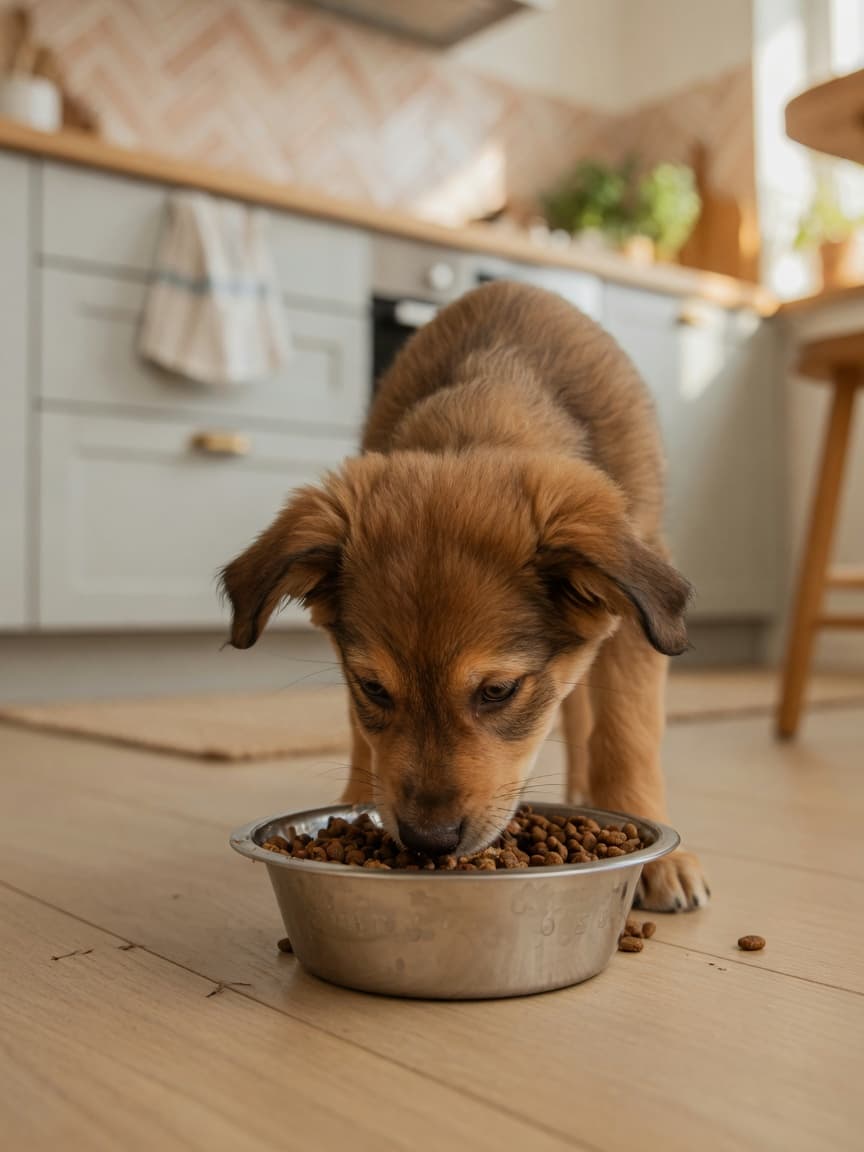
Quando Começar com Ração para Cachorros & Como Transitar do Leite Materno
- Desmame começa: 3–4 semanas de idade
- Introdução de alimentos sólidos: 3–4 semanas (fase de papa/mingau)
- Completamente desmamado: 7–8 semanas
- Ração para cachorro vs ração adulta: Filhotes precisam de ração formulada para cachorros até o encerramento das placas de crescimento (dependendo da raça)
- Tempo de transição (ração adulta para filhote): 7–10 dias
Por Julia Wrenfield, Investigadora e Redatora de Bem-Estar Animal | Publicado em 25 de junho de 2026
Poucas perguntas surgem com mais frequência de donos novatos e criadores do que: quando devo começar com ração para cachorro, e como faço isso com segurança? A resposta envolve compreender duas transições distintas — a mudança do leite materno para alimento sólido (desmame), e a mudança da ração que o criador usava para a ração que você escolheu. Ambas as transições exigem cuidado. Precipitar qualquer uma delas e você arrisca diarreia, lacunas nutricionais e estresse para um animal em desenvolvimento cuja digestão está apenas começando a lidar com o mundo exterior.
O Processo Natural de Desmame (3–7 Semanas)
Na natureza, filhotes de lobo começam a transição do leite por volta de 3–4 semanas, quando a mãe começa a regurgitar alimento parcialmente digerido para eles. Cães domésticos seguem o mesmo calendário biológico. Aos 3 semanas de idade, os filhotes têm olhos e orelhas abertos, os dentes começam a nascer, e a mãe frequentemente limita a amamentação voluntariamente — em parte porque aqueles pequenos dentes doem, e em parte porque seus sinais hormonais mudam.
A enzima digestiva lactase, que decompõe o açúcar do leite (lactose), está presente em altas concentrações ao nascer e começa a diminuir conforme os filhotes amadurecem. Aos 7–8 semanas, a maioria dos cachorros tem atividade de lactase muito baixa. É por isso que o leite de vaca — frequentemente oferecido por donos bem-intencionados — causa diarreia em filhotes mais velhos; contém muito mais lactose do que o sistema do cão consegue processar após o desmame estar completo.
Guia de Desmame Semana a Semana
Semanas 3–4: Introduzindo a Papa
Aos 3–4 semanas, comece a oferecer uma papa feita com ração de qualidade para filhotes hidratada em água morna (ou substituto de leite para filhotes) até atingir consistência de mingau — aproximadamente 1 parte de ração para 3–4 partes de líquido. Coloque a mistura em um prato raso. Os filhotes inicialmente vão caminhar sobre ela, farejar e lamber de forma desajeitada. Isso é completamente normal. Sua coordenação e compreensão de comer em um prato ainda estão em desenvolvimento.
Nesta fase, o leite materno ainda fornece a maioria da nutrição. A papa é exploratória. Não reduza o acesso à amamentação — deixe a mãe decidir quando reduzir o tempo de amamentação.
Semanas 5–6: Espessando a Mistura
Reduza gradualmente a proporção de líquido a cada semana. Nas semanas 5–6, a papa deve ter a consistência de cimento úmido — pedaços de ração reconhecíveis unidos com umidade. Aumente o número de refeições diárias para 3–4 pequenas refeições. A mãe naturalmente começará a passar menos tempo com a ninhada, amamentando com menos frequência. Continue permitindo acesso a ela; a ocasional sessão de amamentação fornece tanto nutrição quanto conforto.
Observe as fezes com cuidado. Fezes macias e acastanhadas são normais. Fezes líquidas, amareladas ou com sangue justificam uma chamada ao veterinário — podem indicar infecções por parvovirose, coccídia ou lombriga que são comuns em filhotes jovens.
Semanas 7–8: Transição Completa para Ração Sólida
Aos 7 semanas, a maioria dos cachorros está comendo ração umedecida a macia com facilidade. Aos 8 semanas, geralmente conseguem gerenciar ração seca, embora muitos criadores e veterinários recomendem continuar oferecendo alimento ligeiramente umedecido até 10–12 semanas para facilitar a digestão. O leite materno desapareceu em grande parte ou está disponível apenas ocasionalmente. O filhote depende nutricionalmente de alimento sólido.
Aos 8 semanas, é tipicamente quando filhotes vão para seus novos lares — o que significa que novos donos herdam um cachorro no meio da transição que pode já estar em uma marca de ração específica.
Mudando de Ração Após Adoção
Se o criador ou abrigo usava uma ração diferente da que você escolheu, nunca mude de forma abrupta. Uma mudança abrupta de ração em um filhote pode causar significativo transtorno gastrointestinal — vômitos, diarreia e recusa em comer. Siga uma transição gradual durante 7–10 dias:
| Dias | Ração Antiga | Ração Nova |
|---|---|---|
| Dias 1–2 | 75% | 25% |
| Dias 3–4 | 50% | 50% |
| Dias 5–6 | 25% | 75% |
| Dias 7–10 | 0% | 100% |
Se seu filhote mostrar fezes moles durante a transição, diminua o ritmo — estenda cada fase por 2 dias extras. Se a diarreia for severa ou durar mais de 48 horas, consulte seu veterinário.
Escolhendo a Ração Correta para Filhotes
Nem todas as rações para filhotes são iguais. Procure por estes marcadores de qualidade:
- Declaração AAFCO ou FEDIAF: O rótulo deve indicar que a ração é "completa e balanceada para crescimento" — isso significa que atende aos padrões nutricionais mínimos para filhotes.
- Fonte de proteína nomeada em primeiro lugar: "Frango," "salmão," ou "cordeiro" devem ser o primeiro ingrediente.
Leitura relacionada
Fontes e leitura adicional
Este artigo baseia-se em investigação veterinária revista por pares e fontes fiáveis. Explore a ciência na nossa Biblioteca de Investigação.
Related articles
Os 19 Melhores Abrigos de Animais em Países Baixos (2026)
the Netherlands's animal shelters, rescue associations and refuges save thousands of dogs, cats and other animals every year, almost always on tiny budgets and volunteer power. To build the most objective ranking possible, we analysed public Google reviews across more than 56 registered animal-prote…
Read more →Os 48 Melhores Abrigos de Animais em Alemanha (2026)
Germany's animal shelters, rescue associations and refuges save thousands of dogs, cats and other animals every year, almost always on tiny budgets and volunteer power. To build the most objective ranking possible, we analysed public Google reviews across more than 152 registered animal-protection o…
Read more →Os 25 Melhores Abrigos de Animais em Itália (2026)
Italy's animal shelters, rescue associations and refuges save thousands of dogs, cats and other animals every year, almost always on tiny budgets and volunteer power. To build the most objective ranking possible, we analysed public Google reviews across more than 121 registered animal-protection org…
Read more →Os 32 Melhores Abrigos de Animais em França (2026)
France's animal shelters, rescue associations and refuges save thousands of dogs, cats and other animals every year, almost always on tiny budgets and volunteer power. To build the most objective ranking possible, we analysed public Google reviews across more than 89 registered animal-protection org…
Read more →Os 8 Melhores Abrigos de Animais em Portugal (2026)
Portugal's animal shelters, rescue associations and municipal centros de recolha save thousands of dogs, cats and other animals every year, almost always on tiny budgets and volunteer power. To build the most objective ranking possible, we analysed public Google reviews across more than 86 registere…
Read more →Terrier de Yorkshire Colapso de traqueia: Causas, Sinais e Cuidados
Terriers de Yorkshire estão entre as raças mais comumente afetadas pelo colapso de traqueia, em grande parte porque a cartilagem da sua traqueia é naturalmente mais mole e mais propensa ao enfraquecimento do que em cães maiores. Isto significa que os anéis de cartilagem que mantêm a via aérea aberta podem achatar durante a respiração, causando uma tosse ca…
Read more →