
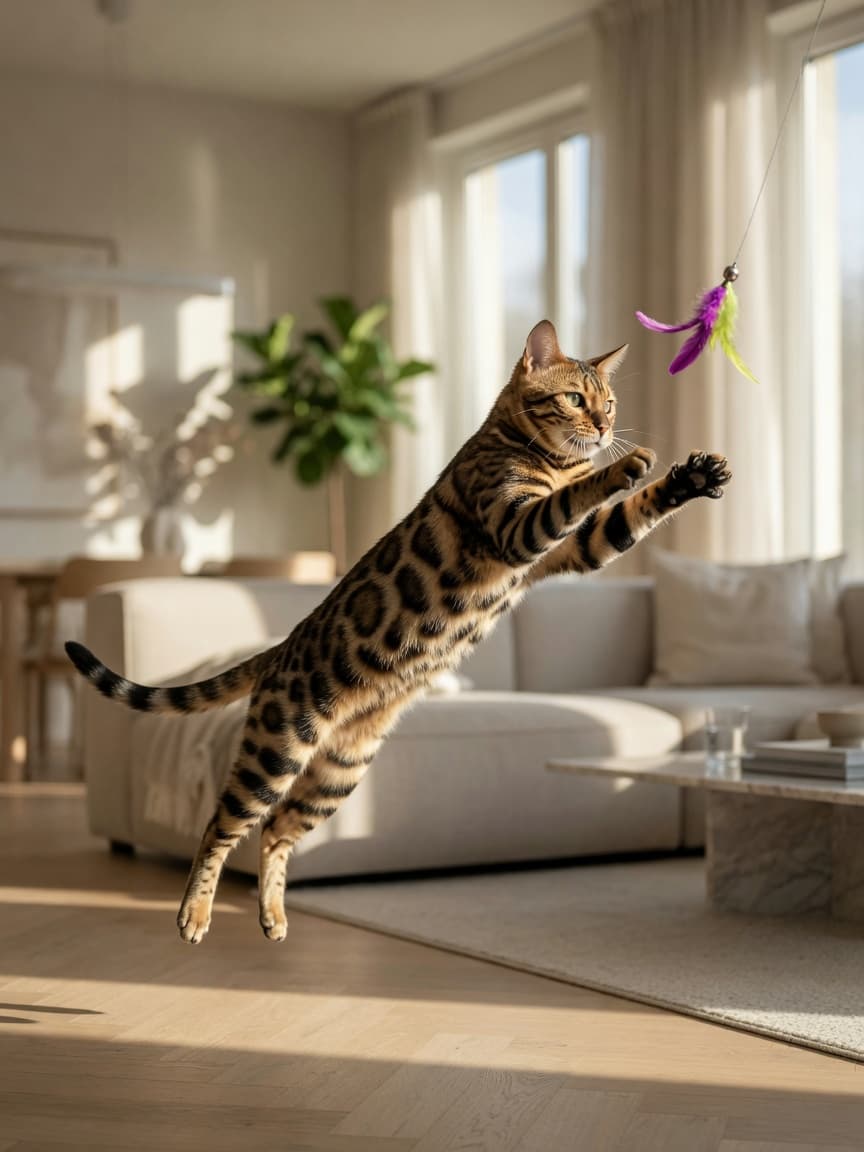
Understanding the Bengal's Wild Heritage
The Bengal cat is unlike most domestic breeds in one fundamental respect: it carries genuine wild blood. The breed was developed in the 1960s and 1970s through crossings between domestic cats and the Asian Leopard Cat (Prionailurus bengalensis), a small wild feline native to South and East Asia. While modern Bengals are many generations removed from their wild ancestor, the genetic legacy remains powerfully present in their behaviour, energy levels, and physical capabilities.
The Bengal Cat Association UK describes the breed as "active, alert, and athletic" — qualities that make them endlessly entertaining but also genuinely demanding. A Bengal that does not receive adequate physical and mental stimulation will not simply nap the frustration away. It will find an outlet, and that outlet is rarely one the owner will appreciate.
Prospective Bengal owners are sometimes surprised by how different life with a Bengal is compared to experience with other cat breeds. Understanding what this breed needs before bringing one home is essential to a successful relationship.
How Much Exercise Does a Bengal Need?
Bengals require a minimum of two hours of active engagement per day — and that does not mean simply having access to an empty room. It means interactive play, environmental exploration, problem-solving, and physical exertion that mirrors what a young wild feline would experience in the course of a day's hunting and territory management.
This two-hour figure should be spread across several sessions rather than delivered all at once. Two or three structured interactive play sessions of fifteen to twenty minutes, combined with an enriched environment that encourages spontaneous activity between sessions, is the ideal framework. A Bengal left alone for ten hours in a sparse flat will accumulate a deficit of movement and stimulation that produces anxiety, aggression, and destructive behaviour.
Enrichment Ideas That Work for Bengals
Cat Exercise Wheels
One of the most effective solutions for high-energy breeds is a cat exercise wheel — a large hamster-wheel-style device sized for cats. Many Bengals take to these with enthusiasm, particularly if introduced as kittens or motivated with a trail of treats along the running surface. A quality cat wheel provides virtually unlimited cardiovascular exercise on demand and is especially valuable in households where the cat cannot access the outdoors. Look for a wheel with a solid running surface rather than spoke gaps, which can catch claws.
Climbing Walls and Vertical Space
Bengals are exceptional climbers and feel most secure when they can access height. A standard cat tree is a starting point, but for a Bengal, a floor-to-ceiling climbing wall with multiple platforms, shelves, and rope bridges provides far more engagement. Wall-mounted cat shelves arranged in a traversable circuit allow a Bengal to run a full loop of the room without touching the floor — a setup that experienced Bengal owners often describe as transformative for their cat's behaviour.
Leash Training
Bengals are one of the breeds most receptive to leash and harness training, and outdoor walks can be an excellent supplement to indoor enrichment. Begin harness training gradually, allowing the cat to wear the harness indoors for short periods before progressing to controlled outdoor exploration. Always use a well-fitted, cat-specific H-harness rather than a collar, and never leave a leashed cat unsupervised. The Bengal Cat Association UK offers guidance on safe outdoor access for the breed.
The Bengal's Fascination with Water
One of the Bengal's most distinctive traits is their unusual affinity for water — a characteristic inherited from the Asian Leopard Cat, which is known to hunt in streams and shallow water. Many Bengals will voluntarily paddle in a shallow bath, play with dripping taps, or swipe at water in their bowl before drinking. Some will attempt to join their owners in the shower.
This water interest can be channelled into enrichment. A shallow tray of water with floating toys or a few pieces of kibble provides a stimulating sensory experience. Drinking fountains are also popular with Bengals, who are often more attracted to moving water than still water in a bowl — and better hydration is an added health benefit.
Food Puzzle Feeders and Mental Stimulation
Physical exercise alone is not sufficient for a Bengal. Their intelligence demands mental engagement, and one of the simplest ways to provide this is through food puzzle feeders. Rather than delivering meals in a standard bowl, use a range of puzzle feeders that require the cat to bat, roll, or manipulate an object to release food. Rotating between different puzzle types prevents habituation and keeps the challenge fresh.
Zooplus carries an extensive selection of interactive feeders, puzzle boards, and slow feeders suitable for active breeds, all available for delivery across the EU. Brands such as Trixie offer multi-level puzzle boards at accessible price points that provide excellent enrichment for intelligent cats.
Hiding portions of the daily food ration around the home — under furniture, behind cushions, on elevated surfaces — also encourages natural foraging behaviour and extends the time your Bengal spends actively seeking food, which is a deeply satisfying activity for them.
Multi-Level Cat Trees and Outdoor Enclosures
A multi-level cat tree with sisal scratching posts, enclosed hideaways, and dangling toys is a baseline requirement for Bengal ownership, not an optional luxury. Choose the largest, most stable model your space will accommodate. Floor-to-ceiling tension poles are particularly valuable as they are both very tall and easy to reposition.
For Bengals in homes with garden access, an outdoor enclosure — commonly called a catio — provides a safe way to experience the outdoors without the risks associated with free-roaming. A well-designed catio with climbing frames, a sheltered resting area, and sensory planting (grasses, catnip, lavender) can provide hours of daily enrichment and significantly reduce indoor behavioural problems.
A Bengal that is well-exercised, mentally stimulated, and given appropriate outlets for their natural behaviours is a genuinely extraordinary companion — curious, affectionate, playful, and endlessly entertaining. Meeting their needs is an investment that pays dividends in the quality of your relationship with this remarkable breed.