
The Rush to Grow Can Come at a Cost
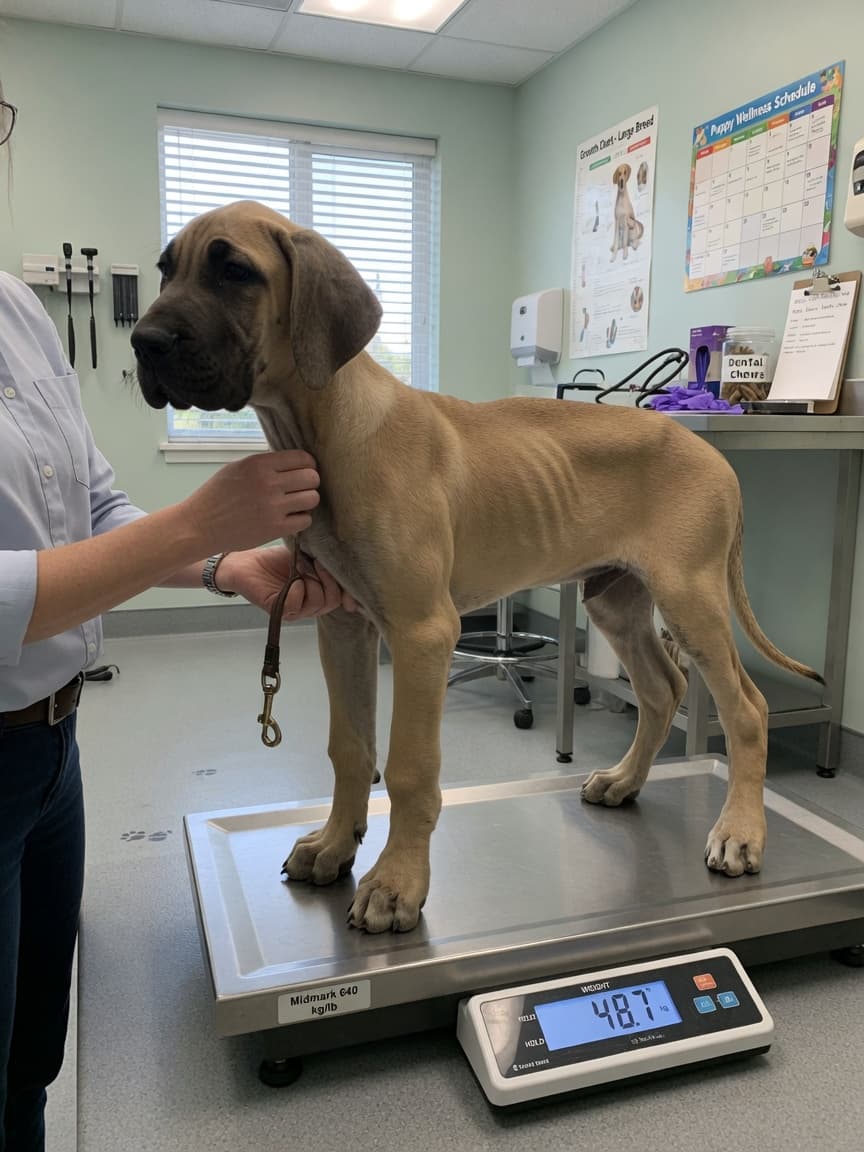
A Great Dane puppy doubles its birth weight within a week. By twelve months, it may weigh sixty kilograms or more. That extraordinary growth rate is extraordinary precisely because it compresses into such a short window — and it creates a period of intense nutritional vulnerability that owners of large and giant breed puppies cannot afford to underestimate. The most dangerous mistake during this window is not underfeeding. It is overfeeding the wrong nutrients.
Why Large Breeds Are Different
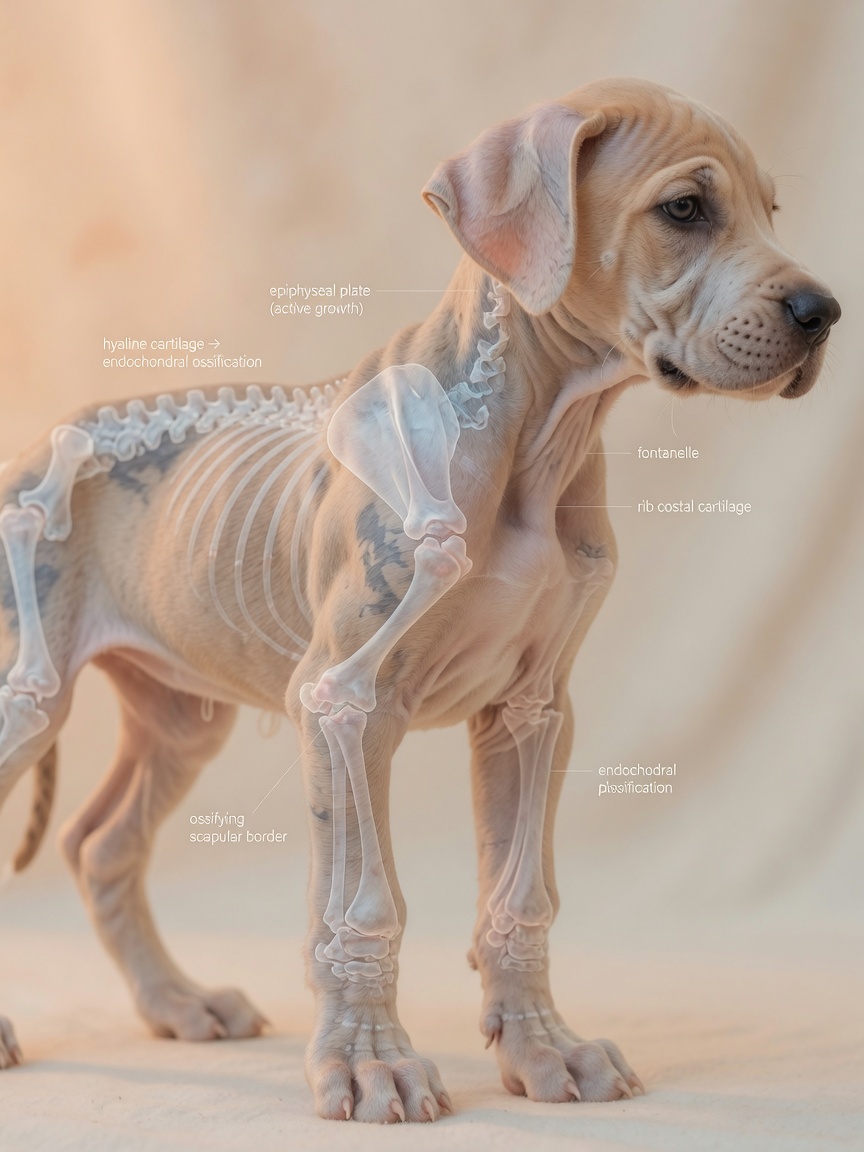
All puppies grow quickly, but the biomechanical stresses on large and giant breeds — broadly defined as dogs expected to exceed 25 kg at adult weight — are categorically different. Their skeletal system develops over a longer period, typically eighteen to twenty-four months, and the cartilage precursor tissue that eventually mineralises into bone is more vulnerable to disruption. The result is a higher prevalence of developmental orthopaedic diseases (DODs) including osteochondrosis dissecans (OCD), hypertrophic osteodystrophy, and hip dysplasia — conditions with strong nutritional components alongside any genetic predisposition.
Calcium: The Central Variable
Of all the nutrients implicated in large breed developmental problems, calcium commands the most attention — and the most misunderstanding.
Too Much Is the More Common Problem
The instinct to supplement a fast-growing large puppy with additional calcium is widespread and understandable. It is also one of the most reliably documented causes of skeletal disease in this population. Unlike adult dogs, puppies lack the hormonal mechanism to excrete excess dietary calcium efficiently. When intake exceeds requirements, calcium is absorbed indiscriminately, depositing in cartilage and disrupting the tightly regulated process of endochondral ossification — the conversion of cartilage to bone.
Phosphorus Ratio Matters Too
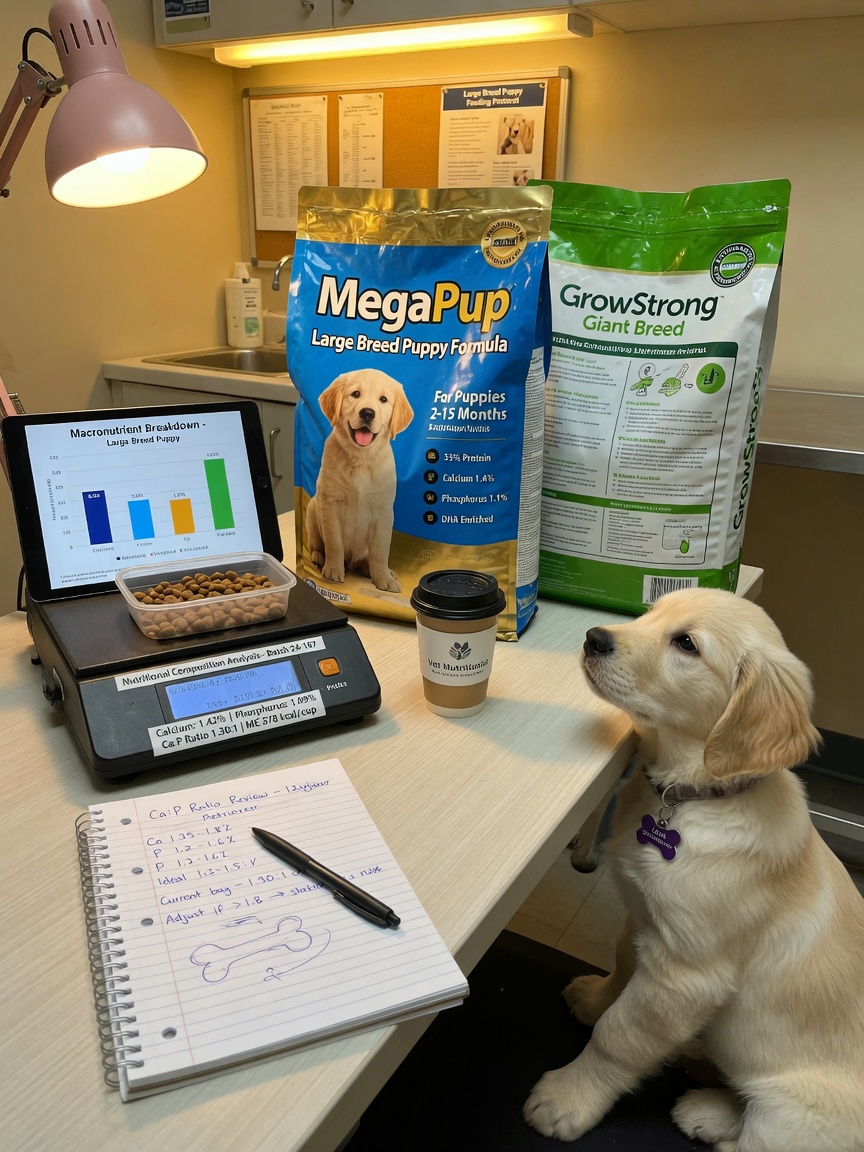
Calcium does not operate in isolation. The calcium-to-phosphorus ratio in the diet must fall within a specific range — broadly 1:1 to 1.8:1 — to support correct skeletal mineralisation. A diet high in meat and low in bone or calcium sources will invert this ratio, leading to nutritional secondary hyperparathyroidism. Conversely, diets high in both calcium and phosphorus without correct balance can impair absorption of other minerals including zinc and magnesium.
Growth Rate Versus Growth Potential
Research from the 1980s and 1990s — some of it conducted on Great Danes specifically — demonstrated that dogs fed ad libitum to maximise growth speed developed far higher rates of skeletal disease than littermates whose intake was restricted to produce a slower, steadier growth curve. Crucially, the restricted-intake dogs reached the same adult body weight and height. They simply took longer to get there.
This evidence underpins a core principle in large breed puppy nutrition: the goal is not to slow growth permanently, but to moderate the rate so that skeletal development can keep pace with muscle and body mass gain. A large breed puppy should remain lean — ribs easily palpable, waist visible from above — throughout the growth phase. An overweight large breed puppy is not a healthy one.
What to Look for in a Large Breed Puppy Food
Several nutritional markers distinguish a genuinely appropriate large breed puppy food from one that merely carries the label.
- AAFCO or FEDIAF growth statement specifically including large breeds: Some growth-formulated foods are validated only for small and medium breeds. Confirm the feeding trial or formulation statement references large breeds explicitly.
- Calcium content between 1.0% and 1.8% dry matter: Higher levels are not appropriate for large breed puppies regardless of other formulation quality.
- Energy density that supports moderate rather than maximal growth: Lower fat content relative to general puppy foods is typical and appropriate.
- Phosphorus within 0.8% to 1.6% dry matter: Combined with the calcium figure, this ensures an appropriate ratio.
- No need for additional calcium supplementation: A food meeting these criteria provides complete mineral nutrition. Adding supplements disrupts the balance deliberately designed into the product.
Homemade and Raw Diets for Large Breed Puppies
Homemade and raw feeding carry higher risk in this population specifically because achieving correct calcium-phosphorus balance without precise formulation is genuinely difficult. A raw diet based on muscle meat with minimal bone will be severely calcium-deficient. A diet heavy in raw meaty bones may oversupply calcium. Neither outcome is benign in a growing large breed.
If a homemade or raw approach is strongly preferred, the diet must be formulated by a board-certified veterinary nutritionist to verified nutritional targets, not assembled from general guidelines found online. This is one context where the cost of professional formulation is directly preventive of significant future veterinary expense.
Practical Guidance for Large Breed Puppy Owners
- Choose a food with an explicit large breed puppy formulation statement — not a general "all life stages" product.
- Feed to maintain a lean body condition, not to fill out your puppy quickly.
- Do not add calcium, bone meal, or multivitamins containing calcium to a complete commercial diet.
- Schedule weight and body condition checks every four to six weeks during the growth phase.
- Transition to an adult large breed formula at approximately twelve months for most large breeds, or eighteen months for giant breeds.
- Discuss breed-specific screening for hip and elbow dysplasia with your vet — nutrition supports, but does not replace, appropriate health monitoring.