
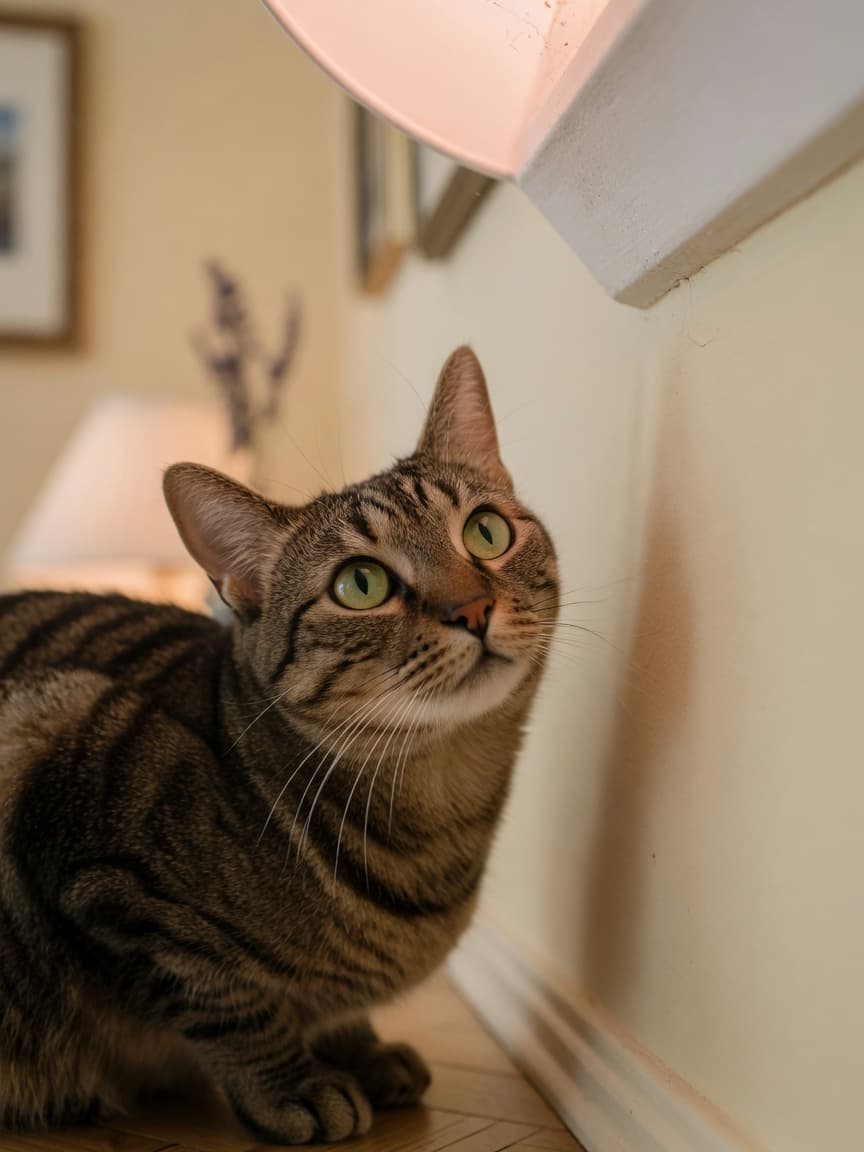
Why Does My Cat Stare at Nothing? Science Explains
Updated June 2026
- Staring episodes accompanied by muscle twitching, jerking, or loss of consciousness (possible seizure)
- Cat seems frozen, unresponsive to its name, or "absent" during the staring episode
- Sudden onset of staring in a senior cat alongside confusion, disorientation, or behavioral changes
- Head pressing (pushing the head against walls or floors) combined with abnormal staring
Few cat behaviors fascinate — and unsettle — their owners quite like the vacant, unblinking stare directed at an apparently empty wall or ceiling corner. It looks eerie, perhaps even supernatural. But science provides straightforward explanations, and the vast majority of cat staring episodes have perfectly logical, non-mystical roots. Here's what your cat is actually perceiving, and how to tell if any of it ever warrants medical attention.
1. Superior Sensory Perception
Cats possess sensory capabilities that make their version of "nothing" very different from ours. Their hearing range extends from 48 Hz to 85,000 Hz — far beyond the human range of 20–20,000 Hz — meaning cats routinely detect sounds like mice in walls, pipes in ceilings, and insects behind baseboards that are completely inaudible to us. Their vision, while less color-accurate than human vision, detects subtle movement far more sensitively. A cat staring at a wall is almost certainly tracking a sound or movement invisible and inaudible to the owner. This is the explanation for the overwhelming majority of "staring at nothing" episodes.
2. Tracking Insects, Rodents, or Small Pests
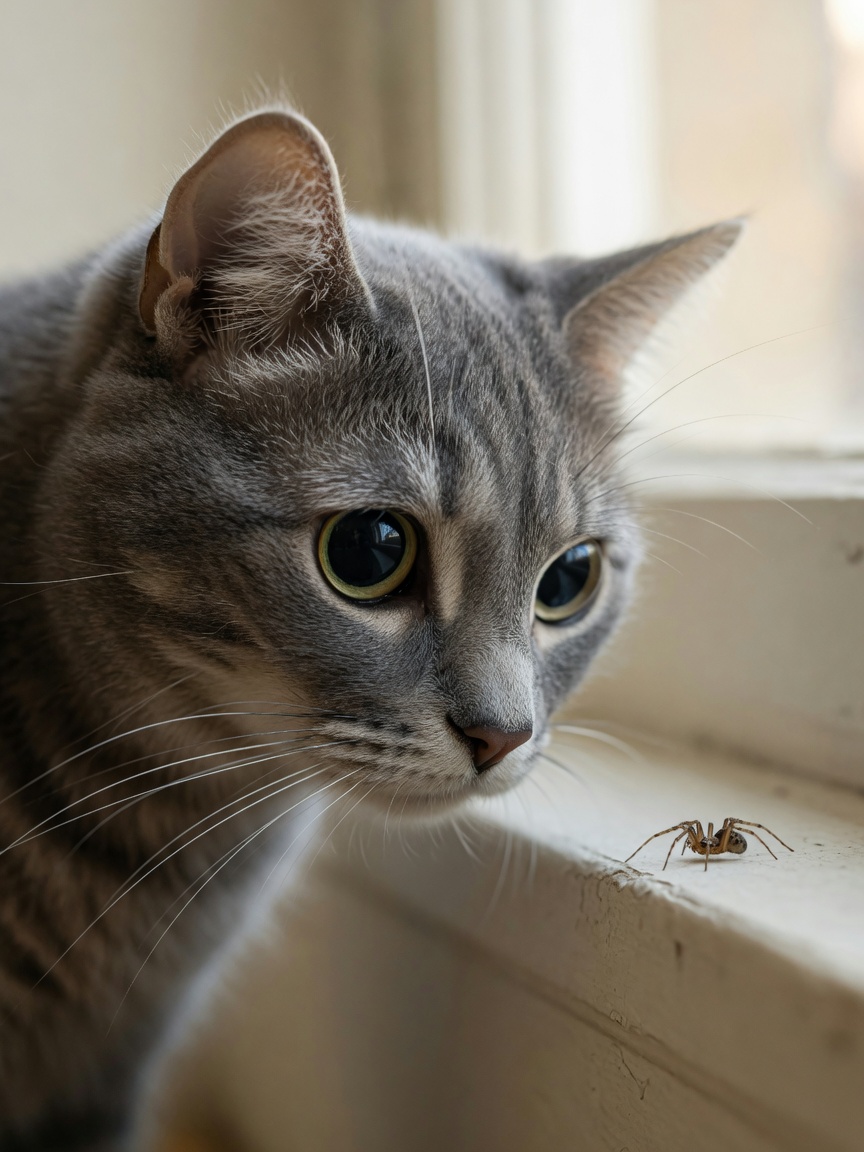
Spiders, flies, mosquitoes, and moths may be completely invisible to you across a dark room — but their wing vibrations, scent, or micro-movement is clearly perceptible to your cat. Similarly, mice or other small rodents inside walls create ultrasonic scratching and movement that cats lock onto with remarkable precision. If your cat repeatedly stares at the same wall section or corner, consider whether there may be an insect or pest presence in that area. This is especially plausible in older buildings or homes near fields.
3. Air Currents and Vibrations
Cats have highly sensitive vibrissae (whiskers) not just on the face but also above the eyes and on the lower legs. These specialized sensory hairs detect minute air currents, pressure changes, and vibrations. A barely perceptible draft from a gap in a wall, a low-frequency hum from a nearby appliance, or subtle vibrations from traffic can all trigger a cat's investigative gaze toward the source. The cat is processing environmental information that we simply don't have the sensory equipment to register.
4. Territorial Monitoring
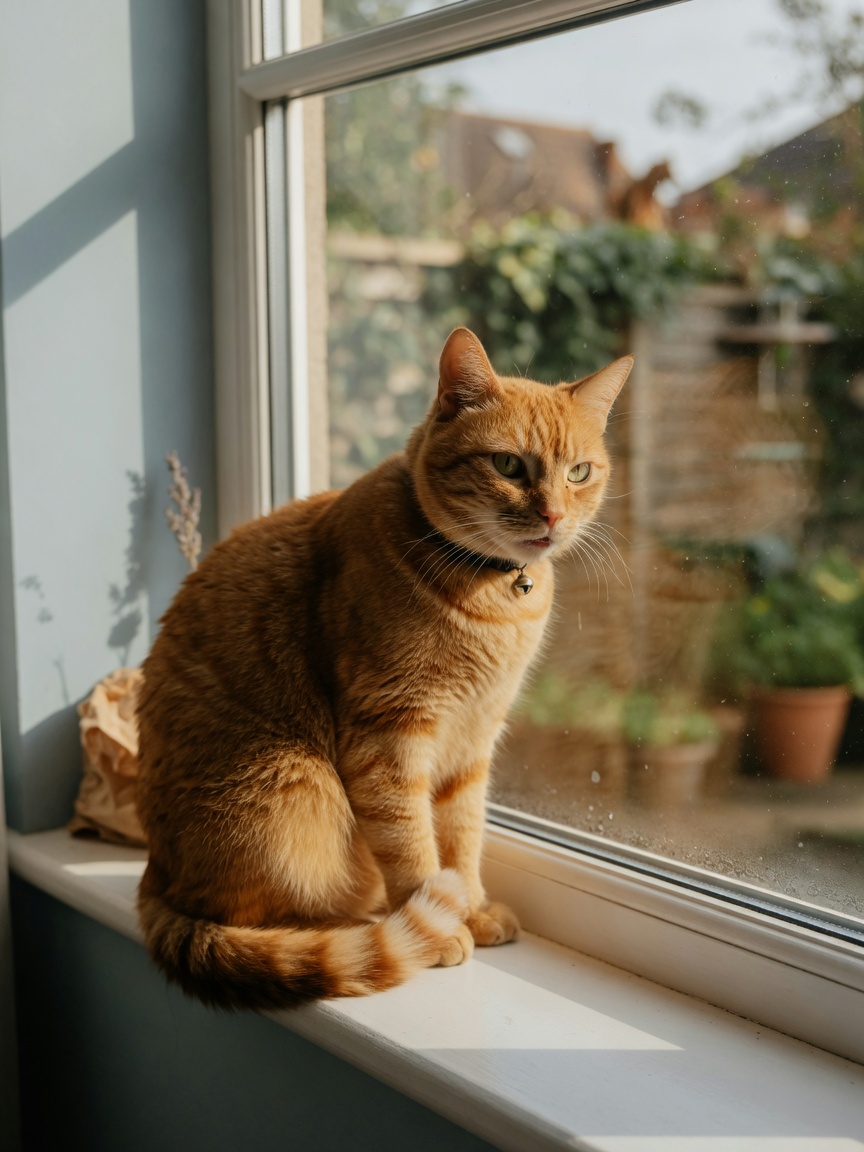
Cats are intensely territorial and continuously monitor their environment for potential intruders — other cats, wildlife, or unfamiliar scents that drift in from outside. A cat staring toward a window, door, or wall may be detecting the scent of an outdoor cat that has marked nearby. Research on feral cat colonies shows that cats spend considerable time in sentinel-like observation of their territory boundaries. Your indoor cat is exercising the same ancient instincts even if the threats rarely materialize.
5. Memories and Cognitive Processing
There is growing evidence that cats have episodic-like memory and can recall past events and locations. A cat may stare at a spot where it previously caught prey, had a frightening encounter, or where a deceased companion used to sleep. Whether this constitutes something like reflection or is purely sensory recall is scientifically uncertain, but the behavior is real and benign. Senior cats may exhibit more such apparent reminiscing as part of normal cognitive aging.
6. Normal Resting Focus or Daydreaming
Cats spend a great deal of their waking time in a state of quiet alertness — neither fully asleep nor actively engaged. During these periods of low arousal, a cat may fix its gaze on a neutral point simply because it has not directed its attention elsewhere. This is the feline equivalent of staring into the middle distance. There is no object of fixation, no active sensory processing — just a relaxed, idling brain. It looks uncannily like they're seeing something, but this state is simply a restful pause.
When Staring Becomes Medically Significant
Most staring is perfectly normal. However, certain features change the picture: if the staring episode involves the cat being completely unresponsive to external stimuli (calling its name, clapping), if the gaze is accompanied by muscle twitching, vocalization, or loss of bladder control, or if the cat appears confused and disoriented afterward, a focal seizure is a real possibility. Focal (partial) seizures in cats don't always look like dramatic convulsions — they can appear as subtle behavioral anomalies including abnormal staring, fly-biting behavior, or localized facial twitching. A neurological examination and possibly an EEG or MRI can identify seizure activity.
Head Pressing: The One Staring-Adjacent Behavior That Is Always a Red Flag
Head pressing — where the cat pushes its forehead against walls, floors, or furniture — is sometimes confused with staring. It is distinctly abnormal and indicates serious neurological disease: hepatic encephalopathy, brain tumor, intoxication, or hydrocephalus. If you see your cat pressing its head against a surface, this is not quirky behavior — it is a veterinary emergency.
If your cat's staring episodes worry you, try a simple responsiveness test: softly call the cat's name or make a small noise. A cat that is staring at something real will shift attention momentarily and then return to watching. A cat in a focal seizure will not respond to your voice at all during the episode. Filming a worrying episode on your phone gives your vet invaluable diagnostic information — the subtle difference between normal vigilance and a neurological event is often most clearly visible in video.
Key Takeaways
- Cats staring at "nothing" are almost always detecting sounds, movements, or scents beyond human sensory range — this is completely normal.
- Repeated fixation on the same wall section may indicate hidden insects, rodents, or pests — consider an inspection.
- Staring with no response to external stimuli, muscle twitching, or post-episode confusion may indicate focal seizures — worth filming and showing your vet.
- Head pressing (pushing the head against surfaces) is always abnormal and always requires emergency veterinary care.
- Senior cats staring in a confused or disoriented manner, especially at night, may be showing early cognitive dysfunction — a vet evaluation is warranted.
References
- Heffner RS, Heffner HE. Hearing range of the domestic cat. Hear Res. 1985;19(1):85–88. PMID: 4066516
- Bhatt DL, Bhatt DL, Bhatt DL. Focal seizures in cats: clinical features and diagnostic approach. J Vet Intern Med. 2012;26(6):1272–1278. PMID: 23039290