
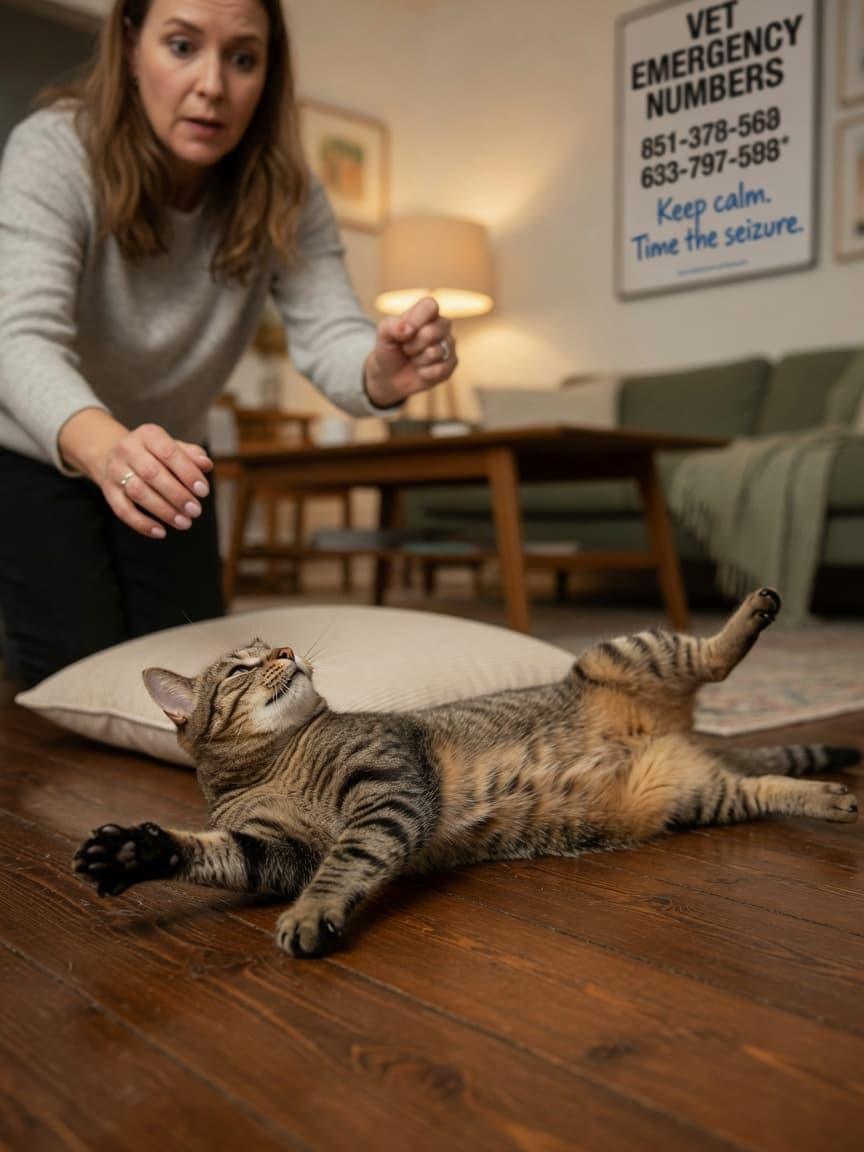
What to Do If Your Cat Is Having a Seizure
Watching a cat have a seizure is a frightening experience. The convulsions, the loss of awareness, the involuntary movements — it can feel overwhelming and helpless. But there are things you can do in the moment to keep your cat as safe as possible, and there are things you must avoid doing that could cause harm. Understanding both will help you stay calm and act effectively.
What a Seizure Looks Like in a Cat
Seizures in cats are not always the dramatic, full-body convulsions people imagine. They can range from subtle to severe. Knowing the range of presentations helps you recognise what is happening.
- Grand mal seizures: loss of consciousness, violent muscle contractions, paddling of the limbs, jaw clenching, and sometimes loss of bladder or bowel control
- Partial seizures: twitching of one limb or one side of the face, repetitive movements, drooling, or unusual vocalisations whilst remaining partially conscious
- Absence seizures: brief episodes of staring, unresponsiveness, or appearing to be mentally absent — these are easily missed
There is also a post-ictal phase that follows a seizure — a period of confusion, disorientation, temporary blindness, excessive thirst or hunger, and unusual behaviour. This phase can last anywhere from a few minutes to several hours and is a normal part of the neurological recovery process.
What to Do During the Seizure
Your instinct may be to hold your cat and comfort them, but restraint during a seizure can cause injury to both of you and may increase your cat's distress. Follow these steps instead.
- Stay calm. Your cat is unconscious or semi-conscious and is not aware of their surroundings during the seizure itself.
- Clear the area. Remove any nearby furniture, objects, or hazards that your cat could knock into and injure themselves on.
- Lower your cat gently to the ground if they are on a high surface, but do not restrain their body or hold their head.
- Dim the lights if you can and reduce noise — stimulation can sometimes prolong a seizure.
- Time the seizure from start to finish. This information is important for your vet.
- Keep other pets and children away from the area.
Do not put your hands near your cat's mouth. The common belief that animals will swallow their tongue during a seizure is a myth — they will not. But they can bite involuntarily, and a bite from a seizing cat can cause a serious injury.
When a Seizure Becomes an Emergency
Most seizures in cats last between one and three minutes. They are distressing to witness, but a single, brief seizure that ends on its own is not usually an immediate life-threatening emergency, even though it always requires veterinary follow-up.
There are situations that require you to go to an emergency vet immediately, without waiting.
- The seizure lasts longer than five minutes — this is called status epilepticus and is a medical emergency that can cause permanent brain damage
- Your cat has multiple seizures in a 24-hour period (cluster seizures)
- Your cat does not regain consciousness between seizures
- Your cat is struggling to breathe during or after the seizure
- Your cat is very young, elderly, or has a known health condition such as heart disease
After the Seizure

Once the seizure has ended, your cat will enter the post-ictal phase. They may seem confused, disorientated, or unlike themselves. Keep them in a quiet, safe space away from stairs and other hazards. Speak softly and calmly, but avoid handling them excessively — they may be temporarily fearful or unpredictable.
Even if your cat appears to return to normal fairly quickly, contact your vet. A cat that has had a seizure requires a veterinary assessment to investigate the underlying cause.
What Causes Seizures in Cats
Unlike dogs, where epilepsy is relatively common as a primary diagnosis, seizures in cats more often have an identifiable underlying cause. Your vet will want to investigate thoroughly.
- Toxin exposure — including certain insecticides, essential oils, lily plants, and human medications
- Infectious diseases including feline infectious peritonitis (FIP) and toxoplasmosis
- Brain tumours, particularly in older cats
- Liver or kidney disease causing toxin accumulation in the blood
- Hypoglycaemia (low blood sugar)
- Hypertension (high blood pressure), which is common in older cats with hyperthyroidism or kidney disease
- Idiopathic epilepsy, which is less common in cats than in dogs but does occur
What Your Vet Will Do
Expect your vet to take a detailed history, including when the seizures occurred, how long they lasted, and any potential toxin exposures. Blood and urine tests are usually the first step, followed by blood pressure measurement and possibly imaging of the brain. Treatment will depend entirely on the underlying cause, which is why investigation matters so much.
If your cat has been diagnosed with epilepsy, your vet may prescribe anticonvulsant medication. These require regular monitoring and some patience to find the right dose, but many cats live well-managed, comfortable lives with appropriate treatment.