
The Gift Nobody Asked For
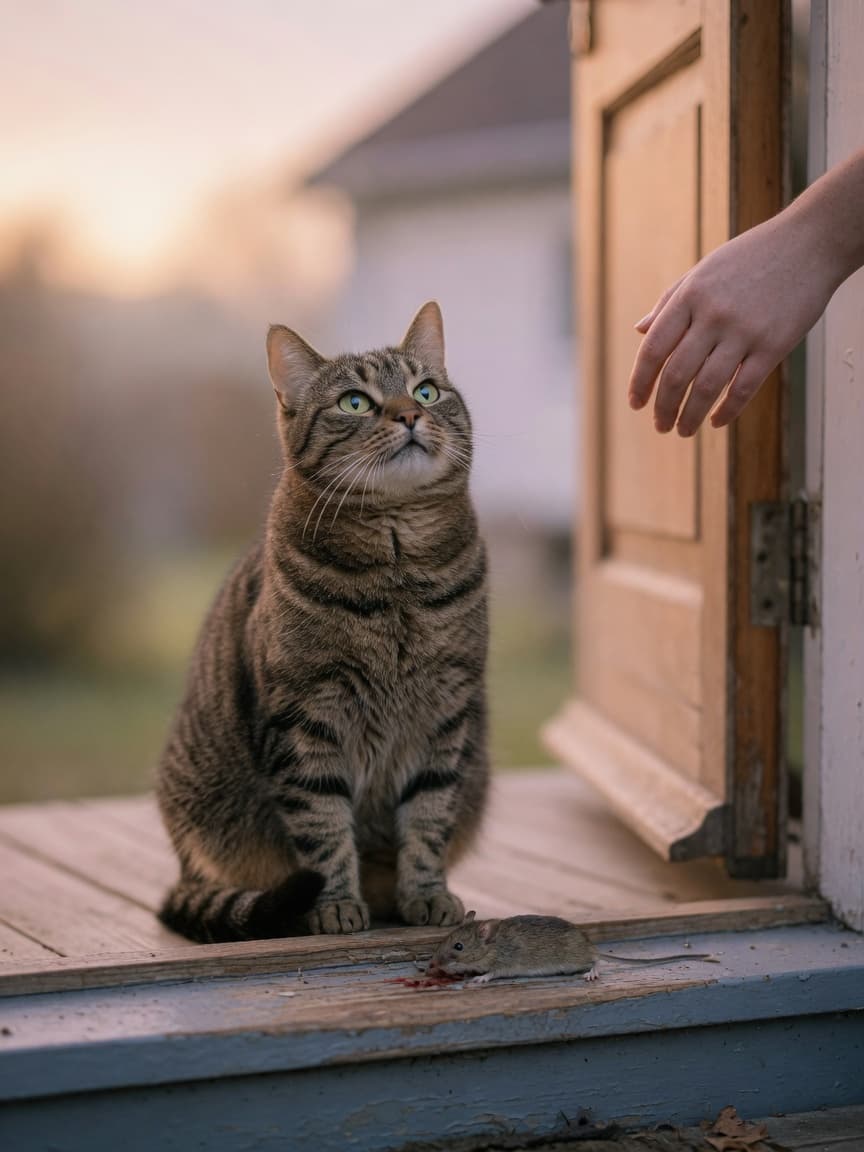
It is one of the more confronting moments of cat ownership: you open the back door in the morning to find a perfectly deceased mouse, or a dishevelled bird, deposited with apparent pride on the doorstep. Your cat, nearby, regards you with an expression of considerable satisfaction. This behaviour — the presentation of prey (or, in indoor cats, toys) to a human — is one of the most frequently misunderstood in the feline repertoire. It is not, as is sometimes suggested, your cat commenting on your hunting inadequacy. The truth is more interesting, and more rooted in the biology of the predatory sequence.
The Predatory Sequence: What Drives Hunting
To understand why cats bring prey home, it helps to understand the predatory sequence — the chain of behaviours that constitutes a hunt. According to International Cat Care, this sequence follows a relatively fixed pattern:
- Stalk — silent, low-bodied movement towards the prey item
- Chase — rapid pursuit triggered by movement
- Pounce — the final leap and capture
- Bite — the killing bite, delivered to the back of the skull or neck
- Dissect and consume — eating the prey
This sequence is not driven by hunger in the way we might expect. Cats will hunt even when fully fed — the drive to perform the predatory sequence is internally motivating, separate from the drive to eat. The ISFM (International Society of Feline Medicine) notes that domestic cats are opportunistic hunters whose predatory motivation persists regardless of dietary satiety, which is why providing food ad libitum does not prevent hunting behaviour.
The prey brought home is typically a by-product of a completed (or nearly completed) predatory sequence. The cat has hunted, caught, and carried its prey — which is itself a natural behaviour, since wild felids routinely carry prey back to a safe location before consuming it.
The Teaching Behaviour Theory
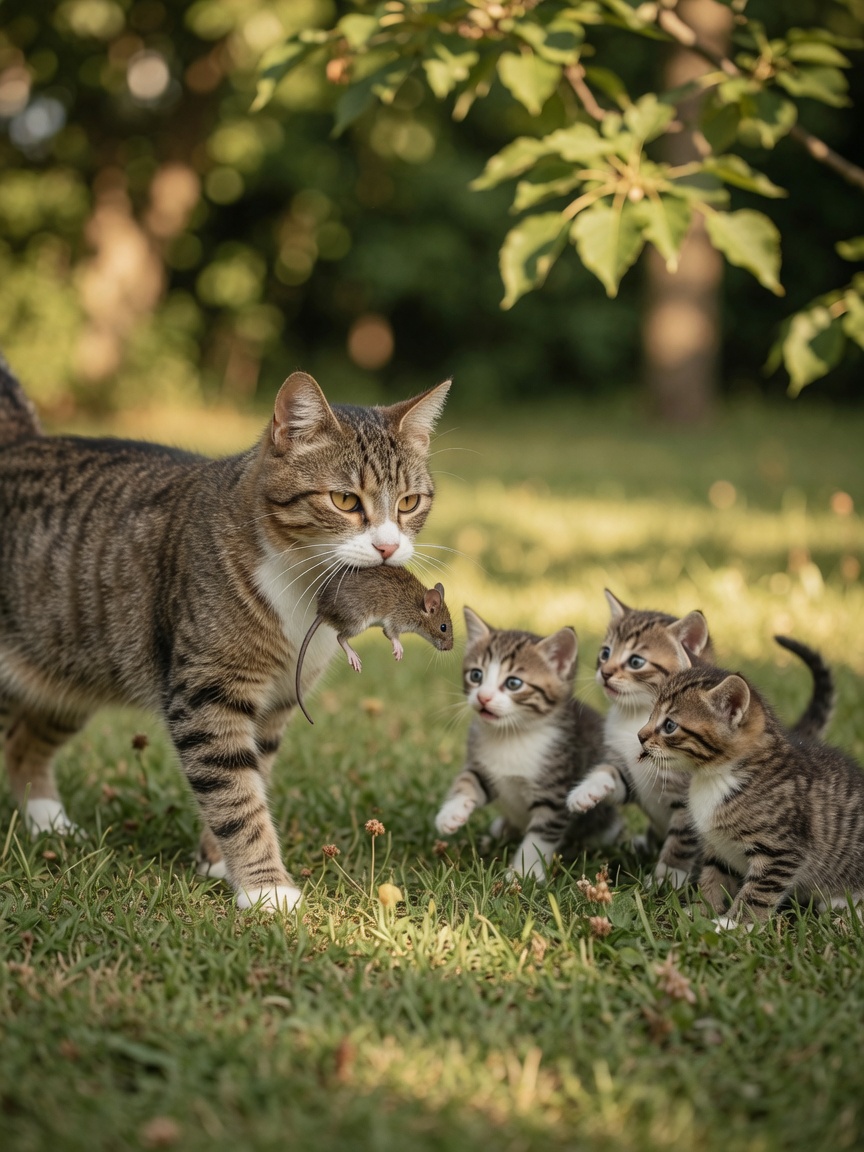
One popular explanation for why cats bring prey to their owners is the teaching behaviour theory: the idea that cats are attempting to teach their human companions to hunt. This explanation draws from observations of wild felids, particularly female cats with kittens. Mother cats do indeed bring prey — first dead, then injured and live — to their kittens as a progressive hunting tutorial, allowing kittens to practise the later stages of the predatory sequence in a controlled setting.
The theory proposes that cats, viewing their human household as a kind of social group, extend this behaviour to their owners — bringing prey as a form of instruction or contribution to the household's food supply. International Cat Care acknowledges this as a plausible interpretation, noting that the behaviour is more commonly seen in female cats (who are the hunters and teachers in wild felid social structures) than in males, though it occurs in both sexes.
It is worth treating this theory with appropriate scientific caution — we cannot directly access a cat's motivational state, and attributing intentional teaching to a non-human animal requires robust evidence. What we can say is that the behaviour is biologically consistent with the patterns seen in mother-kitten prey delivery, and that the social context of the home environment likely does influence where cats choose to bring prey.
Why Toys Sometimes Stand In for Prey
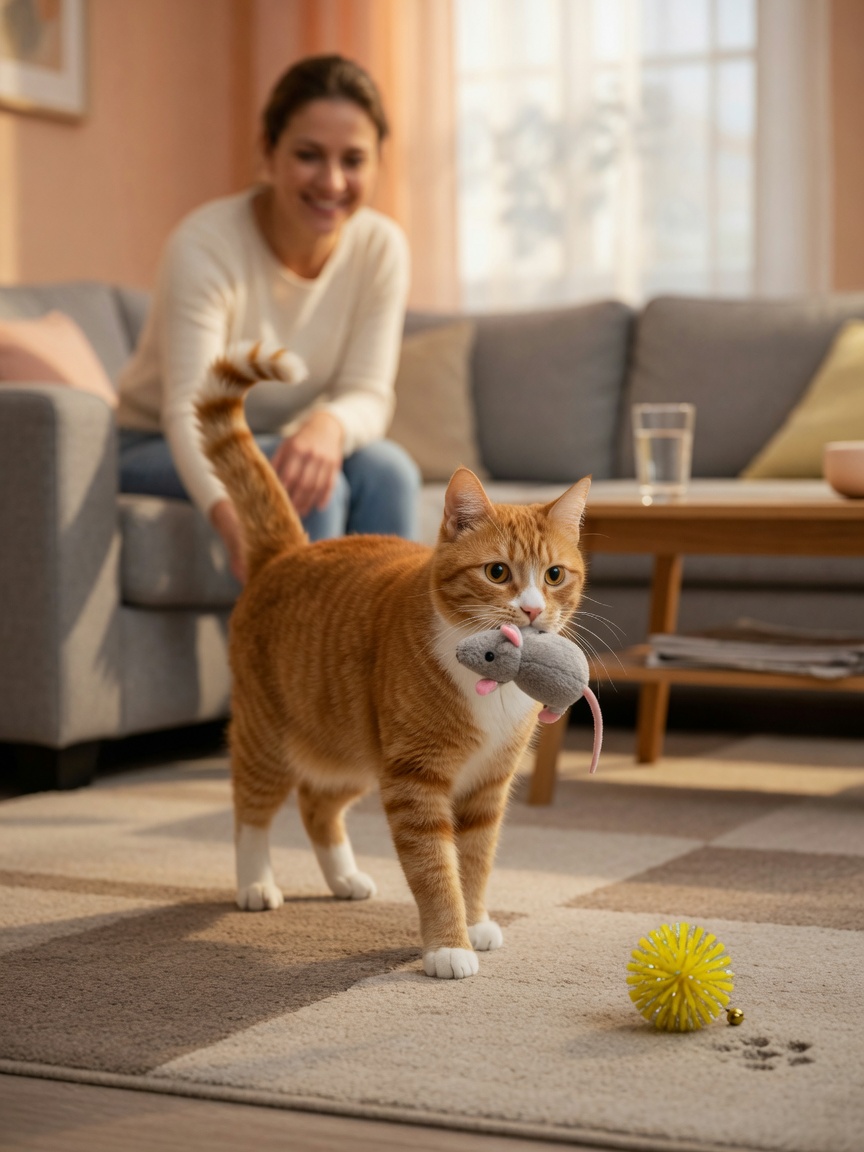
Indoor cats without access to live prey will often redirect the same behaviour onto toys — carrying a toy mouse or a crinkle ball to their owner with apparent ceremony, sometimes vocalising loudly as they do so. This is a direct expression of the same underlying drive: the predatory sequence has been completed on a substitute prey item, and the cat is bringing the "kill" back to the core territory and its social group.
Far from being peculiar, this behaviour is a healthy sign that the cat's predatory drive is finding appropriate expression through play. ISFM guidelines on indoor cat welfare emphasise that providing adequate opportunities for predatory play is one of the most important — and most commonly neglected — aspects of indoor cat enrichment.
Redirecting Prey Drive: Indoor Enrichment Strategies
For outdoor cats that are prolific hunters, there is a growing body of evidence that enriching the indoor environment and providing structured play sessions can meaningfully reduce predation on wildlife. Key strategies recommended by International Cat Care include:
- Interactive play sessions: At least two sessions of 10 to 15 minutes daily using a wand or fishing-rod toy that allows the cat to perform the full predatory sequence — stalk, chase, pounce, bite, and "kill". The toy should be moved in ways that mimic real prey: erratically, with pauses, and close to cover.
- Puzzle feeders: Replacing or supplementing bowl feeding with puzzle feeders engages the food-seeking drive in a constructive way, reducing the motivation to hunt for food.
- Hunting toys: Toys that mimic the feel and movement of prey — feather attachments, fur-covered mice, crinkle balls — are more satisfying than smooth, hard objects. Zooplus offers an extensive range of interactive cat toys, including automated wand toys and realistic plush prey items that are ideal for solo and interactive play.
- Timed outdoor access: Restricting outdoor access to the middle of the day, when songbirds and small mammals are least active, can reduce hunting success without eliminating the cat's outdoor experience entirely.
The Bell Collar Debate
Bell collars are widely recommended as a method for reducing cat predation on birds and small mammals. The logic is straightforward: the bell warns potential prey of the cat's approach, giving them time to escape. However, the evidence base is more complicated than it first appears.
Some studies have found that bell collars reduce bird catches by around 40 to 50%, which is meaningful. But ISFM and International Cat Care both note several important caveats. First, cats can learn to move in ways that minimise bell noise — stalking with extreme slowness or carrying their head in a way that prevents the clapper from striking. Second, some individual cats find collar-wearing stressful, which raises welfare concerns of its own. Third, snap-release or "breakaway" safety collars are essential to prevent injury if the collar catches on a branch or fence.
Overall, bell collars may be a useful tool as part of a broader strategy, but they should not be relied upon as a standalone solution. A combination of environmental enrichment, strategic outdoor access management, and robust play provision is more effective and more comprehensively supports cat welfare.
Appreciating the Gift-Giver
However unwelcome the delivery, a cat that brings prey or toys home is expressing natural, species-typical behaviour rooted in millions of years of evolutionary history. The appropriate response is never punishment — the cat has no capacity to connect a delayed reprimand with the earlier behaviour, and punishment will only create anxiety. Instead, quietly dispose of the prey out of sight, praise your cat calmly, and focus energy on providing the kind of stimulating, play-rich environment that channels these powerful instincts constructively.
Understanding why cats hunt, and what drives them to share their catches, is part of the broader project of appreciating cats as the extraordinary, complex creatures they are — not small, compliant dogs, but obligate predators who happen to have chosen to share our homes.