
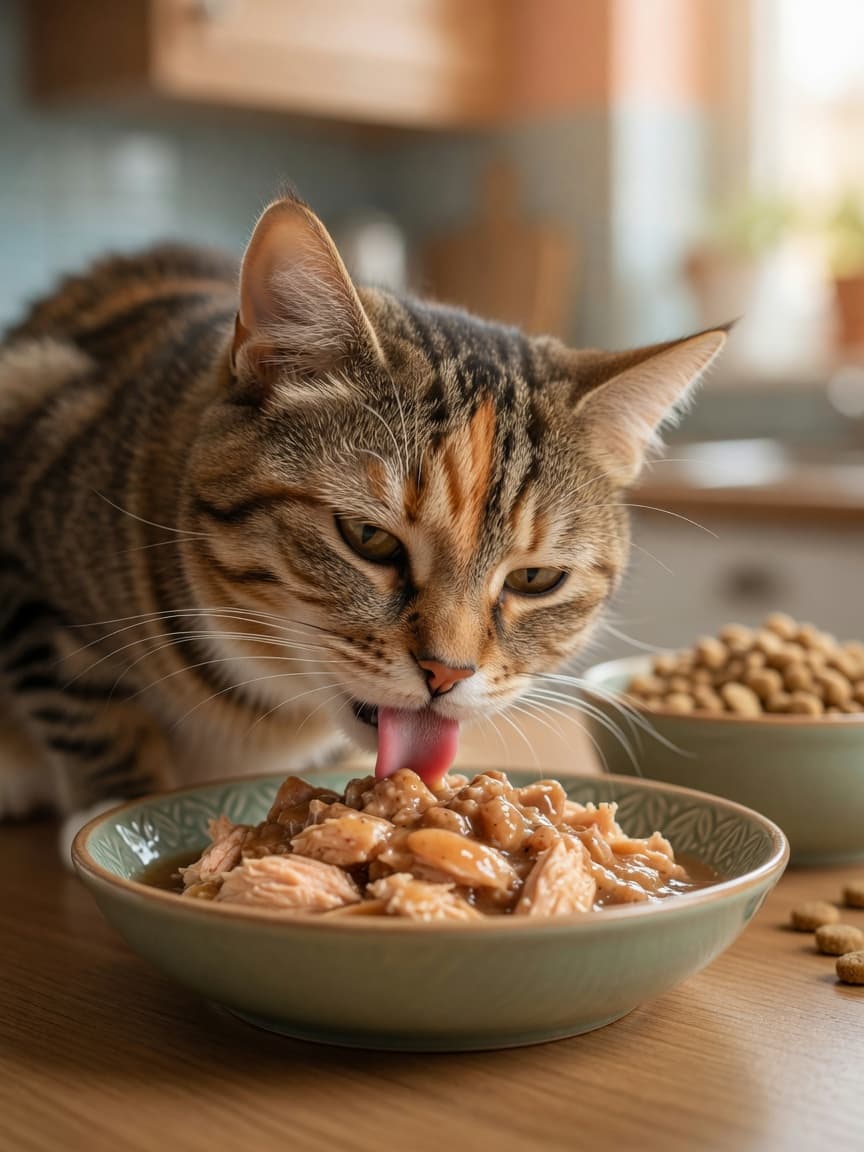
Wet vs Dry Cat Food: Which Is Better? The Science Explained
Walk into any pet store and you'll face a wall of choices: pâtés, chunks in gravy, kibble in a dozen shapes and flavors. The wet vs dry cat food debate is one of the most common questions cat owners bring to veterinary offices, and the answer is more nuanced than most food packaging suggests. Let's look at what the science actually says.
Cats Are Obligate Carnivores With a Low Thirst Drive
Understanding the wet vs dry debate starts with understanding the cat itself. Felis catus evolved as a desert predator whose primary source of hydration came from prey — mice, birds, and small reptiles whose bodies are composed of roughly 65–75% water. As a result, domestic cats have a relatively weak thirst response compared to dogs or humans. Studies have consistently shown that cats do not fully compensate for low dietary moisture by drinking more water from a bowl.
This biological quirk is central to the entire discussion. A cat eating dry kibble lives in a state of mild, chronic under-hydration relative to one eating wet food — and that has measurable consequences over a lifetime.
Moisture Content: The Most Important Difference
The numbers here are stark:
- Wet (canned) cat food: approximately 75–82% moisture
- Dry cat food (kibble): approximately 6–12% moisture
A cat eating 200 g of wet food per day ingests roughly 150–160 ml of water through food alone. The same caloric intake from dry food delivers fewer than 20 ml. Even a cat that drinks enthusiastically from a water fountain is unlikely to close that gap entirely.
When comparing nutritional values, always use a dry matter basis — strip away the moisture and compare what's left. Dry food looks protein-dense on the label precisely because it contains so little water. On a dry-matter basis, many quality wet foods are equally or more protein-rich.
Impact on Kidney Health and the Urinary Tract
Feline lower urinary tract disease (FLUTD) encompasses conditions including cystitis, urolithiasis (bladder stones), and urethral blockages. Dietary moisture is one of the most modifiable risk factors. Higher urine volume dilutes minerals that would otherwise crystallize into struvite or calcium oxalate crystals, and it flushes the bladder more frequently.
Multiple epidemiological studies have found associations between dry food consumption and higher rates of urinary tract disease in cats, particularly in neutered males whose urethra is anatomically narrow. Chronic renal disease — the leading cause of death in older cats — is also thought to be influenced by lifelong hydration status, though the causal relationship is complex and multifactorial.
Veterinary nutritionists routinely recommend transitioning cats with a history of urinary crystals or kidney disease to wet food as a first-line dietary intervention, often before any prescription food is considered.
Protein Quality: Reading Beyond the Percentage
Both wet and dry foods can be high-protein, but the source and digestibility of that protein matters enormously. Dry food manufacture involves extrusion — a high-heat, high-pressure process that damages some amino acids and reduces protein digestibility. Wet food is typically processed at lower temperatures for shorter periods, preserving more of the protein's biological value.
Taurine, an essential amino acid for cats, is particularly heat-sensitive. Commercial foods supplement taurine, but the bioavailability of that added taurine varies by processing method. Cats fed diets with poor taurine bioavailability have historically developed dilated cardiomyopathy — a lesson the industry learned the hard way in the 1980s and 90s.
Look for a named animal protein (chicken, salmon, turkey) as the first ingredient rather than "meat by-products" or "poultry meal" without species specification.
The Dental Health Myth
The myth that dry food cleans teeth likely originates from a comparison to wet food — which does nothing for dental health — rather than from any demonstrated benefit of dry food itself. The abrasive action would require the cat to chew in a sustained, lateral motion, which is not how most cats eat kibble. Studies examining tartar accumulation have found no significant difference between cats fed wet versus dry diets.
Caloric Density and Obesity Risk
Dry food is calorie-dense. A cup of kibble typically delivers 300–400 kcal, while the same volume of wet food might contain only 150–200 kcal. Cats grazing freely on kibble throughout the day — a common feeding practice given dry food's convenience — can easily overconsume calories without their owners realizing it.
Feline obesity rates have climbed steadily; estimates suggest that 40–60% of domestic cats are overweight or obese. Obesity is strongly associated with diabetes mellitus, hepatic lipidosis (fatty liver disease), and orthopaedic problems. Portion-controlled wet food feeding makes calorie management significantly easier and reduces overconsumption risk.
Cost Comparison
Dry food wins on cost, often dramatically. Quality dry cat food may run $1–3 per day for an average adult cat. Comparable-quality wet food frequently costs $2–5 per day or more. For multi-cat households or budget-conscious owners, this is a meaningful difference.
However, the potential long-term veterinary costs associated with urinary disease, kidney disease, and diabetes — all conditions influenced by diet — are worth factoring into the true cost calculation. A $3,000 urinary blockage surgery changes the math considerably.
Practicality: Free-Feeding vs Scheduled Meals
Dry food's greatest practical advantage is that it can be left in a bowl all day without spoiling. Wet food left at room temperature deteriorates within 2–4 hours, making free-feeding impractical and potentially hazardous (bacterial growth). This makes dry food more convenient for owners with irregular schedules.
Scheduled wet food meals — typically two per day — do require more owner involvement but offer the benefit of monitoring food intake. A cat that stops eating is a cat that needs veterinary attention; free-fed dry food can mask appetite changes for days.
Wet vs Dry Cat Food: Side-by-Side Comparison
| Dimension | Wet Food | Dry Food |
|---|---|---|
| Moisture Content | ~75–82% | ~6–12% |
| Hydration Support | Excellent | Poor |
| Urinary Tract Health | Beneficial (dilutes urine) | Higher crystal risk |
| Protein Digestibility | Generally higher | Reduced by extrusion heat |
| Dental Health | No benefit | No meaningful benefit |
| Obesity Risk | Lower (easier portion control) | Higher (calorie-dense, free-fed) |
| Cost per Day | $2–5+ | $1–3 |
| Convenience | Requires scheduled feeding, spoils quickly | Can be left out all day |
The Case for Combination Feeding
For most healthy cats, the evidence points toward a hybrid approach: a foundation of wet food for hydration and protein quality, supplemented with portion-measured dry food for practicality or dental kibble with VOHC certification.
A common combination strategy is feeding two scheduled wet food meals daily (morning and evening) with a small, measured serving of dry food available mid-day. This provides the hydration benefits of wet food while giving owners flexibility on busier days. Total daily calorie targets must account for both foods to avoid overfeeding.
Cats with existing kidney disease, urinary crystals, or diabetes should be transitioned to primarily or exclusively wet food under veterinary guidance. Cats with pancreatitis or gastrointestinal sensitivity may do better on specific formulations regardless of moisture level — always prioritize the individual cat's health history over general guidelines.
- Cats evolved to get most of their water from food; dry food provides very little moisture (6–12% vs 75–82% in wet food).
- Chronic mild dehydration from a dry-food-only diet is a contributing factor in urinary tract disease and may accelerate kidney decline.
- Dry food does not meaningfully clean cats' teeth — this is a persistent myth unsupported by research.
- Dry food is more calorie-dense and easier to overfeed, contributing to the feline obesity epidemic.
- Combination feeding — wet food as the primary diet, small portions of dry food for convenience — is a practical and science-supported approach for most healthy cats.
- Cats with urinary or kidney disease should eat primarily wet food; consult your vet for specific guidance.
- Buckley CM, Hawthorne A, Colyer A, Stevenson AE. Effect of dietary water intake on urinary output, specific gravity and relative supersaturation for calcium oxalate and struvite in the cat. Br J Nutr. 2011;106(Suppl 1):S128–S130. PMID: 22005434
- Finke MD, Litzenberger BA. Effect of food water content on urine characteristics and renal indices in cats. J Vet Intern Med. 1992;6(6):344–349. PMID: 1491542
- Lund EM, Armstrong PJ, Kirk CA, Klausner JS. Prevalence and risk factors for obesity in adult cats from private US veterinary practices. Int J Appl Res Vet Med. 2005;3(2):88–96. PMID: 16261945