
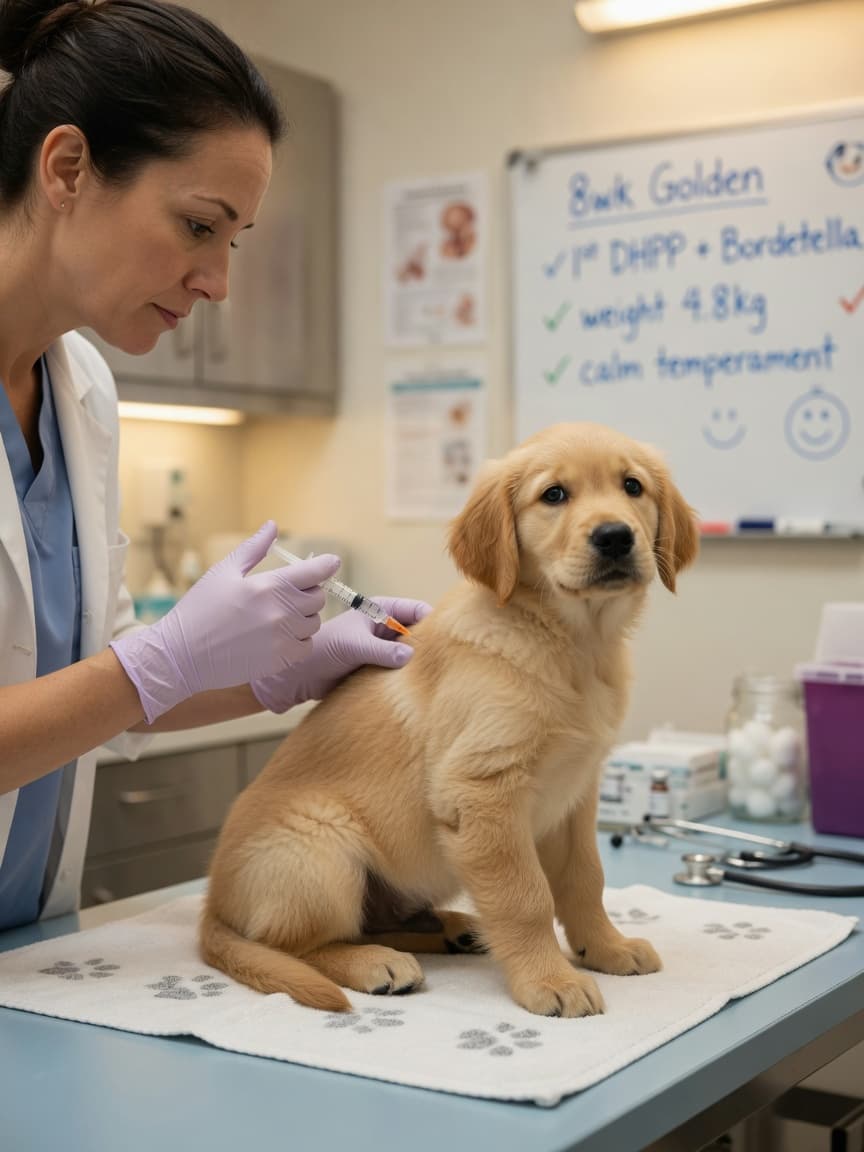
Puppy Vaccination Schedule: Complete Age-by-Age Guide
- First vaccines: 6–8 weeks of age
- Core vaccines: Distemper, Parvovirus, Adenovirus, Rabies
- Series complete: Around 16 weeks
- First booster: 1 year after puppy series
- Always consult your veterinarian for a personalized schedule
By Julia Wrenfield, Pet Wellness Researcher | Published June 25, 2026
Bringing a puppy home is one of life's great joys — and one of your earliest responsibilities is making sure they are protected against the most dangerous infectious diseases. Vaccinations are the single most effective preventive health measure available, and getting the schedule right matters enormously. Too early and maternal antibodies may neutralize the vaccine; too late and your puppy has an unprotected window. This guide walks you through every step of a puppy's core and non-core vaccination schedule, explaining not just when, but why each vaccine is given at each stage.
Why Timing Matters So Much

When puppies are born, they receive passive immunity through their mother's colostrum — antibody-rich first milk consumed in the first 24 hours of life. These maternal antibodies protect the puppy early on, but they also interfere with vaccine-induced immunity. The problem is that the level of maternal antibodies varies widely between individual puppies, even within the same litter. That is why vets administer vaccines in a series rather than a single shot: repeated exposure increases the probability that at least one dose lands after maternal antibodies have waned but before the puppy encounters the real pathogen.
Complete Puppy Vaccination Schedule
| Age | Vaccines | Core / Non-Core | Notes |
|---|---|---|---|
| 6–8 weeks | DA2PP (Distemper, Adenovirus, Parvovirus, Parainfluenza) | Core | First dose of the core combination vaccine. Typically given by breeder or shelter. |
| 10–12 weeks | DA2PP booster; Bordetella; Leptospirosis (1st dose) | Core; Non-Core; Non-Core | Bordetella recommended for puppies with social exposure. Lepto in endemic areas. |
| 14–16 weeks | DA2PP booster; Rabies; Leptospirosis (2nd dose) | Core; Core; Non-Core | Rabies legally required in most jurisdictions. Final puppy series DA2PP dose. |
| 12–16 weeks (optional) | Lyme disease (1st dose); Canine Influenza H3N2/H3N8 | Non-Core | Recommended in tick-endemic regions and high-risk environments (dog parks, boarding). |
| ~2–4 weeks after Lyme 1st dose | Lyme disease (2nd dose); Canine Influenza booster | Non-Core | Both vaccines require a 2-dose primary series 2–4 weeks apart. |
| 12 months | DA2PP booster; Rabies booster; Bordetella; Leptospirosis annual | Core/Non-Core | One year after completion of puppy series. Rabies may be 1- or 3-year product depending on local law. |
| Every 1–3 years (adult) | DA2PP (every 3 years); Rabies (per local law); Bordetella (annually or every 6 months) | Core | WSAVA guidelines recommend triennial DA2PP for adults after initial boosters are complete. |
Core Vaccines Explained
Canine Distemper
Distemper is caused by a paramyxovirus and attacks the respiratory, gastrointestinal, and nervous systems. It is highly contagious and often fatal in unvaccinated puppies. Survivors may carry lifelong neurological damage. The distemper vaccine has been available for decades and has dramatically reduced incidence worldwide, though outbreaks still occur in unvaccinated populations.
Canine Parvovirus (CPV-2)
Parvovirus is perhaps the most feared puppy disease. It destroys the intestinal lining and bone marrow, causing bloody diarrhea, severe dehydration, and sepsis. Mortality in untreated cases exceeds 80%. The virus is environmentally resilient — it can survive outdoors for over a year. Vaccination is critical, and puppies should avoid high-risk environments (dog parks, pet stores) until their series is complete.
Adenovirus (Hepatitis)
Canine adenovirus type 1 causes infectious canine hepatitis, a severe liver disease. The vaccine uses adenovirus type 2 (CAV-2), which cross-protects against type 1 and also protects against one form of kennel cough. This dual protection makes the CAV-2 component particularly valuable.
Rabies
Rabies is fatal in virtually all unvaccinated animals that develop clinical signs, and it is transmissible to humans. Vaccination is legally mandated in most countries and US states. The first rabies vaccine is given no earlier than 12 weeks of age, typically between 12 and 16 weeks. Depending on local regulations and the product used, booster intervals are either 1 year or 3 years.
Non-Core Vaccines: Who Needs Them?
Non-core vaccines are recommended based on geographic risk, lifestyle, and exposure. The most commonly discussed include:
- Bordetella bronchiseptica: Primary cause of kennel cough. Recommended for puppies attending daycare, dog parks, boarding, or grooming salons. Available as injectable, intranasal, or oral formulations.
- Leptospirosis: A bacterial disease spread through water and soil contaminated with infected urine. Risk is higher in areas with wildlife (raccoons, deer) and standing water. Given as a 2-dose primary series then annually.
- Lyme disease: Recommended in tick-endemic regions (northeastern US, upper Midwest, parts of Europe). Should accompany year-round tick prevention.
- Canine influenza (H3N2/H3N8): Recommended for dogs with frequent social contact. Most boarding facilities in the US now require it.
What About Titer Testing?
Titer tests measure circulating antibody levels against specific diseases. Some owners use them to determine whether their dog genuinely needs a booster or already has protective immunity. The WSAVA (World Small Animal Veterinary Association) supports titer testing as an alternative to routine triennial DA2PP boosters in adult dogs. However, titers are not a substitute for rabies vaccination, which is legally mandated regardless of titer levels.
Vaccine Reactions: What to Watch For
Mild reactions — slight swelling at injection site, lethargy for 24–48 hours, low-grade fever — are normal and expected. Serious allergic reactions (anaphylaxis) are rare but can occur within minutes to an hour of vaccination. Signs include facial swelling, vomiting, collapse, or difficulty breathing. If you observe any of these, contact your vet immediately. Wait 20–30 minutes at the clinic after each vaccine appointment during the puppy series to monitor for early reactions.
- Core vaccines (DA2PP + Rabies) are essential for every puppy regardless of lifestyle.
- The puppy series requires multiple doses spaced 3–4 weeks apart because of maternal antibody interference.
- Non-core vaccines (Bordetella, Lepto, Lyme, Influenza) are chosen based on your puppy's specific risk factors.
- Always complete the 12-month booster to finalize the immune response from the puppy series.
- Titer testing is a valid option for adult dogs but does not replace legally required rabies vaccination.
Supporting Your Puppy's Health Beyond Vaccines
Vaccination works best alongside good nutrition, parasite prevention, and regular wellness checks. A well-nourished puppy mounts a stronger immune response to vaccines. High-quality puppy food formulated for growth provides the protein, DHA, and micronutrients that support immune development during this critical first year.
Looking for quality puppy food and health products trusted by European pet owners? Zooplus carries a wide selection of veterinarian-recommended puppy nutrition brands, from Royal Canin and Hill's to premium natural options — with convenient home delivery across Europe.
References
- Day MJ, et al. "WSAVA Guidelines for the vaccination of dogs and cats." Journal of Small Animal Practice. 2016;57(1):E1-E45. PMID: 26780857
- Larson LJ, Schultz RD. "Do two current canine parvovirus type 2 and 2b vaccines provide adequate immunity to the new type 2c variant?" Veterinary Therapeutics. 2008;9(2):94-101. PMID: 18677672
- Waner T, Mazar S. "The effects of vaccination on canine distemper virus seroprevalence." Veterinary Journal. 2014;202(3):492-496. PMID: 25454489