ForPetsHealthcare
Dogs

How to Train Your Dog to Focus on You

By Julia WrenfieldUpdated August 4, 20264 min read
Evidence-based · Sources checked
{"en": "Golden Retriever making direct eye contact with owner during outdoor training session in park", "es": "Golden Retriever manteniendo contacto visual directo con su due\u00f1o durante sesi\u00f3n de entrenamiento en parque", "fr": "Golden Retriever \u00e9tablissant un contact visuel direct avec son propri\u00e9taire lors d'une s\u00e9ance d'entra\u00eenement en parc", "de": "Golden Retriever mit direktem Blickkontakt zum Besitzer w\u00e4hrend Trainingseinheit im Park", "nl": "Golden Retriever maakt direct oogcontact met eigenaar tijdens trainingsessie in park", "pt": "Golden Retriever mantendo contato visual direto com o dono durante sess\u00e3o de treinamento no parque", "it": "Golden Retriever che mantiene contatto visivo diretto con il proprietario durante sessione di addestramento al parco"}

Whether you're navigating a busy park, passing other dogs on a walk, or simply wanting a more obedient companion at home, a dog that focuses on you is far easier to manage and safer in unpredictable situations. Teaching your dog to maintain eye contact and attention on you is one of the most valuable skills you can cultivate together. This foundational behaviour not only strengthens your bond but also makes every other training goal considerably easier to achieve.

Understanding Why Focus Training Matters

Dogs are naturally inclined to be distracted by their environment. Squirrels, other dogs, food scents, and unfamiliar sounds all compete for their attention. However, when your dog learns to prioritise you over these distractions, you gain a powerful tool for safety and behaviour management. A dog with strong focus skills is less likely to pull on the lead, chase wildlife, or engage in reactive behaviours towards other animals.

Start with Basic Attention Building

Before attempting focus work in distracting environments, establish the foundation at home where your dog can succeed.

  1. Choose the right time: Train when your dog is calm but not tired. Early morning or after light exercise works well for most dogs.
  2. Use high-value rewards: Identify what genuinely motivates your dog—whether that's small pieces of chicken, cheese, or a favourite toy. Save these exclusively for focus training.
  3. Start in a quiet space: Begin training in your kitchen or living room where distractions are minimal.
  4. Capture natural eye contact: When your dog naturally looks at your face, immediately mark the behaviour with "Yes!" and reward. This teaches them that looking at you results in positive outcomes.

Building the "Watch Me" Command

Once your dog understands that eye contact earns rewards, formalise this behaviour with a specific cue.

  • Hold a treat close to your eyes so your dog must look at your face to see the reward
  • Say "Watch me" or "Focus" as they make eye contact
  • Reward immediately and enthusiastically
  • Gradually increase the duration they maintain eye contact before rewarding
  • Practise this 5-10 times per session, keeping sessions short and positive

Be patient—this typically takes 2-3 weeks of consistent practice before your dog reliably responds.

Gradually Introducing Distractions
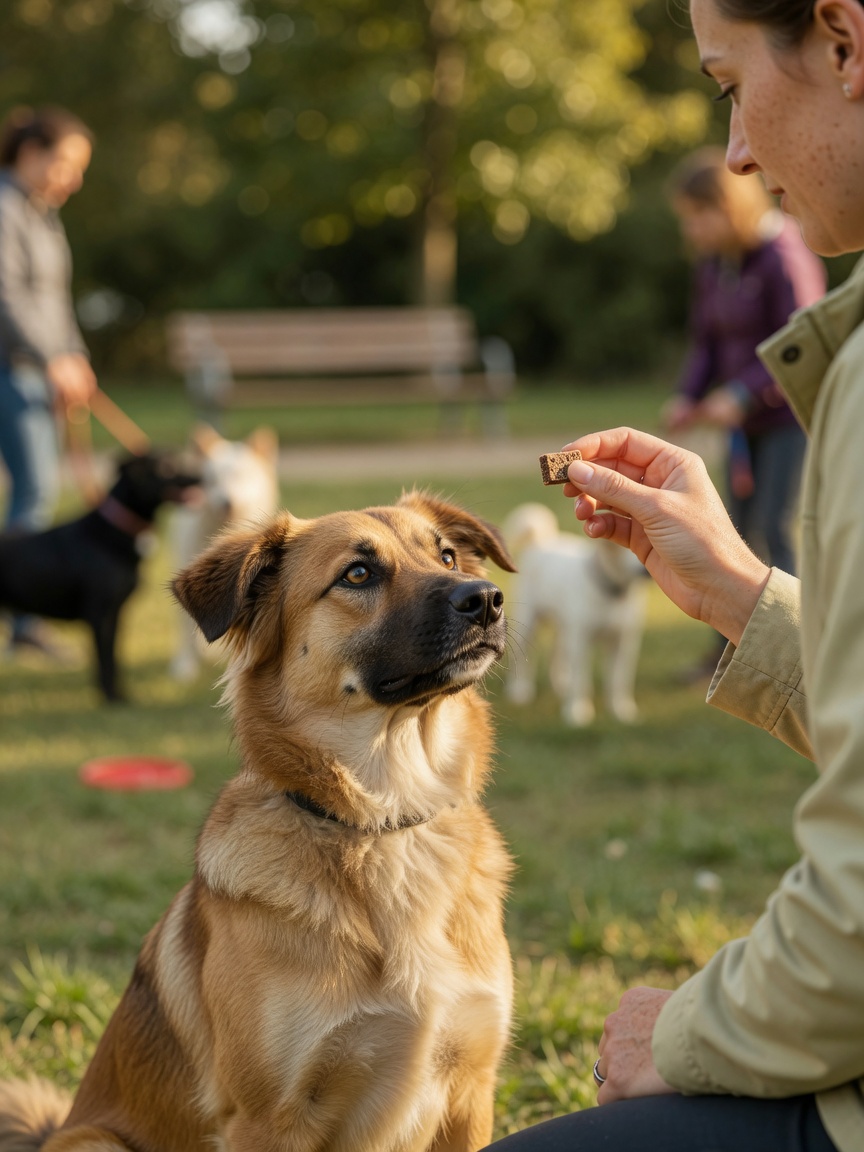
A dog focusing intently on its owner's eyes during outdoor training in a busy park with distractions in the background.

Once your dog masters "Watch me" indoors, slowly increase environmental challenges. First, practise in different rooms of your home, then in your garden, and finally in public spaces. Always start with minimal distractions and only progress when your dog succeeds 8 out of 10 times.

When introducing distractions, use even higher-value rewards. If your dog normally works for regular training treats, bring out the premium chicken for these more challenging sessions.

Common Mistakes to Avoid

  • Progressing too quickly: Moving to distracting environments before your dog has mastered the basics will result in failure and frustration.
  • Using punishment: Never scold or correct your dog for failing to focus. This creates anxiety and damages your relationship.
  • Inconsistent rewards: Your dog needs to predict that focusing on you always pays off.
  • Training when frustrated: Dogs sense your emotional state. Keep sessions upbeat and end on a positive note.

Key Takeaways for Success

Training your dog to focus on you is a gradual process that requires patience, consistency, and the right motivation. Start in controlled environments, use rewards your dog genuinely loves, and celebrate small progress. With regular practise—just 10-15 minutes daily—most dogs develop reliable focus skills within 4-8 weeks. This investment pays dividends throughout your dog's life, making every walk, interaction, and training session more enjoyable for you both.

#how to train your dog to focus on you#dog health#dog nutrition#forpetshealthcare

Sources & further reading

This article is based on peer-reviewed veterinary research and reputable animal-health sources. Explore the underlying science in our Research Library.

Related articles

The 19 Best Animal Shelters in the Netherlands (2026)

the Netherlands's animal shelters, rescue associations and refuges save thousands of dogs, cats and other animals every year, almost always on tiny budgets and volunteer power. To build the most objective ranking possible, we analysed public Google reviews across more than 56 registered animal-prote…

Read more →

The 25 Best Animal Shelters in Italy (2026)

Italy's animal shelters, rescue associations and refuges save thousands of dogs, cats and other animals every year, almost always on tiny budgets and volunteer power. To build the most objective ranking possible, we analysed public Google reviews across more than 121 registered animal-protection org…

Read more →

The 48 Best Animal Shelters in Germany (2026)

Germany's animal shelters, rescue associations and refuges save thousands of dogs, cats and other animals every year, almost always on tiny budgets and volunteer power. To build the most objective ranking possible, we analysed public Google reviews across more than 152 registered animal-protection o…

Read more →

The 32 Best Animal Shelters in France (2026)

France's animal shelters, rescue associations and refuges save thousands of dogs, cats and other animals every year, almost always on tiny budgets and volunteer power. To build the most objective ranking possible, we analysed public Google reviews across more than 89 registered animal-protection org…

Read more →

The 8 Best Animal Shelters in Portugal (2026)

Portugal's animal shelters, rescue associations and municipal centros de recolha save thousands of dogs, cats and other animals every year, almost always on tiny budgets and volunteer power. To build the most objective ranking possible, we analysed public Google reviews across more than 86 registere…

Read more →

Sphynx Cat Skin care and hygiene: Causes, Signs & Care

Sphynx cats have little to no coat, which means the skin itself takes on jobs that fur normally does — insulation, oil dispersal, and barrier protection — leaving it prone to greasiness, blocked pores, fungal infections, and sunburn. The single most important thing to know is that a Sphynx's skin ne…

Read more →
Disclaimer:This article is for informational purposes only and does not constitute veterinary advice. Always consult a qualified veterinarian for your pet's health concerns.

Free newsletter

Pet health tips, straight to your inbox

Weekly science-backed advice for dog & cat owners. No spam, unsubscribe anytime.