
Why Indoor Cats Need Active Enrichment
Indoor cats enjoy significant advantages over their outdoor counterparts: they are protected from traffic, predators, infectious disease, and the unpredictable risks of the outside world. Studies consistently show that indoor cats live considerably longer on average. But safety alone does not equal happiness.
In the wild, cats spend a substantial portion of their waking hours engaged in hunting-related behaviour — stalking, chasing, pouncing, and exploring. An indoor cat with no outlets for these instincts can become bored, frustrated, overweight, and prone to stress-related health problems such as cystitis, over-grooming, and anxiety. Providing a genuinely stimulating home environment is not a luxury — it is a welfare necessity.
The Basics of Feline Enrichment
Enrichment refers to anything that encourages a cat to engage in natural behaviours and exercise their body and mind. Good enrichment should address several key areas:
- Physical exercise and movement
- Mental stimulation and problem-solving
- Opportunities to hunt, stalk, and catch (even if only simulated)
- Safe resting and hiding spots
- Social interaction at the cat's own pace
- Sensory variety — new smells, textures, sounds, and sights
The good news is that meeting these needs does not require an enormous budget or a large home. Thoughtful use of space and a small investment in the right equipment can transform the quality of life for an indoor cat.
Vertical Space: Cat Trees and Shelving
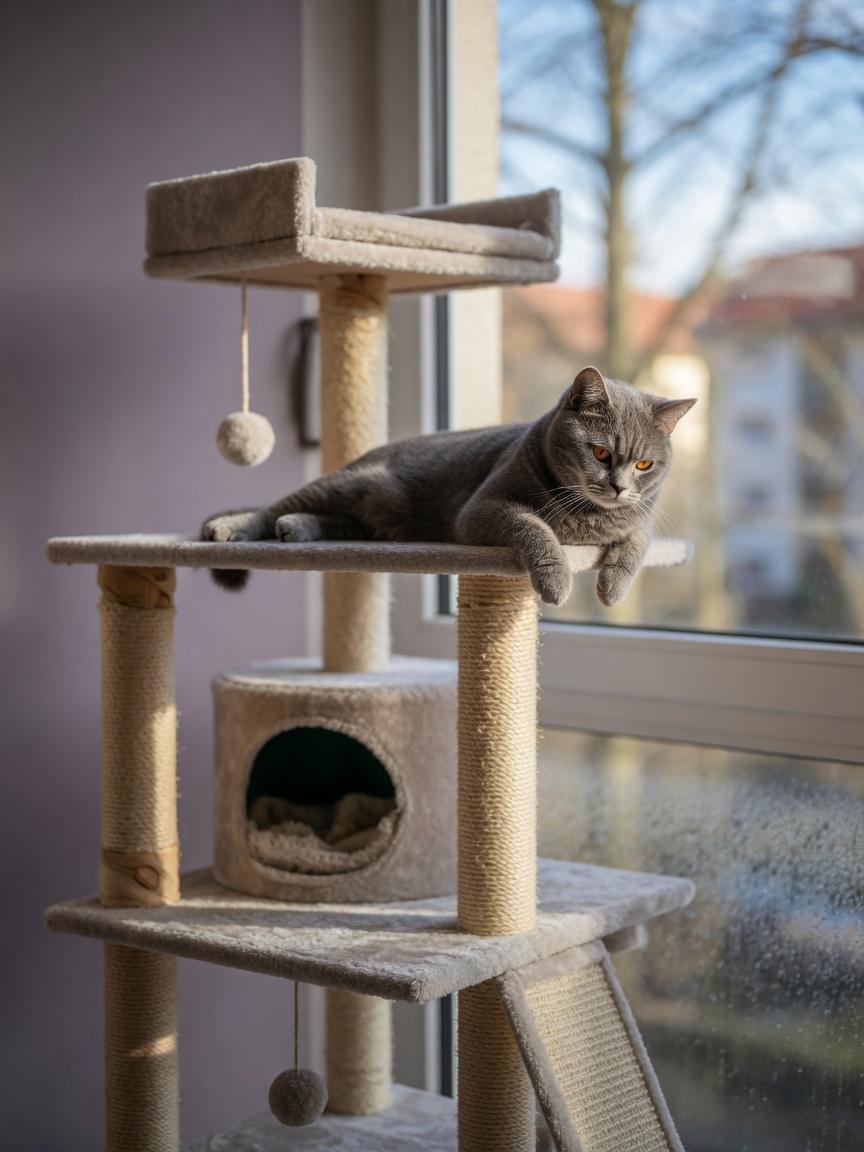
Cats are natural climbers, and height is deeply important to their sense of security and territory. A cat who can see their environment from above feels safer and more in control. In a multi-cat household, vertical space also reduces conflict by allowing cats to spread out without competing for floor-level territory.
A good cat tree should be tall enough for your cat to stretch fully, stable enough not to wobble when they jump onto it, and positioned near a window for maximum interest. Look for trees with multiple platforms, hiding cubbies, and sisal-covered posts for scratching. Zooplus offers a wide range of cat trees in various heights and configurations, including wall-mounted shelving systems that work well in smaller flats.
If budget is a concern, DIY wall-mounted shelves with carpet offcuts can be just as effective as commercial options. The important thing is that the vertical space exists — not that it comes in a particular form.
Window Perches and Bird Feeders
A window perch is one of the simplest and most effective forms of enrichment you can provide. Access to a window turns the outside world into a living television programme — birds, squirrels, passers-by, leaves, and light all provide genuine visual stimulation for cats who might otherwise spend hours sleeping on the sofa.
Consider placing a bird feeder or bird bath in your garden within view of your cat's favourite window. The activity it attracts will keep many cats engaged for surprisingly long periods. Even a window box planted with cat-safe herbs such as catnip, valerian, or silver vine will introduce interesting new smells and, during warmer months, insects to watch.
Puzzle Feeders and Food Enrichment
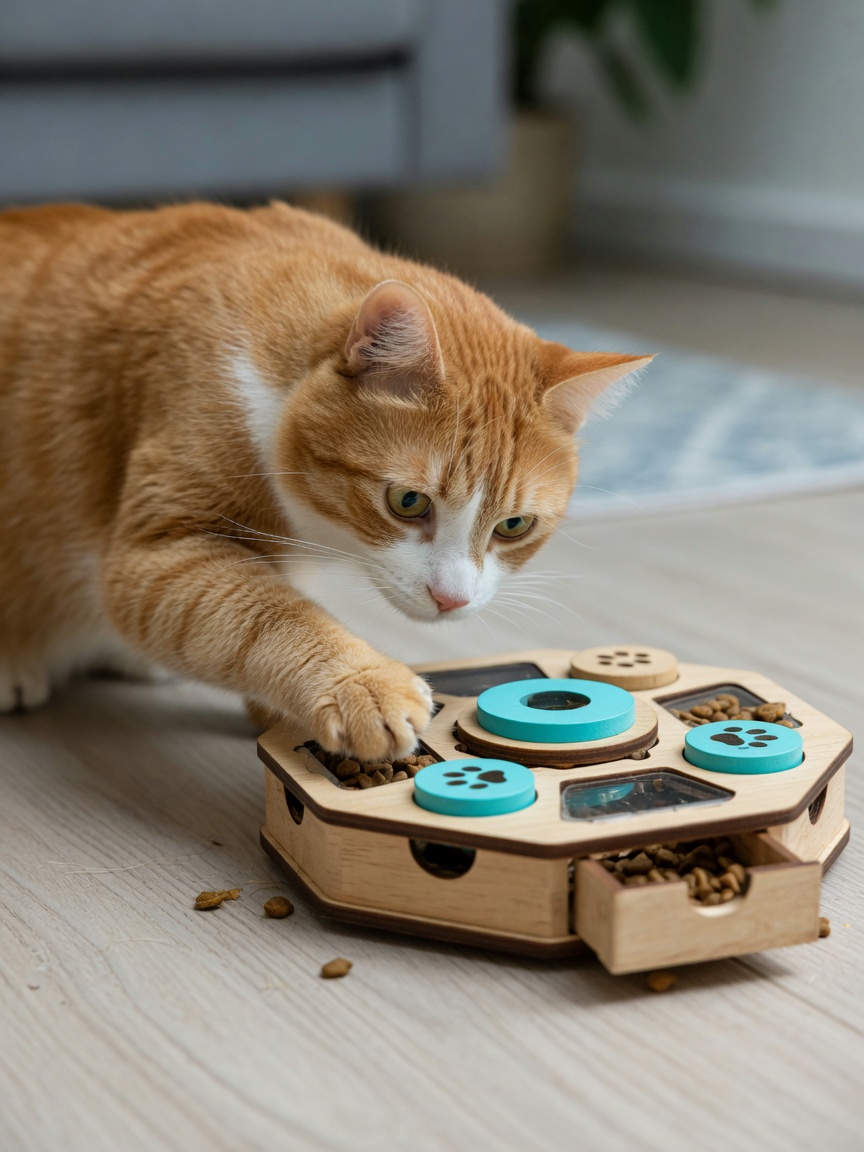
As noted, puzzle feeders make cats work for their food, mimicking the effort involved in hunting prey. But the benefits extend well beyond weight management. Cats who use puzzle feeders consistently tend to be calmer, less likely to engage in attention-seeking behaviour, and more confident overall.
Begin with simple feeders — a muffin tin with kibble in alternate wells, or a snuffle mat — and gradually introduce more complex options. Rotate between different puzzle types to maintain novelty. Frozen wet food in a Kong or similar toy adds an extra layer of challenge and is particularly effective for cats who eat too quickly.
Spreading meals across three or four small portions throughout the day, rather than two large meals, also increases the amount of time your cat spends engaged with food-related activity, which is a healthy expression of natural behaviour.
Interactive Play: The Most Important Enrichment You Can Provide
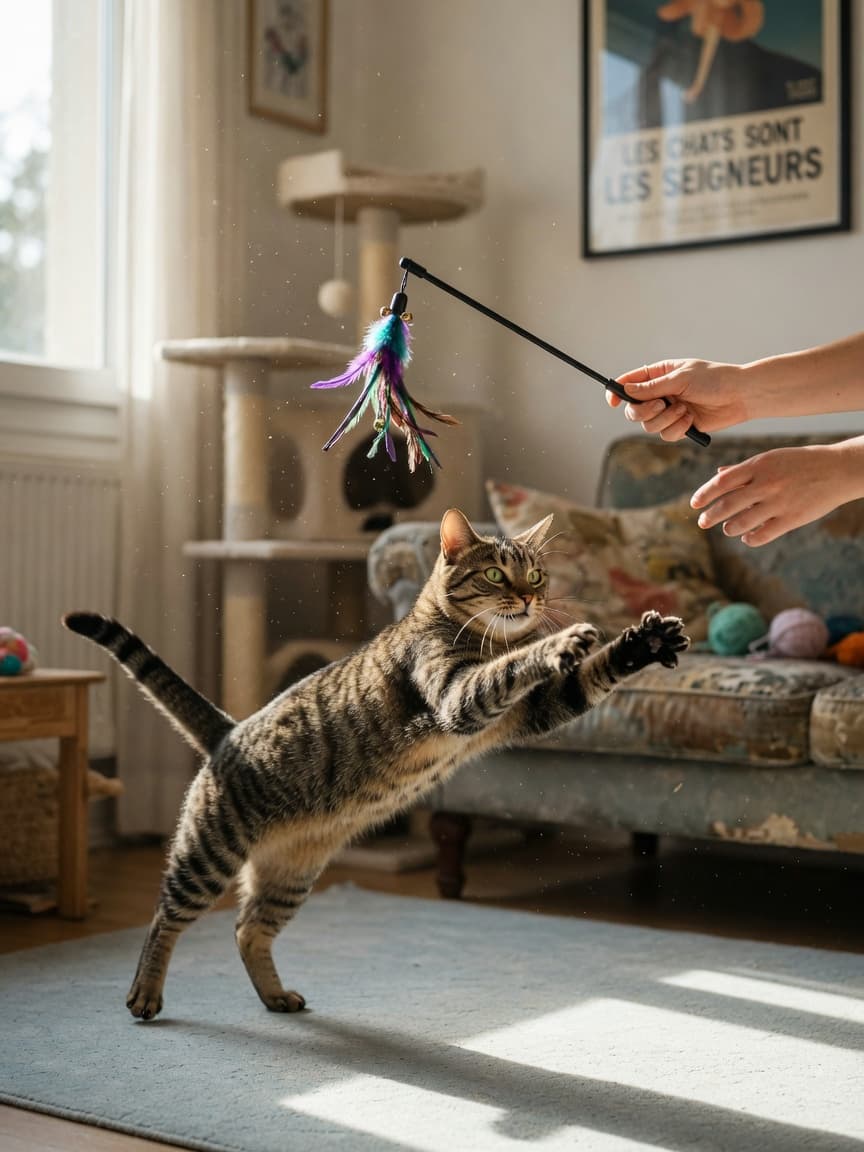
No toy, puzzle, or piece of furniture replaces genuine interaction between you and your cat. Interactive play — where you control a toy and your cat chases, stalks, and catches it — activates the full predatory sequence and is deeply satisfying to cats in a way that batting a ball around alone simply is not.
How to Play Effectively
- Use wand toys with feathers, ribbons, or fabric attachments that move unpredictably.
- Mimic prey behaviour: let the toy move slowly, pause, then dart away. Allow your cat to catch it periodically — a hunt with no catch is frustrating, not fun.
- Aim for at least two sessions of ten to fifteen minutes per day, ideally one in the morning and one in the evening when cats are naturally most active.
- End play sessions with a small food reward to complete the hunt-catch-eat sequence and help your cat settle calmly afterwards.
Toy Rotation: Keeping Things Fresh
Even the best toys lose their appeal when left out constantly. Cats habituate quickly — a toy that was thrilling on Monday may be entirely ignored by Wednesday. Rotation solves this problem simply: keep a selection of toys and bring out only two or three at a time, rotating them every few days.
When a toy reappears after a period of absence, it often gets the same enthusiastic response it received when it was new. Store unused toys in a bag with a piece of catnip for added novelty when they reappear.
Cat-Safe Plants
Plants add sensory interest to a home and some species actively attract cats through their chemical properties. Cat-safe options that provide enrichment include:
- Catnip (Nepeta cataria): the classic choice, though around 30 per cent of cats do not respond to it
- Silver vine (Actinidia polygama): often effective in cats that do not respond to catnip
- Valerian: produces a similar effect to catnip in many cats
- Cat grass (wheat grass, oat grass): cats enjoy chewing this, and it may help with hairballs
Crucially, avoid toxic plants. Common household plants including lilies (extremely toxic), azaleas, ivy, and dieffenbachia should be removed entirely from homes with cats. A full list is available from the ASPCA and most major veterinary organisations.
Videos and Audio for Cats
There is a growing body of content specifically designed for cats — videos of birds, fish, squirrels, and insects on YouTube and dedicated apps. Many cats show clear interest in these, though responses vary. Some cats watch intently; others are entirely indifferent. It is worth trying, particularly for cats who spend long periods alone.
Leaving gentle background audio — classical music or dedicated cat relaxation tracks — has been shown in some studies to reduce stress in cats left home alone. It is not a substitute for enrichment but can form a useful part of the overall environment.
Outdoor Enclosures: Catios
For cats who would benefit from fresh air and a more complex sensory environment, outdoor enclosures — commonly known as catios — offer the best of both worlds. A catio can be as simple as a window box with mesh sides or as complex as a large garden enclosure connected to the house via a cat flap.
Even a small catio dramatically increases the sensory input available to a cat: natural light, fresh air, the sounds and smells of birds and insects, and a variety of textures underfoot. For cats who seem restless or frustrated indoors, access to even a small outdoor enclosure can produce a marked improvement in behaviour and wellbeing.
Social Time and Respecting Your Cat's Pace
Finally, remember that your presence matters enormously to most cats, even those who seem aloof. Spending quiet time in the same room, talking gently, offering slow blinks (the feline equivalent of a friendly smile), and respecting when your cat chooses to interact rather than demanding affection on your terms all contribute to a cat who feels safe, seen, and genuinely content in their indoor life.