
Crate Training a Dog: Step-by-Step Guide for Any Age
By Julia Wrenfield, Pet Wellness Researcher — June 25, 2026
- Works for: Puppies and adult dogs of any age
- Goal: Dog voluntarily rests in crate — a comfortable, safe personal space
- Never: Use the crate as punishment or leave dog in it excessively
- Key principle: Go slowly — rushing creates crate aversion that takes months to undo
- Timeline: 1–3 weeks for most dogs to settle reliably in crate
The crate is one of the most useful tools in a dog owner's toolkit — and one of the most misused. Done correctly, crate training gives a dog a personal safe haven, aids house training, keeps them safe during unsupervised time, and simplifies veterinary care and travel. Done poorly — introduced too fast, used for punishment, or left in too long — it creates anxiety and behavioral problems. This guide covers how to do it right, for any age dog.
Choosing the Right Crate
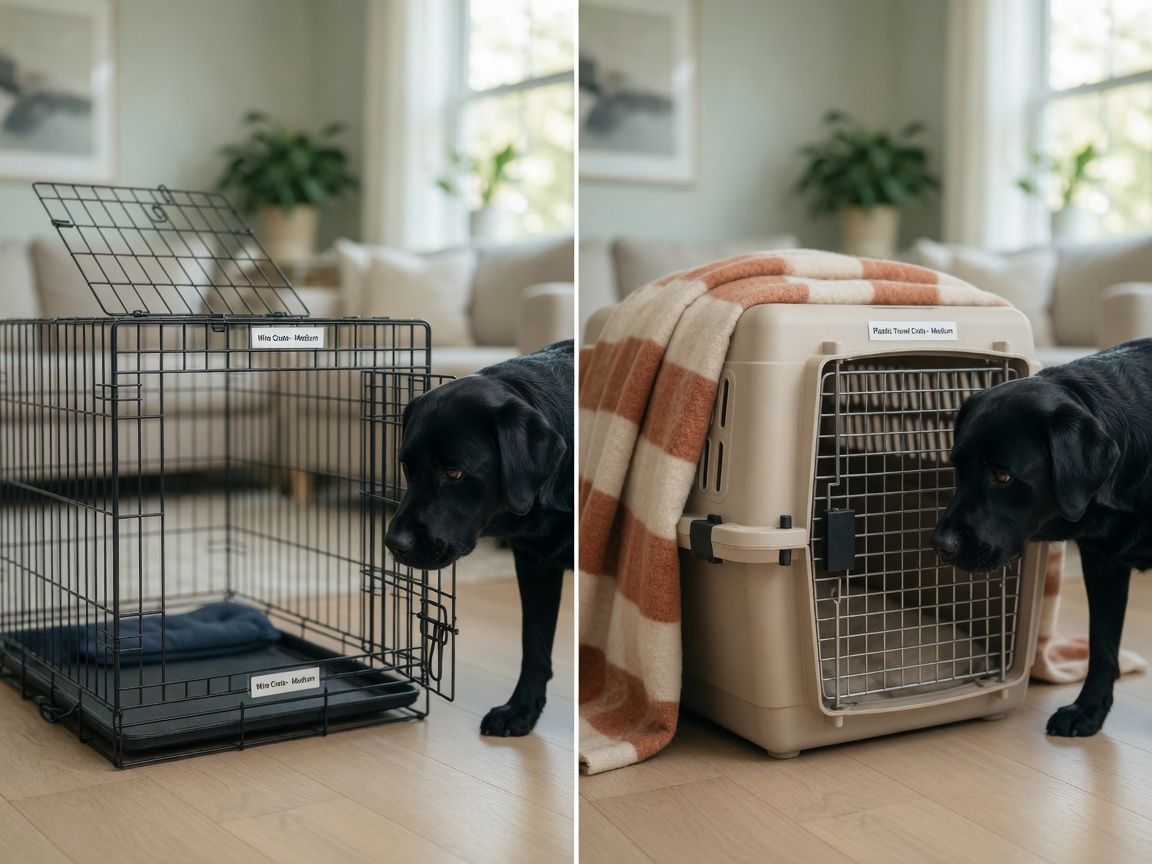
Two primary types: wire crates (open, good airflow, most dogs prefer the visibility) and plastic travel crates (more den-like, better for dogs who prefer enclosed spaces or need airline-approved crates). Either works. Some dogs prefer the enclosed feeling of a plastic crate covered with a blanket over a wire crate. Watch your dog's preference.
Sizing Guide by Breed Size
| Dog Size | Adult Weight | Recommended Crate Size | Example Breeds |
|---|---|---|---|
| X-Small | Under 10 lbs | 18–22 inches | Chihuahua, Yorkshire Terrier |
| Small | 10–25 lbs | 24 inches | Beagle, Cocker Spaniel, Pug |
| Medium | 25–50 lbs | 30–36 inches | Border Collie, Bulldog, Whippet |
| Large | 50–90 lbs | 42 inches | Labrador, Golden Retriever, Boxer |
| X-Large | 90–110 lbs | 48 inches | German Shepherd, Rottweiler |
| Giant | 110+ lbs | 54+ inches | Great Dane, Saint Bernard, Mastiff |
Sizing rule: The dog should be able to stand up fully, turn around comfortably, and lie stretched out. Bigger is not always better for house training purposes — a crate too large for a puppy may allow them to eliminate in one corner and sleep in another. Many wire crates come with a divider panel for this reason.
Setting Up the Crate
Place the crate in a social area of the home — a bedroom or living room where the dog can see and hear family activity. A crate in an isolated basement or spare room is less likely to become a positive space. Add comfortable bedding (a blanket that smells of you is ideal), and for nervous dogs, consider a synthetic pheromone spray (Adaptil) on the bedding. Never put the crate in direct sunlight or near a heat source.
Step-by-Step Introduction Protocol
Step 1: Crate Open, Dog Explores
Leave the crate open with the door propped or removed. Drop a few high-value treats just inside the entrance — not forcing the dog to go far in. Let the dog explore at their own pace. Do not push, lure deeply, or close the door. Some dogs walk in immediately; others take several days to investigate freely. Both are normal. Repeat 5–10 times over the first day, each time placing treats slightly further into the crate.
Step 2: Feeding Meals in the Crate
Begin feeding all meals inside the crate. Initially place the bowl just inside the entrance so the dog eats comfortably. Over several meals, move the bowl progressively further back. If the dog hesitates to enter, keep the bowl position where they were last comfortable — do not force progress. Once the dog is eating comfortably with their whole body inside the crate, you can begin closing the door gently for just the duration of the meal.
Step 3: Short Sessions with Door Closed
Once the dog is comfortable eating inside with the door closed, begin very brief closed-door sessions outside of mealtime. Toss a treat in, dog goes in, close door for 30 seconds, open and release calmly. Gradually extend: 1 minute, 2, 5, 10. Never close the door when the dog is actively trying to exit. If the dog is distressed, you have moved too fast — go back a step. Provide a food-stuffed Kong or chew during longer sessions to create a positive association.
Step 4: Building Duration
Begin leaving the room while the dog is crated. Start with very brief absences (1 minute), return calmly (no big reunions), and gradually extend. Do not return to the crate when the dog is vocalizing or crying — wait for a pause in the noise, however brief, before returning. Returning to crying teaches the dog that crying opens the crate door.
Step 5: Nighttime Crating
For puppies, keep the crate in or adjacent to the bedroom initially. This allows the puppy to hear and smell you, which dramatically reduces nighttime distress. A young puppy (under 12 weeks) may need a middle-of-the-night toilet break — set an alarm rather than waiting for crying, which prevents the crying habit from developing.
Common Mistakes
- Rushing the introduction — the single most common mistake. Go slower than feels necessary.
- Using the crate as punishment — the dog must always go to the crate voluntarily. Sending them to the crate in anger destroys the positive association.
- Leaving the dog in too long — adult dogs should not be crated more than 4–6 hours at a time (excluding overnight sleep). Puppies need toilet breaks every 2–3 hours minimum.
- Letting the dog out when vocalizing — inadvertently trains the dog that barking and crying is the exit button.
- Removing the crate too soon — many dogs continue to use crates as resting places for life; removing it once "trained" may deprive the dog of a space they genuinely value.
Crate Training Adult Dogs
The same protocol applies to adult dogs — and it works. Adult dogs often take to crates even faster than puppies because they have better impulse control and can hold their bladder longer. The key is going at the dog's pace. An adult dog with a previous negative crate experience will need extra patience and extra delicious treats, but crate training is absolutely achievable at any age.
- Correct crate size: dog stands, turns around, and lies stretched out fully — use a divider panel for puppies.
- Introduce the crate gradually over days; never force entry or close the door before the dog is comfortable inside.
- Feed all meals in the crate to build a powerful positive association.
- Never use the crate for punishment — it must always remain a voluntary, positive space.
- Do not let the dog out when vocalizing; wait for a pause, however brief, before opening the door.
References
- Reid PJ. (1996). Excel-erated Learning: Explaining in Plain English How Dogs Learn and How Best to Teach Them. James & Kenneth Publishers.
- Palestrini C, Minero M, Cannas S, et al. (2010). Video analysis of dogs with separation-related behaviors. Applied Animal Behaviour Science, 124(1–2), 61–67.
- American Kennel Club. (2021). Crate training your puppy. Retrieved from PMID: no specific pub; ref: King C, Landsberg G, et al. (2014). Effect of a coated toy on canine behavior. Journal of Veterinary Behavior.