
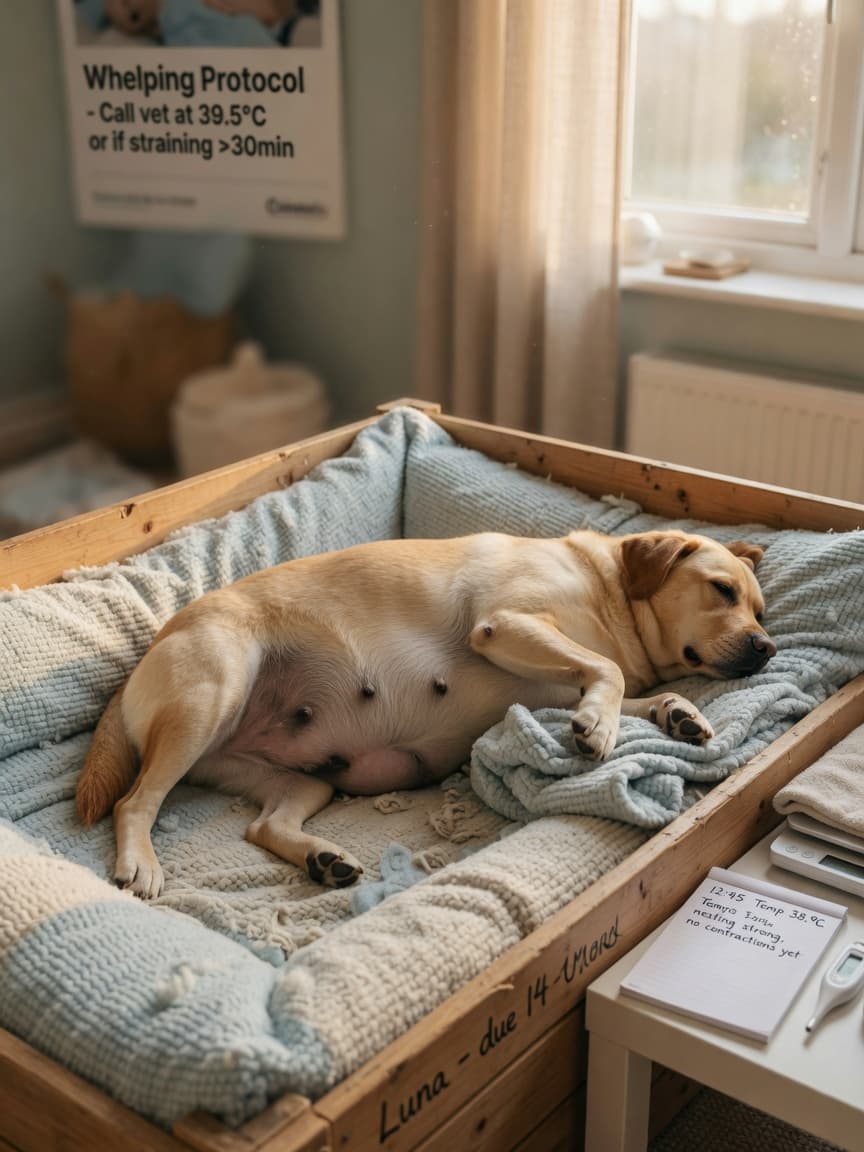
Dog Whelping Guide: Preparing for Birth & What to Do
- Temperature drop below 37.8°C signals labor within 24 hours
- Active labor: one puppy every 30–60 minutes is normal
- Puppy stuck >30 minutes of active straining = veterinary emergency
- Green discharge before first puppy = call vet immediately
- Count placentas — one per puppy
Whelping — the process of a dog giving birth — is one of the most critical events in your dog's life. For experienced breeders, it can feel routine; for first-time dog owners, it can be overwhelming and anxiety-inducing. The good news is that most dogs manage labor and delivery with minimal intervention. The key is knowing what to prepare in advance, what normal labor looks like, and — critically — when to pick up the phone and call your vet.
Setting Up the Whelping Box
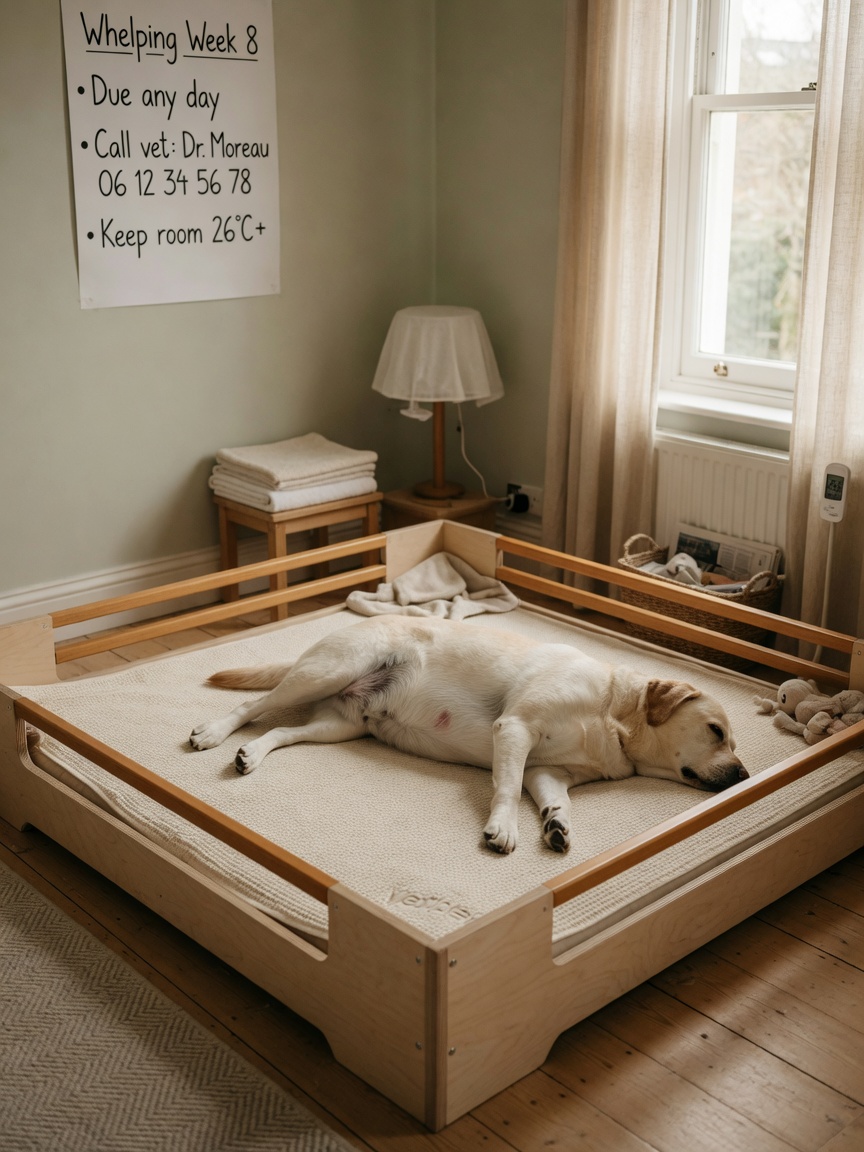
A whelping box gives your dog a safe, contained space to deliver and raise her puppies. Ideally, introduce it two weeks before the due date so she becomes comfortable with it. Key features to consider:
Size: The box should be large enough for the mother to stretch out fully and turn around, but small enough that newborn puppies can't wander too far from her warmth. A common rule is approximately 1.5 times the mother's body length on each side.
Pig rails: Low interior rails set about 10 cm from the walls prevent the mother from accidentally rolling onto puppies.
Location: Choose a warm (around 25–27°C ambient), quiet, low-traffic area of the home. Avoid drafts — newborns cannot regulate their body temperature for the first two weeks of life. A secluded room or corner where the dog feels private but can still be easily observed by you is ideal.
Bedding: Use materials that are easy to clean and replace. Vetbed (veterinary fleece bedding) is excellent — warm, washable, and allows moisture to pass through so puppies stay dry. Avoid materials with loose threads that could tangle around limbs.
Signs Labor Is Starting
Knowing when labor begins helps you time your support appropriately. The clearest pre-labor signals are:
- Temperature drop: Rectal temperature falls below 37.8°C (100°F) from the normal 38–39°C. This temperature drop, sustained for 12–24 hours, reliably predicts the onset of active labor within the next day. Take temperature twice daily in the final week.
- Nesting: Intense scratching, rearranging bedding, and seeking the whelping box.
- Restlessness and panting: The dog may seem unable to settle, circling repeatedly.
- Loss of appetite: Many dogs refuse food in the 12–24 hours before delivery.
- Shivering: Often accompanies early contractions even without a fever.
- Clear vaginal discharge: A mucus plug may be expelled in the hours before active labor.
Stage 1: Early Labor and Contractions
Stage 1 labor is characterized by uterine contractions that are not yet visible externally. The cervix is dilating. This phase lasts 6 to 12 hours in most dogs, though it can extend up to 24 hours in first-time mothers. Your dog will appear anxious, may vomit, and will continue nesting. Contractions are happening internally but are not yet the strong, visible pushing efforts of Stage 2.
During Stage 1, keep the environment calm and quiet. Check in frequently but resist the urge to hover — excess disturbance can slow labor. Have your vet's emergency number written down and ready.
Stage 2: Active Delivery
Stage 2 begins when the first puppy moves into the birth canal. You will now see active straining — visible abdominal contractions where the dog visibly bears down. The first puppy should arrive within 30 to 60 minutes of active, strong straining. Puppies are born in a fluid-filled amniotic sac. The mother will typically break this sac, sever the umbilical cord, and begin vigorously licking the puppy to stimulate breathing.
If the mother doesn't break the sac within a minute, you must do it yourself — tear the sac from around the puppy's face immediately and wipe away any fluid. Rub the puppy gently but firmly with a clean, dry towel to stimulate breathing. A crying, wriggling puppy is a good sign.
Between puppies, intervals of 15 to 60 minutes are normal. Some dogs rest for up to 2 hours between puppies and resume straining. Monitor carefully and keep puppies nursing on the mother between deliveries — this stimulates further contractions via oxytocin release.
Stage 3: Placenta Delivery
Each puppy should be followed by the delivery of a placenta (afterbirth), typically within 15 minutes of the puppy's birth. Count every placenta — there should be one per puppy. A retained placenta can cause serious infection (metritis) in the mother. Allow the mother to eat one or two placentas if she wishes — they contain hormones that support milk production — but remove the rest to avoid gastric upset.
Stages 2 and 3 alternate until all puppies are delivered. The full delivery process for an average litter of 6–8 puppies may take 3–6 hours.
Normal vs. Emergency Situations
Most deliveries proceed without issue, but knowing the red flags is essential. Call your vet immediately if:
- A puppy is stuck (only partially visible) and the mother has been straining actively for more than 30 minutes without delivery.
- There is dark green or black discharge before the first puppy is born (green signals placental separation and means puppies need to be delivered very soon — it is normal between puppies but not before the first).
- More than 4 hours pass between puppies and you know more remain.
- The mother appears in severe distress, collapses, or shows signs of shock (pale gums, rapid weak pulse).
- A puppy is born still and cannot be revived after 2 minutes of stimulation.
- You believe puppies remain undelivered after the mother seems to have finished.
After the Birth: First Hours and Days
Once all puppies are delivered, ensure every pup is nursing. Colostrum — the first milk — is rich in antibodies and must be consumed within the first 12–24 hours to confer passive immunity. Keep the whelping area at 29–32°C for the first week. Weigh each puppy daily — healthy puppies gain weight consistently from day 2 onward. A puppy that fails to gain or loses weight needs urgent attention.
Offer the mother fresh water and a small, easily digestible meal after whelping. She will need significantly increased calories during lactation — up to three times her normal intake for large litters.
Be fully prepared for whelping day with professional-grade supplies. Shop whelping kits on Zooplus →
Key Takeaways
- Set up the whelping box two weeks before the due date and place it in a warm, quiet location.
- A sustained temperature drop below 37.8°C signals active labor within 12–24 hours.
- Stage 2 labor: one puppy every 30–60 minutes of active straining is normal; over 30 minutes of straining with no puppy is an emergency.
- Count all placentas — one per puppy. A retained placenta causes serious infection.
- Green discharge before the first puppy, or puppies stuck for more than 30 minutes, are veterinary emergencies.
References
- Linde-Forsberg C. (1994). Abnormalities in pregnancy, parturition and the periparturient period in the dog. Veterinary Annual. PMID: 7709328
- Münnich A, Küchenmeister U. (2014). Dystocia in numbers — evidence-based parameters for intervention in the dog. Reproduction in Domestic Animals. PMID: 25292198