
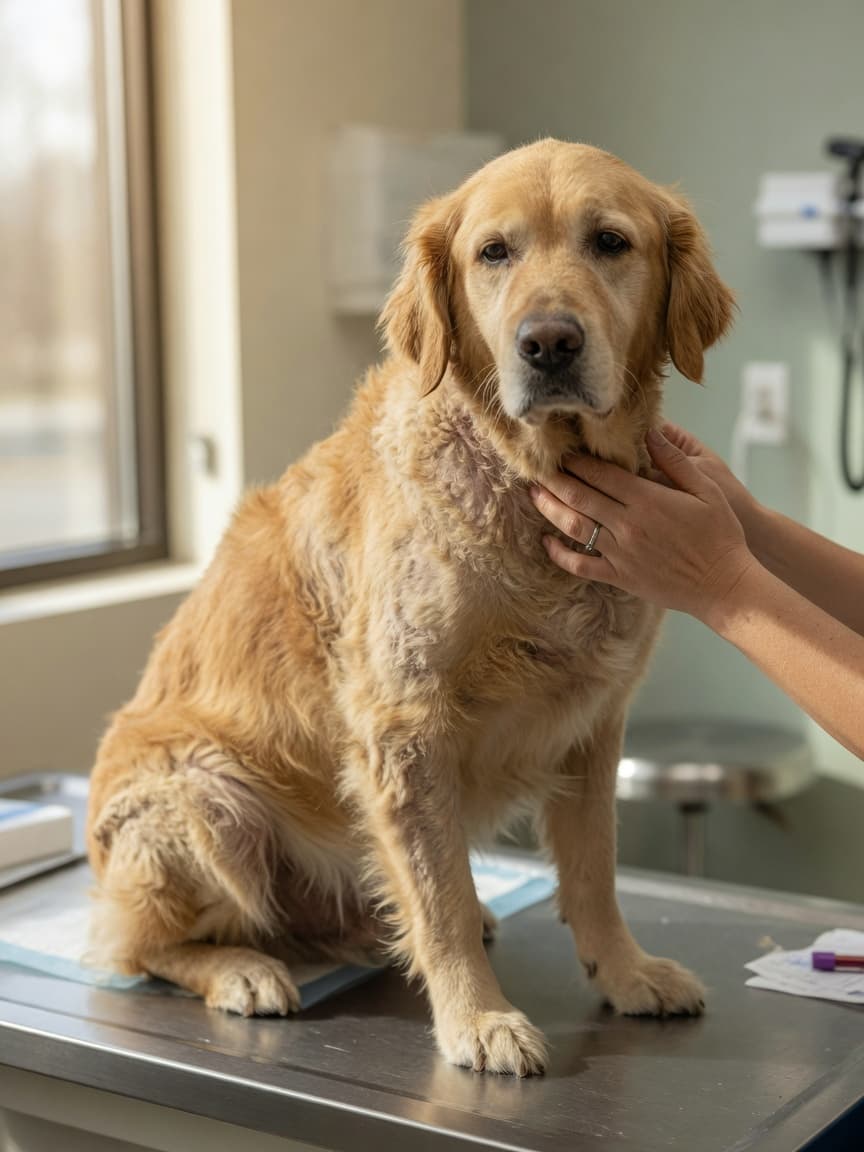
What Is Hypothyroidism?
Hypothyroidism is the most commonly diagnosed endocrine disorder in dogs, occurring when the thyroid gland fails to produce sufficient thyroid hormone — primarily thyroxine (T4) and triiodothyronine (T3). These hormones regulate metabolism throughout the body, influencing everything from heart rate and body temperature to skin cell turnover and energy utilisation. When thyroid hormone levels fall below normal, virtually every organ system is affected, resulting in a gradual, insidious decline that can be easy to overlook or attribute to ageing.
In dogs, the vast majority of cases — approximately 95% — result from primary hypothyroidism caused by immune-mediated destruction of thyroid tissue (lymphocytic thyroiditis) or idiopathic atrophy of the gland. Secondary hypothyroidism due to pituitary disease is rare. The condition primarily affects middle-aged dogs (typically four to ten years old), and neutered animals appear to be at slightly higher risk.
Breeds Most Commonly Affected
While hypothyroidism can occur in any breed, certain medium to large breeds are significantly overrepresented:
- Golden Retriever
- Dobermann Pinscher
- Irish Setter
- Great Dane
- Cocker Spaniel
- Airedale Terrier
- Boxer
- English Setter
Dobermanns and Golden Retrievers in particular have a well-documented hereditary predisposition to lymphocytic thyroiditis. ECVIM-CA (European College of Veterinary Internal Medicine — Companion Animals) guidance notes that breed-specific reference ranges for thyroid hormones may be relevant in some cases, as certain breeds tend to have lower baseline thyroid hormone concentrations.
Clinical Signs: Recognising the Subtle Decline
Because thyroid hormones regulate metabolism, hypothyroidism produces a pattern of slowed, low-energy signs. Owners often notice these changes gradually over months:
- Lethargy and mental dullness: the dog tires easily, is reluctant to exercise, and may seem less interested in its surroundings — sometimes described as a personality change
- Weight gain without increased appetite: a hallmark finding; the dog gains weight despite no change — or even a reduction — in food intake
- Cold intolerance: seeking warmth, reluctance to go outside in cool weather, shivering inappropriately
- Skin and coat changes: the coat becomes dull, brittle, and sparse; the skin thickens (myxoedema) and may develop a scaly texture; bilaterally symmetrical hair loss, often starting over pressure points and the flanks
- Tragic facial expression (myxoedema): accumulation of glycosaminoglycans in the skin produces a thickened, puffy appearance particularly over the forehead, giving the dog a sad or droopy look
- Reproductive abnormalities: prolonged or absent oestrus cycles in females; reduced libido in males
- Bradycardia: a slower than normal heart rate is occasionally detected on examination
- Peripheral neuropathy: less common, but some hypothyroid dogs develop muscle weakness, ataxia, or facial nerve paralysis
It is worth noting that no single sign is pathognomonic for hypothyroidism — the diagnosis rests on a combination of clinical findings, breed, and laboratory results interpreted together.
Diagnosis: Understanding the Tests
Thyroid hormone testing in dogs requires careful interpretation, as many illnesses and medications — particularly glucocorticoids, phenobarbital, sulphonamides, and NSAIDs — can suppress thyroid hormone concentrations, causing "euthyroid sick syndrome" that mimics hypothyroidism. Testing a sick dog or a dog receiving these medications may yield falsely low results.
The diagnostic pathway typically involves:
- Total T4 (TT4): the initial screening test. A value within the normal reference range effectively rules out hypothyroidism. A low value requires further investigation, as it does not confirm the diagnosis on its own.
- Free T4 by equilibrium dialysis (fT4 ED): considered more specific than total T4 because it measures the biologically active fraction of thyroxine. Less influenced by concurrent illness or medication, though not entirely immune to these effects.
- Canine TSH (cTSH): thyroid-stimulating hormone rises when the pituitary attempts to stimulate a failing thyroid. An elevated cTSH alongside low TT4 or fT4 strongly supports the diagnosis. However, up to 38% of hypothyroid dogs have TSH values within the normal range, so a normal TSH does not exclude the condition.
- Thyroglobulin autoantibodies (TgAA): useful in breeding programmes and for confirming an immune-mediated aetiology, particularly in Dobermanns. Not a direct measure of thyroid function.
ECVIM-CA recommends interpreting all thyroid tests alongside the full clinical picture and, where doubt exists, conducting a therapeutic trial with levothyroxine and reassessing after four to eight weeks.
Treatment: Levothyroxine in Europe
Treatment is straightforward and highly effective: daily oral supplementation with synthetic levothyroxine (L-thyroxine, T4). In Europe, veterinary-licensed formulations include Forthyron and Soloxine, both widely available. Human-labelled levothyroxine is also used in many EU countries where veterinary formulations are not stocked by every pharmacy.
The typical starting dose is 10–22 micrograms per kilogram bodyweight, given once or twice daily. Dogs have a much higher metabolic clearance of levothyroxine than humans, which is why they require relatively higher doses. Twice-daily dosing is often recommended initially to achieve stable blood levels, with some dogs maintained on once-daily dosing long term.
Improvement in clinical signs is usually noticeable within four to eight weeks, with skin and coat changes sometimes taking several months to fully resolve.
Monitoring Thyroid Levels
The first recheck is usually four to eight weeks after starting treatment. A post-pill T4 level is measured four to six hours after the morning dose to confirm levels are within the therapeutic range (typically 30–70 nmol/L, though this varies by laboratory). Dose adjustments are made accordingly. Once stable, twice-yearly monitoring is generally recommended. Owners should also report any signs of over-supplementation — panting, restlessness, polydipsia, or weight loss — as these suggest the dose may be too high.
Diet and Quality of Life
Many hypothyroid dogs present overweight. Weight loss follows naturally as thyroid hormone levels normalise with treatment, but a calorie-controlled diet during treatment helps accelerate this. Zooplus carries a wide range of high-quality weight-management and senior dog foods that provide appropriate nutrition without excess calories — useful while your dog's metabolism recalibrates. Regular, gentle exercise also supports weight management and general wellbeing.
Hypothyroidism is a lifelong condition, but with consistent daily medication it is eminently controllable. Most dogs treated appropriately enjoy an excellent quality of life with a normal lifespan.
Written by Julia Wrenfield