
Dog Heartworm: Prevention, Testing & What Treatment Involves
By Julia Wrenfield, Pet Wellness Researcher
Heartworm disease (Dirofilaria immitis) is one of the most serious and potentially fatal parasitic infections affecting dogs. Named for the adult worms that live in the heart, pulmonary arteries, and adjacent blood vessels of infected dogs, heartworm causes progressive cardiovascular and pulmonary damage that, without treatment, leads to heart failure and death. Understanding the disease's lifecycle explains why prevention is so critical — and why treatment is so demanding.
Heartworm Lifecycle: A Mosquito-Dependent Chain
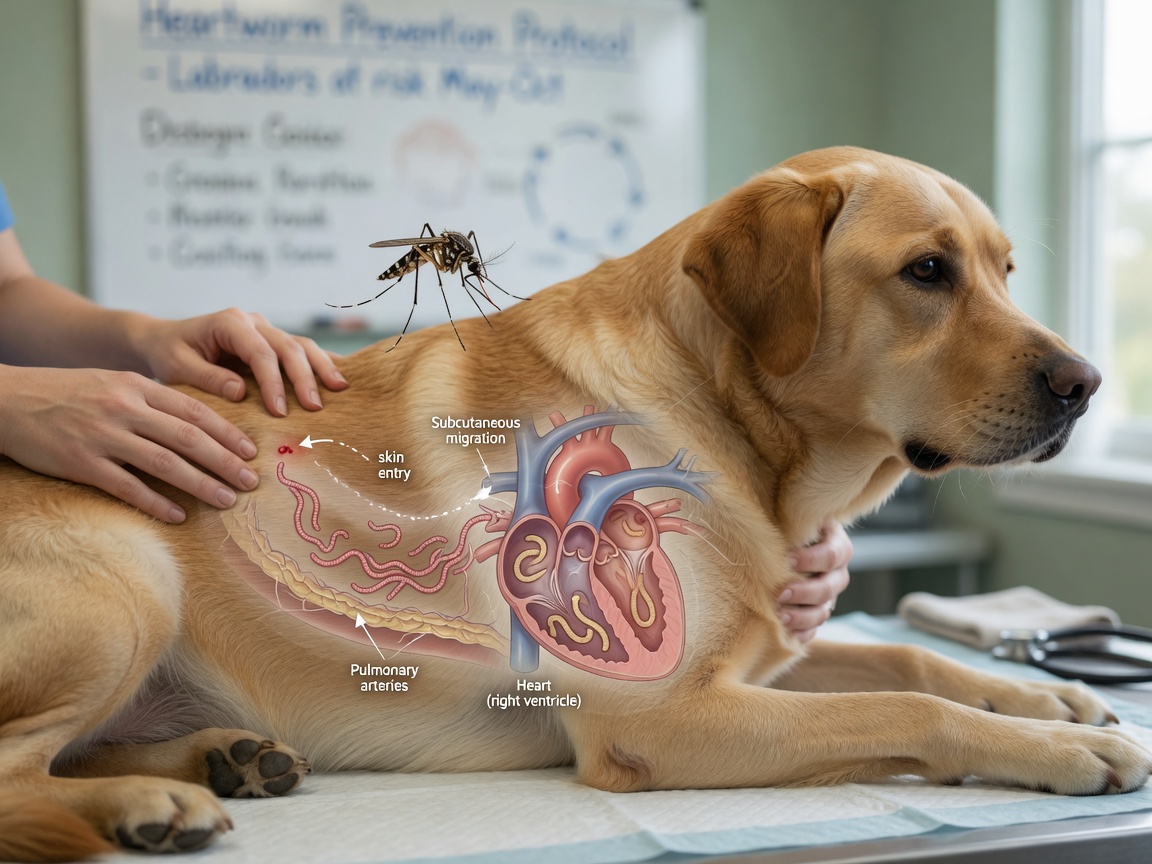
Heartworm transmission requires a mosquito intermediate host. Without mosquitoes, the parasite cannot complete its lifecycle and spread between dogs. This biological fact explains the geographic distribution of heartworm and guides prevention strategies.
- Microfilariae in blood: An infected dog circulates first-stage larvae (microfilariae, or L1) in the bloodstream. These are produced by adult female worms already living in the dog's heart and vessels.
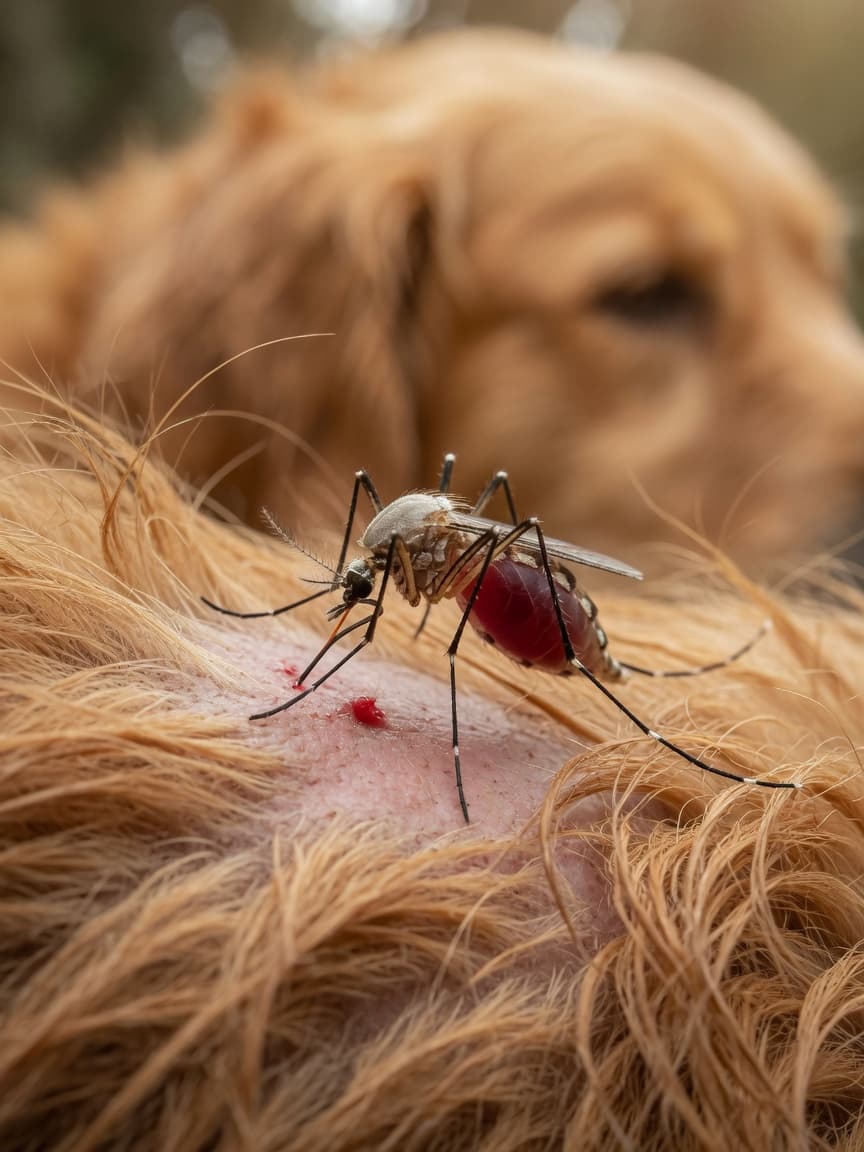
- Mosquito uptake: When a female mosquito feeds on the infected dog, she ingests microfilariae along with blood. Inside the mosquito, larvae develop through stages L1 → L2 → L3 over approximately 10–14 days (temperature-dependent; development is faster in warmer climates).
- Transmission: When the infected mosquito feeds on a new host dog, infective L3 larvae are deposited on the skin and enter through the bite wound.
- Migration and maturation: Over 6–7 months, larvae migrate through subcutaneous tissue and eventually reach the pulmonary arteries and right side of the heart, maturing into adult worms (L3 → L4 → L5 → adult). Adult worms can reach 15–30 cm in length.
- Reproduction: Adult worms mate and females produce microfilariae, completing the cycle. Adult worms can live 5–7 years inside a dog.
Because the pre-patent period (time from infection to detectable adults) is 6–7 months, a dog can be infected for many months before testing positive on a standard antigen test — a key consideration for diagnosis and prevention timing. Research published in Parasites & Vectors (PubMed) provides comprehensive detail on heartworm epidemiology and the impact of climate on mosquito vector range.
Geographic Distribution and Emerging Risk in Europe
Heartworm is endemic in the southern United States (where the American Heartworm Society estimates millions of dogs are infected annually), South America, the Mediterranean basin (Italy, Spain, Portugal, southern France, Greece), and parts of Asia and Australia. However, climate change is facilitating northward expansion of both the mosquito vectors and the parasite itself.
In Europe, dogs in Italy, Spain, Portugal, and southeastern France face significant risk. Dogs travelling from northern Europe to these regions for holidays represent an increasingly important route of exposure — and on return, can introduce microfilariae into local mosquito populations, though sustained transmission in cooler northern climates remains limited by temperature requirements for larval development. The ESCCAP risk maps are the most current reference for European heartworm distribution.
A 2024 report by The Guardian highlighted expert warnings that heartworm's European range is expanding as mosquito season lengthens across southern and central Europe.
Clinical Signs of Heartworm Disease

The American Heartworm Society classifies heartworm disease into four classes based on severity:
- Class I (Mild): No clinical signs or only mild cough. Worm burden is typically low.
- Class II (Moderate): Occasional cough, mild exercise intolerance, abnormal lung sounds on auscultation.
- Class III (Severe): Exercise intolerance, persistent cough, difficulty breathing, syncope (fainting), signs of right-sided heart failure including abdominal fluid accumulation (ascites).
- Class IV (Caval Syndrome): Life-threatening; large worm burden obstructs blood flow through the heart. Dogs present collapsed, with haemoglobin in urine, cardiovascular shock. Surgical worm removal is the only option; mortality is high.
Early-stage infection is often clinically silent — dogs show no external signs despite having worms in their cardiovascular system. This makes routine testing essential in endemic areas.
Testing: When and How
The standard heartworm test is a blood antigen test that detects proteins produced by adult female worms. The AVMA recommends:
- Annual testing for all dogs in endemic areas, even those on prevention.
- Testing before starting preventatives in dogs of unknown history.
- Testing 6–7 months after a gap in preventative coverage (the pre-patent period means worms acquired during the gap will not yet test positive immediately).
- Microfilaria testing (blood smear or filter concentration test) alongside antigen testing, as some infections are "occult" (antigen positive but microfilaria negative due to immune complex formation or single-sex infections).
Treatment: What to Expect
Treating an established heartworm infection is a complex, months-long process with significant patient management requirements:
- Stabilisation: Dogs with moderate to severe disease require exercise restriction, anti-inflammatories, and sometimes diuretics to manage heart failure before adulticide treatment begins.
- Doxycycline pre-treatment: A 4-week course of doxycycline targets Wolbachia, an intracellular bacterium that lives within heartworms. Eliminating Wolbachia before killing adult worms reduces the severity of inflammatory reactions during worm die-off.
- Melarsomine (adulticide): An arsenic-based injectable drug administered in a specific 3-dose protocol into the lumbar muscles. This kills adult worms over several weeks.
- Strict exercise restriction: As worms die, they are absorbed by the immune system and pulmonary vasculature. Dead worm fragments can cause potentially fatal pulmonary embolism, particularly if the dog's heart rate increases. Dogs must be cage-rested or strictly leash-only for 6–8 weeks following adulticide treatment. This is one of the most challenging aspects of treatment for active dogs.
- Follow-up testing: Antigen retesting at 6 months post-treatment confirms successful worm elimination.
Treatment costs, depending on the dog's size and disease severity, can run into hundreds to thousands of pounds or euros. Complications are possible. Dogs that survive treatment often have lasting cardiovascular changes.
Prevention: Safe, Simple, and Essential
Preventatives work by killing the larvae that mosquitoes deposit before they mature into adults. They are administered monthly (or in some cases bi-monthly or annually) and are extremely safe when given to heartworm-negative dogs. Common preventatives include:
- Ivermectin-based monthly chews (Heartgard, generic equivalents)
- Milbemycin oxime-based products (Interceptor, Milbemax)
- Moxidectin (ProHeart injectable — provides 6- or 12-month coverage)
- Combination products that also address fleas, ticks, and intestinal worms
Critically: never administer heartworm preventatives to a dog that has not been tested and confirmed negative. Giving a preventative to a microfilaraemic dog can trigger severe, potentially fatal anaphylactic-like reactions as the drug rapidly kills large numbers of circulating microfilariae. Always test before starting prevention in unprotected dogs.
Key Takeaways
- Heartworm (Dirofilaria immitis) requires a mosquito intermediate host; the lifecycle from infection to detectable adults takes 6–7 months.
- The disease is endemic in southern Europe (Italy, Spain, Portugal), the US South, and expanding northward with climate change.
- Early infection is clinically silent — annual testing is essential for dogs in endemic areas or those that travel.
- Treatment is complex, costly, risky, and requires weeks of strict exercise restriction; prevention is dramatically preferable.
- Never give heartworm preventatives without confirming the dog is currently negative — microfilaraemic dogs can have severe reactions.