
Types of Heart Disease in Dogs
Heart disease in dogs encompasses several distinct conditions, but the two most clinically significant are myxomatous mitral valve disease (MMVD) and dilated cardiomyopathy (DCM). Understanding the difference between them helps owners of different breeds understand their individual risk and what to watch for.
Myxomatous mitral valve disease is by far the most common cardiac condition in dogs, responsible for the majority of heart disease cases presenting to veterinary practices across Europe. It involves progressive degeneration of the mitral valve — the valve between the left atrium and left ventricle — causing it to leak blood backwards with each heartbeat. Over time, the heart enlarges to compensate, and eventually congestive heart failure develops. The disease progresses slowly through a preclinical phase before symptoms emerge.
Dilated cardiomyopathy involves weakening and enlargement of the heart muscle itself, reducing the heart's ability to pump blood effectively. It is less common overall but is the predominant form of heart disease in large and giant breeds. Both conditions can progress to congestive heart failure, in which fluid accumulates in the lungs (pulmonary oedema) and/or in the abdomen and chest cavity.
Breeds Most Commonly Affected
Cavalier King Charles Spaniels have the highest prevalence of MMVD of any breed — virtually all individuals of this breed develop the condition to some degree by middle age, and the European Cavalier health initiative has established breed-specific health screening protocols in collaboration with veterinary cardiologists across the continent. Dachshunds, Chihuahuas, Maltese, and other small breeds are also commonly affected.
Dilated cardiomyopathy is most prevalent in Dobermanns, Irish Wolfhounds, Great Danes, Boxers, and Newfoundlands. The Dobermann is particularly notable for its high prevalence and the insidious nature of the disease — DCM in this breed often presents with sudden collapse or death due to arrhythmia before overt heart failure symptoms develop, making cardiac screening in breeding animals a priority. ESCCAP and breed health committees in several European countries support proactive screening programmes for high-risk breeds.
Recognising the Symptoms

The onset of symptoms marks the transition from the preclinical phase of heart disease to clinical heart disease, often referred to as congestive heart failure when fluid accumulation occurs. The most common presenting symptom is a persistent cough — typically soft and moist in character, often worse at night or after exercise, and sometimes accompanied by the dog appearing to retch or swallow repeatedly after coughing. This cough results from fluid build-up in or around the lungs putting pressure on the airways.
Exercise intolerance is another early and important sign. Owners often describe their dog as tiring more quickly on walks than before, being reluctant to climb stairs, or stopping to rest more frequently. Increased respiratory rate — particularly noticeable when the dog is resting or sleeping — is a sign of developing pulmonary oedema. A resting respiratory rate of more than 30 breaths per minute warrants veterinary contact.
Fainting (syncope) episodes, in which the dog briefly loses consciousness and collapses before recovering, can occur due to arrhythmias or severely reduced cardiac output. Abdominal distension caused by ascites — fluid accumulation in the abdomen — may be visible in some dogs with right-sided heart failure. Weight loss and muscle wasting are features of advanced heart disease. In breeds predisposed to DCM, sudden death may unfortunately be the first sign.
Diagnosis
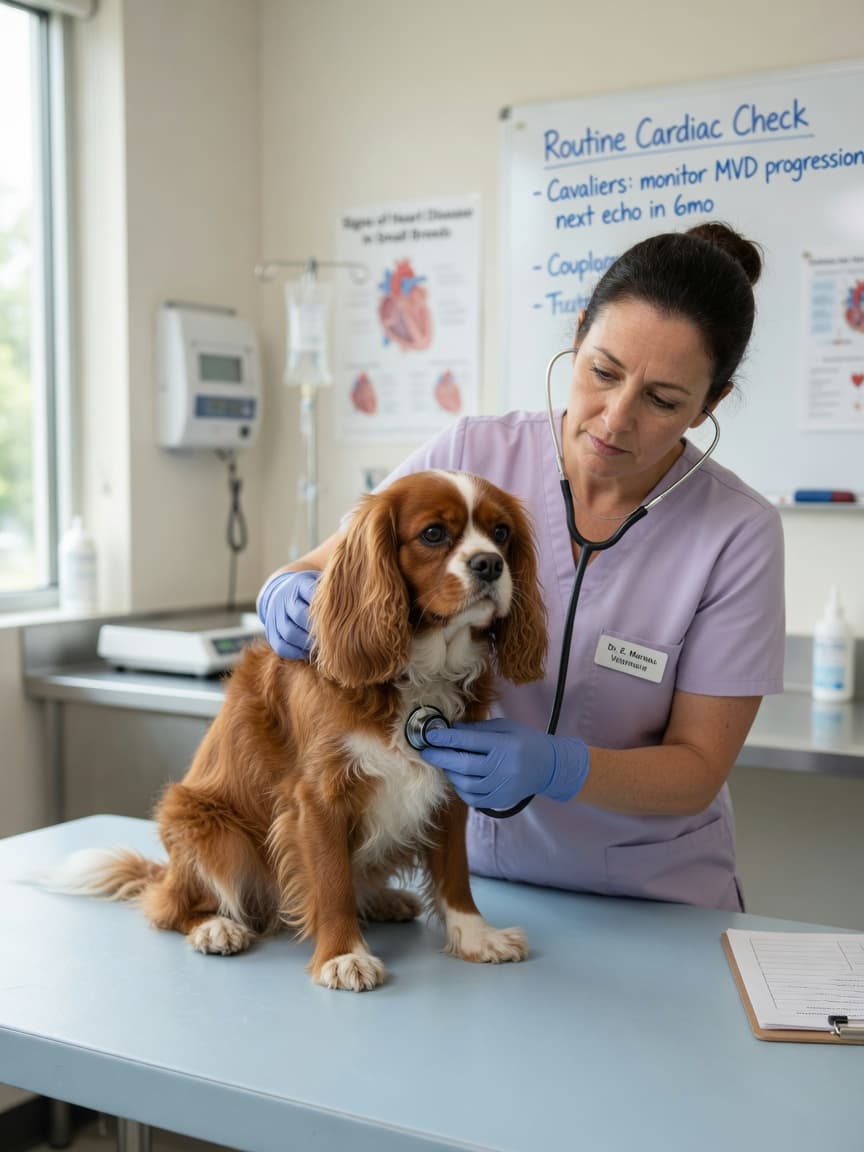
A heart murmur detected during a routine veterinary examination is often the first indication of MMVD in small breeds. Murmurs are graded on a scale of one to six based on intensity, with higher grades generally correlating with more significant disease, though grading alone cannot determine whether the heart is enlarged or how far disease has progressed.
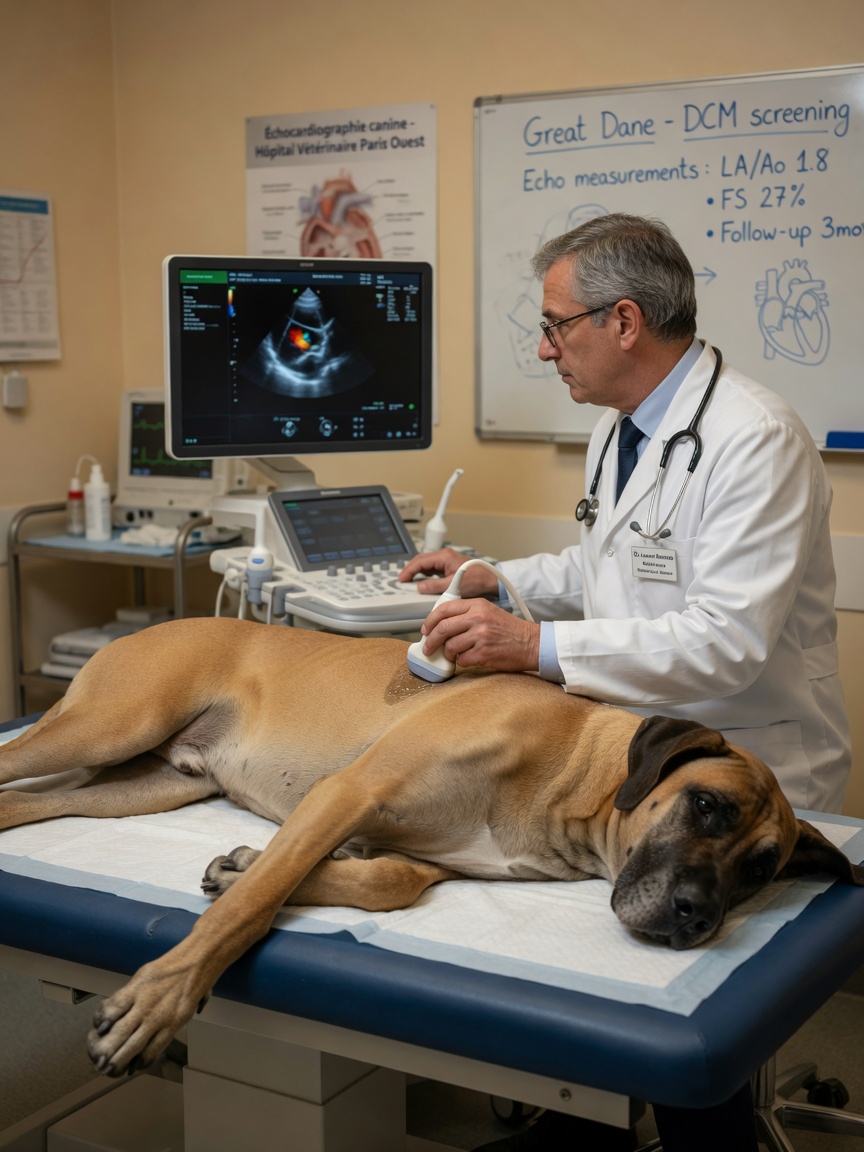
Chest radiographs (X-rays) are an important diagnostic tool, allowing the vet to assess heart size and look for signs of pulmonary oedema. Echocardiography — an ultrasound examination of the heart — is the definitive diagnostic test, providing detailed information about valve function, heart chamber dimensions, and myocardial contractility. It requires specialist equipment and is typically performed by a veterinary cardiologist or a vet with advanced training in cardiology. An electrocardiogram (ECG) may be used to detect arrhythmias, particularly relevant in Dobermanns and Boxers. Blood tests including cardiac biomarkers such as NT-proBNP and troponin are increasingly used to assess cardiac stress and guide treatment decisions.
Medication and Management
For dogs with MMVD, a landmark study called the EPIC trial demonstrated that starting pimobendan — a drug that improves cardiac contractility and causes vasodilation — before the onset of clinical signs in dogs with significant cardiac enlargement delays the onset of heart failure and extends survival. This has changed practice across Europe, with many veterinary cardiologists now recommending echocardiographic monitoring and early pimobendan treatment for dogs with preclinical disease.
Once congestive heart failure has developed, treatment typically combines pimobendan with a diuretic such as furosemide to remove excess fluid, and an ACE inhibitor such as enalapril or benazepril to reduce the heart's workload. Additional medications may be added depending on the individual dog's response and disease progression. Dogs in heart failure require regular monitoring — initially every few weeks, then every two to three months — with medication adjustments based on clinical signs, radiographic assessment, and blood tests.
Moderate, consistent exercise is beneficial for dogs with compensated heart disease, but strenuous activity and situations causing excitement or extreme heat should be avoided. A low-sodium diet helps reduce fluid retention. Zooplus and many European pet food retailers stock cardiac support diets suitable for dogs under veterinary supervision.
Living with a Dog with Heart Disease
A diagnosis of heart disease is understandably concerning, but modern veterinary cardiology has transformed the outlook for affected dogs. Many dogs live comfortably for a year or more after a diagnosis of congestive heart failure, and considerably longer when disease is identified in the preclinical phase. Open communication with your veterinary team, attentive monitoring at home, and adherence to the prescribed medication regimen give your dog the best possible chance of a comfortable life.