

What Are Bladder Stones in Dogs?
Bladder stones, medically known as uroliths or urolithiasis, are hard mineral deposits that form in a dog's urinary bladder. They can range in size from tiny grains of sand to large, smooth structures several centimetres in diameter, and they can cause significant pain, urinary obstruction, and damage to the bladder lining. Bladder stones are among the more commonly diagnosed urological conditions in dogs across Europe, and their management has advanced considerably in recent years thanks to improved diagnostics and targeted dietary therapies.
Understanding the type of stone involved is essential, as different stone compositions require very different treatment approaches. The most common types seen in European dogs are struvite, calcium oxalate, and urate stones, each with distinct causes, risk factors, and preferred treatment strategies.
Types of Bladder Stones
Struvite Stones
Struvite stones, composed of magnesium ammonium phosphate, are the most frequently diagnosed type in dogs across the EU. In the vast majority of cases, they form in association with a urinary tract infection (UTI) caused by bacteria that produce urease — an enzyme that breaks down urea in the urine and raises its pH, creating conditions ideal for struvite crystal formation. Female dogs are significantly more prone to struvite stones because their shorter, wider urethras make them more susceptible to ascending bacterial infections. Cocker Spaniels, Miniature Schnauzers, Bichon Frises, and Shih Tzus are among the breeds with higher reported rates.
Calcium Oxalate Stones
Calcium oxalate stones are the second most common type in dogs and, unlike struvite stones, are not typically associated with infection. They are more common in older, neutered male dogs and in breeds including Miniature Schnauzers, Yorkshire Terriers, Lhasa Apsos, Maltese, and Miniature Poodles. These stones form when urine contains excessive levels of calcium and oxalate, and they cannot be dissolved through dietary management alone — a key distinction from struvite stones. Recurrence rates are relatively high for calcium oxalate stones, making long-term prevention strategies particularly important.
Urate Stones
Urate stones are most commonly seen in Dalmatians due to a unique genetic metabolism of purines that leads to higher-than-normal excretion of uric acid in the urine. They can also occur in dogs with portosystemic shunts, where reduced liver function impairs normal uric acid processing. Urate stones are softer and more amenable to dissolution diets than calcium oxalate, though management still requires close veterinary supervision.
Other Stone Types
Less commonly, dogs may develop cystine, silica, or calcium phosphate stones. Mixed-composition stones, containing more than one mineral type, also occur. Laboratory analysis of any removed stone is essential to confirm the exact composition and guide future treatment and prevention.
Recognising the Symptoms
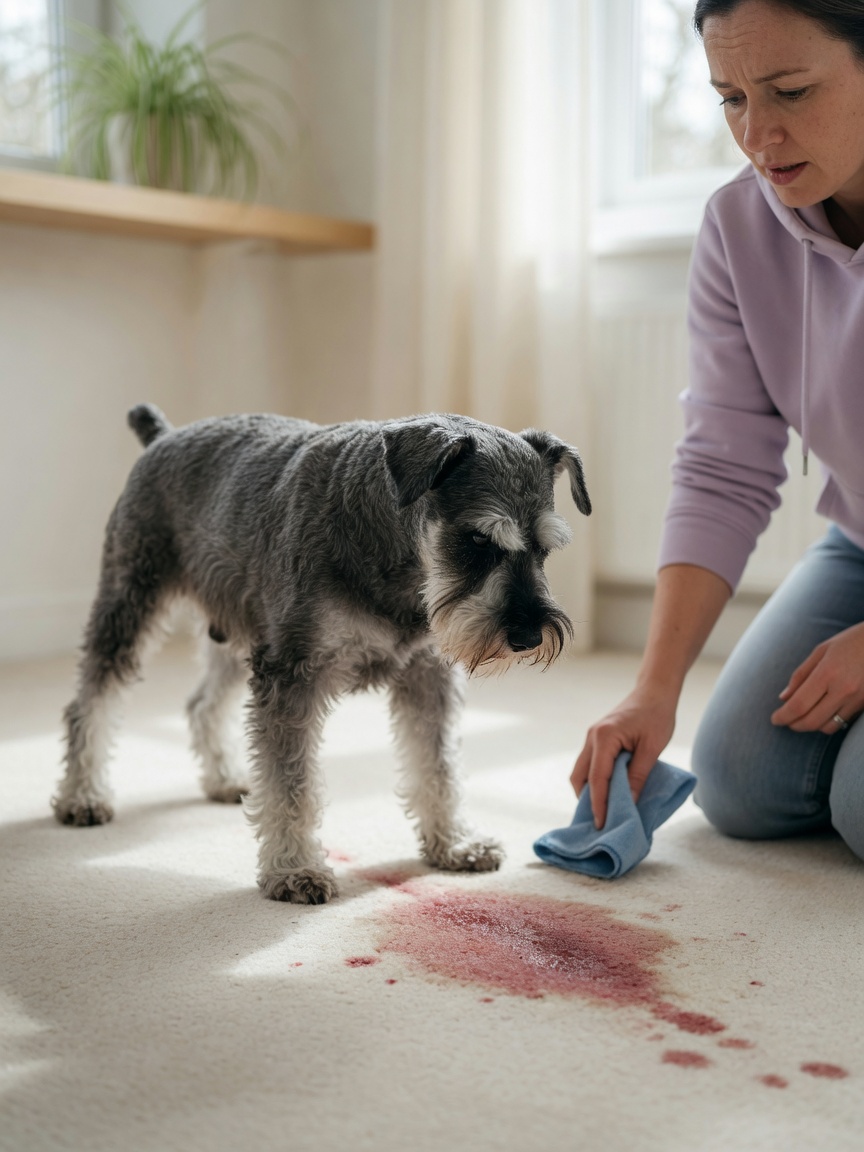
The clinical signs of bladder stones in dogs can vary depending on the size, number, and location of the stones. Common symptoms include:
- Straining to urinate: Your dog may squat or posture repeatedly with little or no urine passing. This can look similar to constipation.
- Blood in the urine (haematuria): Urine may appear pink, red, or brown. This occurs as the stones abrade the bladder lining.
- Frequent urination in small amounts: The dog may urinate more often than usual but produce only small quantities each time.
- Crying out or showing discomfort during urination: Particularly noticeable in cases where stones are causing significant irritation or partial obstruction.
- Licking at the genital area: Dogs may lick excessively in response to urinary discomfort.
- Urinary accidents indoors: A previously house-trained dog may begin having accidents due to urgency or inability to hold urine.
- Lethargy and loss of appetite: More pronounced in severe cases, particularly where obstruction has led to back-pressure on the kidneys.
A complete urinary obstruction — most common in male dogs, whose urethra is longer and narrower — is a medical emergency requiring immediate veterinary attention. A dog that cannot pass any urine at all should be seen by a vet without delay.
Diagnosis

Diagnosis of bladder stones typically involves a combination of diagnostic tools:
- Physical examination: In some cases, large stones can be felt by palpation of the abdomen.
- X-ray (radiography): Most struvite and calcium oxalate stones are radio-opaque and will show up clearly on plain abdominal X-rays. Urate and cystine stones are less visible on X-ray.
- Ultrasound: Ultrasonography can detect stones of all compositions, assess the bladder wall for thickening or masses, and evaluate the kidneys for secondary changes. It is often used alongside X-rays for a complete picture.
- Urinalysis: Examination of urine under a microscope can reveal crystals consistent with the stone type. Culture and sensitivity testing of a urine sample is essential if infection is suspected.
- Stone analysis: Any stones retrieved — whether surgically or by other means — should be sent for laboratory analysis to confirm their exact mineral composition.
Treatment Options
Dissolution Diet
Struvite stones in dogs can often be dissolved through a prescription dissolution diet designed to acidify the urine and reduce the levels of magnesium, ammonium, and phosphate that feed stone growth. If an underlying infection is present, concurrent antibiotic therapy is essential. Stone dissolution typically takes four to twelve weeks and requires regular monitoring through X-rays or ultrasound. Your vet will prescribe the appropriate veterinary diet; leading veterinary nutrition brands stock dissolution formulas that can also be found through online retailers such as Zooplus.
Urohydropropulsion
This non-surgical technique is used to flush small stones out of the bladder through the urethra using flushing fluid administered under sedation. It is a useful option for small struvite stones, particularly in female dogs where the urethra is wide enough to allow stone passage.
Surgical Removal (Cystotomy)
For stones that cannot be dissolved or flushed — including calcium oxalate stones and large struvite stones — surgical removal via cystotomy (opening of the bladder) remains a reliable and commonly performed treatment across European veterinary practices. The procedure is straightforward and carries a good prognosis when performed by an experienced surgeon. All removed stones should be submitted for laboratory analysis.
Laser Lithotripsy
Available at specialist referral centres in several EU countries, laser lithotripsy uses a scope-guided laser to fragment stones within the bladder or urethra without open surgery. It is particularly useful for stones lodged in the urethra.
Prevention: Diet, Hydration and Monitoring
Preventing recurrence is one of the most important aspects of managing bladder stones, as they commonly return without ongoing management. Key preventive strategies include:
- Increased water intake: Dilute urine is less likely to form crystals. Encourage your dog to drink more water by providing multiple water stations, using a pet water fountain, or transitioning to wet food. Adding water or low-sodium broth to dry food is also helpful.
- Prescription prevention diets: Long-term maintenance diets formulated to maintain appropriate urine pH and mineral levels are essential for many stone-forming dogs. Zooplus stocks a range of urinary health diets from reputable brands suitable for long-term use.
- Regular urinalysis: Routine urine testing every three to six months allows your vet to catch early crystal formation before stones develop.
- Treating urinary infections promptly: For dogs prone to struvite stones, swift treatment of any UTI is essential to prevent the bacterial environment that promotes stone formation.
- Routine imaging: Annual X-rays or ultrasound checks are advisable for high-risk individuals to detect early recurrence.
With attentive management and close collaboration with your veterinary team, most dogs with a history of bladder stones can lead comfortable, healthy lives with significantly reduced risk of recurrence.