
How Cats Domesticated Themselves: 10,000 Years of History
By Julia Wrenfield, Pet Wellness Researcher
There is a popular joke that dogs were domesticated by humans, but cats domesticated humans. Like many jokes, it contains more truth than it might appear. The genomic, archaeological, and behavioral evidence now strongly supports the idea that cats — uniquely among our major domestic species — largely chose to enter the human world, and did so on terms that suited them. Understanding how this happened tells us something fascinating not only about cats, but about the nature of domestication itself.
The story begins approximately 10,000 years ago, in the Fertile Crescent of the ancient Near East, and it is a story shaped as much by grain as by genetics.
The Agricultural Revolution and the Rodent Problem
When Neolithic humans transitioned from nomadic hunter-gatherer lifestyles to settled agriculture, they created something that had never existed before in the history of mammalian ecology: permanent, large-scale grain storage. Granaries were a revolutionary technology — but they attracted an unwanted guest. Mice and rats, following their own ecological opportunism, flooded into human settlements wherever food was stored.
Wild cats, already accomplished rodent hunters, followed their prey. The Fertile Crescent was home to Felis silvestris lybica, the African wildcat — a species closely related to today's domestic cat and, critically, one that tolerates human proximity rather better than most wild felids. As these cats moved into villages and granaries, they provided an enormously valuable service: pest control. And humans, pragmatically, tolerated or even encouraged them.
This mutual arrangement required no active breeding program, no selection pressure applied by human hands. The cats that were least fearful of humans thrived in this niche; the humans who were most tolerant of cats suffered fewer grain losses. Over generations, natural selection did the rest.
The Genetic Evidence
The genomic picture of cat domestication has been substantially clarified over the past two decades. A landmark study published in Nature by Driscoll and colleagues analyzed the mitochondrial DNA of 979 domestic cats and wildcats from across the Old World, tracing the origins of all domestic cats to a relatively small founding population of Felis silvestris lybica from the Near East.
What made this study particularly striking was the date: the divergence between domestic cat lineages and their nearest wild relatives occurred approximately 10,000 to 12,000 years ago — precisely coinciding with the emergence of agriculture in the Fertile Crescent. The cats did not come first; the grain did.
As Science Daily reported on subsequent genomic research, a second wave of cat domestication may also have occurred in China, where a different wildcat species — Felis silvestris bieti — shows evidence of early association with human settlements. However, the Near Eastern lineage proved more successful globally, and modern domestic cats worldwide trace primarily to those Fertile Crescent ancestors.
The Egyptian Connection
While cats first entered the human world in the Near East, it was in Egypt that the relationship deepened most dramatically. Egyptian civilization, which arose roughly 5,000 years ago along the Nile, brought cats into a new role: from tolerated pest controllers to active cultural icons.
The Egyptians venerated cats in ways that went far beyond practical utility. The goddess Bastet was depicted with a cat's head; killing a cat, even accidentally, was a capital offense under certain periods of Egyptian law. Cats were mummified and offered as religious gifts. This reverence, combined with Egypt's role as a Mediterranean trading hub, accelerated the spread of domestic cats across the ancient world.
As National Geographic describes, genetic studies can actually track the spread of cat lineages through ancient trade routes. Egyptian cat genetics appear in samples from across the Roman Empire, suggesting that cats spread globally not through a single domestication event but through a combination of Near Eastern origins and Egyptian-mediated dispersal.
What Domestication Changed — and Didn't Change
Compared to dogs, cats show surprisingly few genomic signatures of domestication. Where dog genomes have been substantially remodeled by thousands of years of selective breeding — producing extreme variation in size, coat type, skull shape, and behavior — domestic cat genomes differ from wildcat genomes in relatively subtle ways.
The most significant domestication-related changes in cats involve genes associated with fear response, reward processing, and memory. Domestic cats are less fear-reactive to human presence than their wild counterparts; they show enhanced ability to associate pleasant stimuli (food, affection) with human contact; and they appear to have enhanced working memory for spatial navigation — a trait that may have been selected for in animals navigating complex human environments.
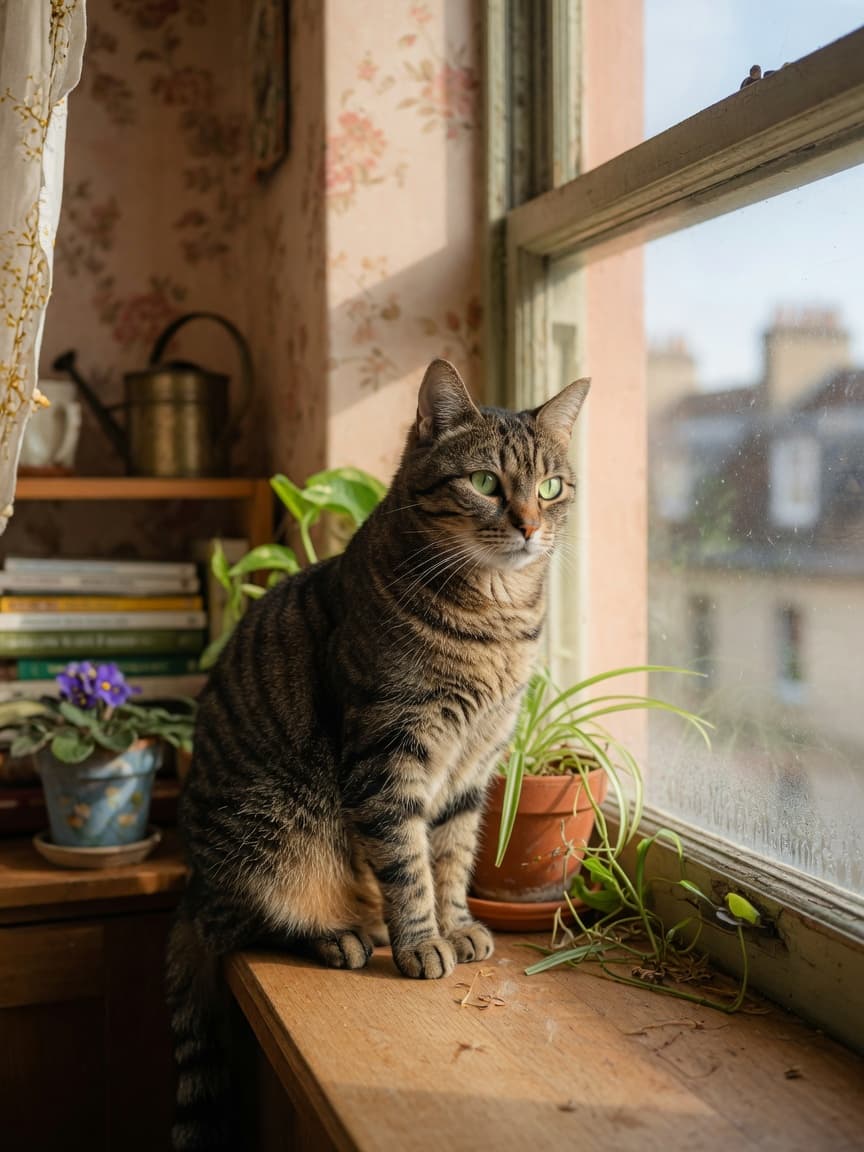
Coat color variation — the tortoiseshells, tabbies, calicos, and solid colors we associate with domestic cats — is actually a relatively late development, appearing in the archaeological record most prominently during the medieval period. The first domestic cats were, in appearance, virtually identical to the striped tabbies that still appear today as the ancestral pattern. The diversity of modern cat coats reflects human aesthetic preferences applied over the past thousand or so years — a blink of an eye in evolutionary terms.
The BBC reported on a comprehensive ancient DNA study examining cat remains from sites across Europe, Africa, and the Middle East spanning thousands of years. The results confirmed that domestic cat genetics remained remarkably stable over most of recorded history — consistent with an animal that lived alongside humans without being actively shaped by them in the way livestock were.
The Cat's Independent Streak: Not a Bug, but a Feature
The self-domestication theory helps explain something that every cat owner knows from personal experience: cats are not fully domesticated in the way that dogs are. They retain a degree of behavioral independence that no amount of selective breeding over 10,000 years has entirely eliminated. They hunt whether or not they are hungry. They form social bonds selectively rather than indiscriminately. They respond to commands situationally rather than reflexively.
These are not failures of domestication. They are features of an animal that domesticated itself on its own terms, retaining those aspects of wildcat behavior that serve it well and modifying only those aspects — primarily fearfulness of humans — that were necessary to exploit the new ecological niche of human settlement.
As the RSPCA notes in its welfare guidance, understanding the cat's evolutionary history is directly relevant to its care. Cats remain semi-solitary animals with strong predatory instincts and territorial needs. They need environmental enrichment that allows expression of hunting behavior; they need control over social interactions; they need the ability to retreat and have personal space. These are not whims or behavioral problems — they are the behavioral inheritance of 10,000 years of a very particular kind of evolution.
Implications for Modern Cat Ownership
The domestication history of cats has practical implications for how we house, feed, and interact with them. Because cats are, in evolutionary terms, obligate solitary hunters adapted to eating multiple small meals daily, feeding large meals twice a day may not suit their physiology or psychology as well as puzzle feeders, scatter feeding, or timed dispensers that better approximate their natural feeding pattern.
Because cats did not evolve in multi-individual social groups the way dogs did, introducing multiple cats to a household requires careful management of territory and resources. The stress of cohabitation with unwanted social companions is one of the leading welfare concerns in domestic cat populations today.
And because the domestic cat's bond with humans is real but differently structured than the dog's — built on mutual benefit rather than pack loyalty — the cat's expressions of affection deserve to be read on their own terms. A cat that sits near you but not on you, that blinks slowly in your direction, that brings you gifts from its hunting expeditions — these are genuine expressions of connection from an animal that, unlike your dog, had the evolutionary option of simply walking away.
Looking for quality pet nutrition? Zooplus offers Europe's widest range of science-backed pet food and supplements, with free delivery on orders over €29. Shop now →
Key Takeaways
- Cats are unique among domestic animals in having largely initiated their own domestication by entering human agricultural settlements voluntarily.
- All domestic cats trace their lineage to Felis silvestris lybica, the Near Eastern wildcat, approximately 10,000 years ago.
- The spread of cats globally was accelerated by ancient Egyptian culture, which venerated cats and traded widely across the Mediterranean.
- Domestic cat genomes show far fewer domestication-related changes than dogs — only key modifications to fear response and reward processing.
- Coat color diversity in domestic cats is a recent (medieval) development; the original domestic cat looked like a striped tabby.
- Cats' behavioral independence — their hunting instincts, territorial nature, and selective sociability — is a product of self-domestication and should be respected in their care.