
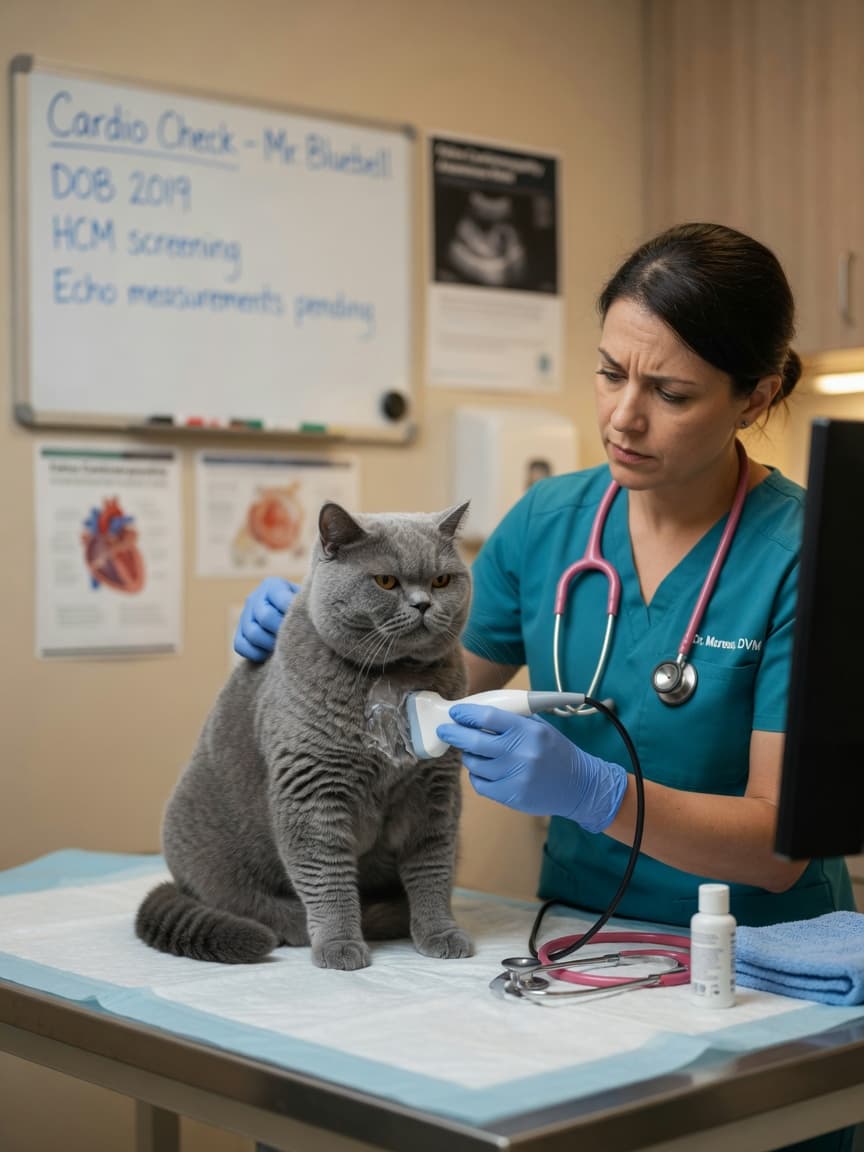
British Shorthair Health: HCM, PKD & Weight Management
- Lifespan: 12–20 years (one of the longest-lived pedigree breeds)
- Weight: 4–8 kg; obesity very common
- Key risks: HCM, Polycystic Kidney Disease (PKD), obesity, dental disease
- DNA test available: PKD1 gene mutation (mandatory in ethical breeding)
- Screening recommended: Annual echocardiogram from age 2
The British Shorthair is the archetypal British cat — stocky, plush-coated, dignified, and endearingly laid-back. With a history stretching back to the Roman occupation of Britain, this breed has been selectively developed for robustness and longevity, and in many respects it lives up to that reputation. However, several inherited and lifestyle-related conditions pose real risks. Understanding them allows owners to make informed choices and give their British Shorthair the healthiest possible life across what can be a remarkably long lifespan of 12–20 years.
Hypertrophic Cardiomyopathy (HCM)
As in many pedigree cat breeds, Hypertrophic Cardiomyopathy is the most clinically significant hereditary disease in British Shorthairs. HCM causes the muscular walls of the heart's left ventricle to thicken, reducing cardiac output and — in advanced cases — triggering congestive heart failure, pleural effusion (fluid around the lungs), and aortic thromboembolism (blood clots that can cause sudden paralysis of the hindlimbs).
The specific gene mutations driving HCM in British Shorthairs have not been as clearly defined as in Maine Coons or Ragdolls (where MYBPC3 mutations are well characterised), which means DNA testing has limited utility in this breed. The primary monitoring tool remains the echocardiogram — an ultrasound scan performed by a veterinary cardiologist. Annual echocardiograms from age 2 are strongly recommended. Cats diagnosed early can be managed with medications including atenolol, furosemide, and clopidogrel depending on disease stage, significantly improving quality of life and survival time.
Polycystic Kidney Disease (PKD)
Polycystic Kidney Disease is a hereditary condition in which fluid-filled cysts develop within the kidneys from birth. Over time, these cysts grow and multiply, gradually replacing normal kidney tissue. The disease is caused by a mutation in the PKD1 gene and is inherited in an autosomal dominant pattern — meaning a single copy of the mutation from one parent is sufficient to cause the disease.
The good news is that a reliable DNA test is available for the PKD1 mutation. Ethical breeders test all breeding cats and will not mate two affected individuals. If you are acquiring a British Shorthair kitten, ask the breeder for documented PKD1 DNA test results for both parents — this is non-negotiable.
Cats with PKD may not show clinical signs until middle age, when the cysts have grown large enough to significantly impair kidney function. Signs include increased thirst and urination (PU/PD), weight loss, vomiting, and lethargy. There is no cure, but chronic kidney disease (CKD) management — including renal prescription diets, phosphate binders, subcutaneous fluids, and anti-nausea medications — can maintain quality of life for years. Annual blood and urine screening from age 3 allows early detection of declining renal function.
Obesity: The Most Preventable Health Risk
If HCM and PKD are the hereditary threats, obesity is the self-inflicted one — and it may be the most common health problem British Shorthairs face in real households. This breed has a naturally low activity level, a muscular-but-compact frame that makes weight gain easy to overlook under that dense plush coat, and an appetite that shows no natural self-regulation. Neutered British Shorthairs in particular are at extreme risk.
Obesity in this breed accelerates joint degeneration, worsens cardiac strain (which, given the HCM risk, can be genuinely dangerous), promotes diabetes mellitus, and shortens lifespan measurably. A healthy adult British Shorthair should have a visible waist when viewed from above and ribs that are easily palpable but not visible. If you are feeling thick fat pads before reaching the ribs, your cat is overweight.
Practical weight management strategies include: measuring every meal with kitchen scales rather than estimating; dividing the daily ration into three or four small meals spread across the day to reduce hunger; using puzzle feeders to slow eating and increase cognitive engagement; and choosing a high-protein, lower-carbohydrate food specifically formulated for indoor or neutered cats. Many veterinary nutritionists recommend wet food as the primary diet for British Shorthairs because of its higher moisture content and typically lower caloric density compared to dry kibble.
Looking for a low-calorie, high-protein food for your British Shorthair? Browse indoor cat nutrition on Zooplus →
Dental Disease
British Shorthairs have relatively broad, round skulls which might suggest good dental spacing — but in practice, periodontal disease remains highly prevalent. The breed's tendency toward indoor sedentary living, combined with a preference for dry kibble in many households, contributes to plaque accumulation. Early dental disease causes pain and eating difficulties; advanced disease leads to tooth root abscesses and systemic bacterial load that can exacerbate kidney disease.
Daily tooth brushing is the gold standard. Dental treats, enzymatic gels applied to the gumline, and water additives containing chlorhexidine provide supplementary benefit. Annual professional scaling and polishing under general anaesthesia, combined with dental X-rays to assess below the gumline, should be part of every British Shorthair's preventive care plan.
Lifespan and Senior Care
With excellent preventive care, British Shorthairs can live 15–20 years. Senior cats (over age 10) should transition to biannual vet check-ups, with blood panels including kidney function, thyroid, and liver markers. This is also the age at which dental disease and CKD most commonly converge — meaning that management of one condition directly benefits the other.
Key Takeaways
- HCM is the top hereditary cardiac risk — annual echocardiograms from age 2 are the only reliable monitoring tool in this breed.
- PKD is fully preventable through DNA testing of breeding cats — always ask for PKD1 test results before buying a kitten.
- Obesity is the most common preventable problem; measure food by weight, choose high-protein wet food, and use puzzle feeders.
- Annual blood panels from age 3 catch early kidney disease before clinical signs appear.
- With proactive management, British Shorthairs can live well into their late teens.
References
- Lyons LA, et al. (2004). Feline polycystic kidney disease mutation identified in PKD1. Journal of the American Society of Nephrology. PMID: 15466260
- Paige CF, et al. (2009). Prevalence of cardiomyopathy in apparently healthy cats. Journal of the American Veterinary Medical Association. PMID: 19422319