
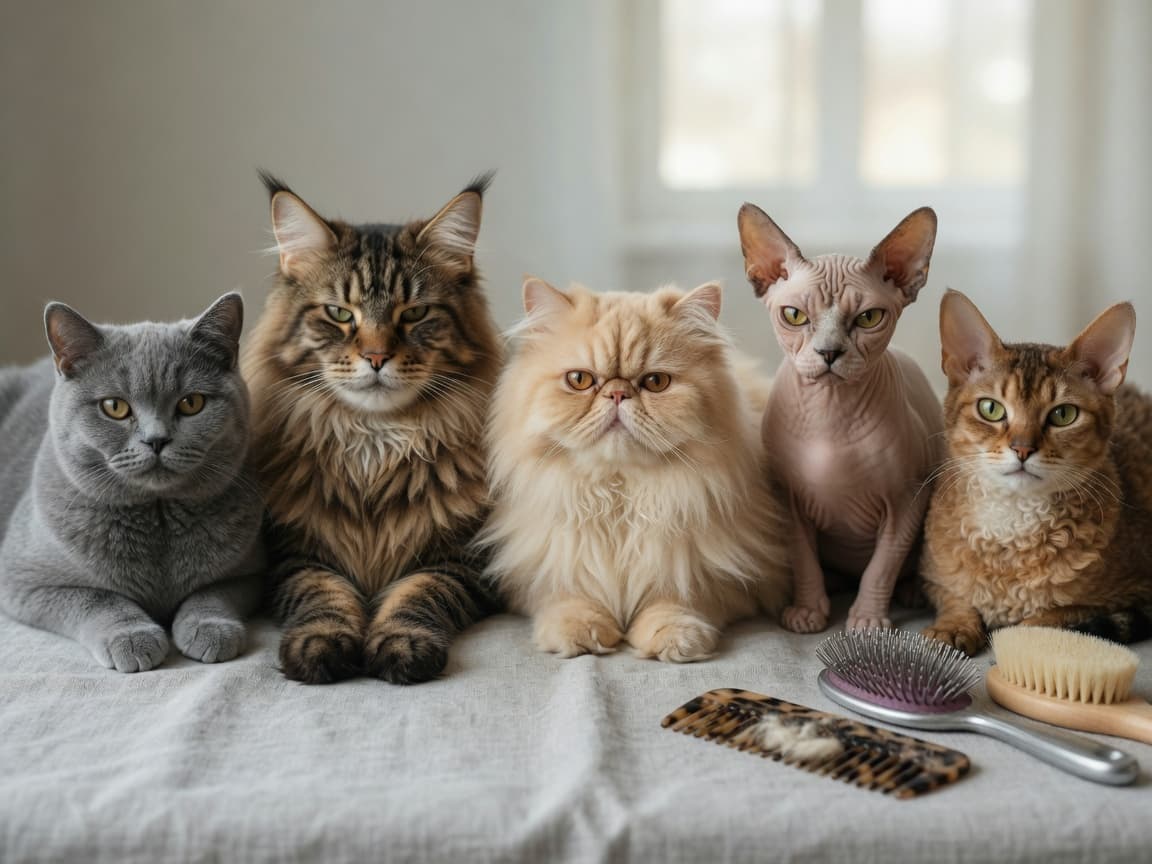
Why Cat Coat Type Matters for Grooming
Cats are famously self-sufficient groomers, but that does not mean their coats take care of themselves — at least not for all breeds. A British Shorthair and a Persian may both be domestic cats, but their grooming requirements could scarcely be more different. Understanding your cat's coat type helps you establish a grooming routine that keeps the skin and coat healthy, reduces hairball formation, and gives you a regular opportunity to check for skin problems, parasites, and lumps that might otherwise go unnoticed.
The 5 Main Cat Coat Types
1. Short Coat (British Shorthair, Siamese, Russian Blue, Burmese)
Short-coated cats are the easiest to maintain. Their dense, close-lying fur resists matting and requires minimal intervention — most short-coated cats manage very well with the grooming they do themselves, though regular brushing still provides benefits.
- Grooming frequency: Once or twice per week
- Tools needed: Rubber grooming mitt or fine-toothed comb
- Bathing needs: Rarely necessary; most short-coated cats dislike water and manage without it
- Matting risk: Very low
- Shedding level: Moderate — British Shorthairs in particular shed more than their plush coat suggests
A rubber grooming mitt used during petting sessions makes weekly brushing feel natural to the cat rather than an imposed routine, and helps collect loose fur before it ends up on your clothing.
2. Medium Coat (Maine Coon, Norwegian Forest Cat, Siberian)
Medium-coated cats carry a semi-long, often layered coat that is water-resistant in many breeds — a functional heritage from their origins in cold, wet climates. These coats are more prone to tangles than short coats, particularly around the ruff (chest and neck fur), tail, and behind the ears.
- Grooming frequency: Two to three times per week; daily during seasonal shedding
- Tools needed: Wide-toothed metal comb, slicker brush, detangling spray
- Bathing needs: Occasionally beneficial, especially for show cats or during heavy moults
- Matting risk: Moderate — check regularly around armpits and collar area
- Shedding level: High, with pronounced spring and autumn coat changes
3. Long Coat (Persian, Ragdoll, Birman)
Long-coated cats are among the most demanding in terms of grooming. The Persian is the classic example: its extraordinarily thick, flowing coat matts rapidly without daily attention. Matts that form close to the skin can be painful and, if ignored, can trap moisture, leading to skin infections. Many Persian owners opt for a "lion cut" during warmer months to reduce the grooming burden.
- Grooming frequency: Daily — this is non-negotiable for coats like the Persian's
- Tools needed: Wide-toothed comb (essential for working through knots without pulling), pin brush, matt splitter or seam ripper for established matts
- Bathing needs: Monthly bathing is beneficial and helps prevent grease build-up at the root
- Matting risk: Very high without daily grooming
- Shedding level: High — despite the hair not falling freely, it accumulates at scale
Zooplus offers a well-stocked range of cat grooming combs and pin brushes suited to long-coated breeds, including the Trixie and Artero lines, with delivery across the EU.
4. Hairless Coat (Sphynx, Peterbald, Donskoy)
Hairless cats are not, as a rule, maintenance-free. Without fur to absorb the natural skin oils that all cats produce, these oils accumulate on the surface of the skin, leaving a greasy residue that builds up rapidly. Sphynx cats in particular require weekly bathing to remove this build-up, otherwise the skin becomes tacky to the touch, spots can form, and the cat may develop skin irritation.
- Grooming frequency: Bathing weekly; ear cleaning weekly (hairless cats accumulate more ear wax without fur to catch debris)
- Tools needed: Gentle, pH-balanced cat shampoo; soft cloth for skin wiping between baths
- Bathing needs: Weekly — essential, not optional
- Matting risk: Not applicable
- Shedding level: None — but dander (dead skin cells) is still produced in quantity
Sphynx cats are also sensitive to temperature extremes. They lose body heat rapidly without fur and benefit from cat-specific jumpers or indoor warmth during colder months.
5. Curly Coat (Cornish Rex, Devon Rex, Selkirk Rex)
Rex cats carry a distinctive curly or wavy coat that results from a genetic mutation affecting the hair structure. In Cornish and Devon Rex, only the down layer (the fine undercoat) is present — the coarser guard hairs are absent entirely. This makes the coat extremely soft but also fragile and prone to breakage, particularly if brushed too firmly.
- Grooming frequency: Two to three times per week with a very gentle touch
- Tools needed: Soft bristle brush or a rubber mitt; avoid firm slicker brushes which can damage the delicate curl
- Bathing needs: Monthly is beneficial — Rex cats accumulate skin oil similarly to hairless breeds, though less severely
- Matting risk: Low, but the coat can become patchy if over-brushed
- Shedding level: Low to moderate
Seasonal Shedding in Cats
Like dogs, cats experience seasonal coat changes driven by changes in daylight length and temperature. Spring brings the heaviest shed as the winter coat is released, and a secondary moult typically occurs in autumn. Indoor cats living in artificial light and stable temperatures often shed more diffusely throughout the year rather than in concentrated seasonal bursts.
Increased grooming during shedding season reduces the volume of hair your cat ingests during self-grooming, directly lowering the frequency of hairballs. A paste hairball remedy can be useful during peak moult periods for cats prone to this problem.
The Hypoallergenic Myth
The idea of a hypoallergenic cat is appealing but largely misleading. Human cat allergies are primarily triggered not by fur itself, but by a protein called Fel d 1, which is produced in a cat's saliva, sebaceous glands, and skin. When cats groom themselves — which they do for several hours a day — they spread Fel d 1 throughout their coat. As the coat sheds and dander disperses into the environment, the allergen travels with it.
Breeds often marketed as hypoallergenic, such as the Siberian, Balinese, or Rex cats, may produce slightly lower quantities of Fel d 1, or shed less visibly, meaning less allergen dispersal — but no breed is entirely free of the protein. Even hairless Sphynx cats produce Fel d 1 in their skin secretions. Allergy sufferers should spend time with a specific cat before committing to ownership, rather than relying on breed reputation alone.
Grooming as a Health Check for Cats
Grooming sessions are an ideal time to examine your cat systematically. Run your hands along the body and look for:
- Flea dirt (black specks at the skin surface, particularly along the back and at the base of the tail)
- Areas of hair loss or thinning — these can indicate over-grooming, ringworm, or parasitic infestation
- Skin lesions, crusting, or raised areas that were not previously present
- Changes in coat texture — a previously glossy coat that becomes dull or greasy can signal a systemic health issue
Any persistent skin change that does not resolve within a week or two warrants a veterinary check.
Written by Julia Wrenfield, vet-informed pet health editor at ForPetsHealthcare.