
Boxer Overview
The Boxer is classified under FCI Group 2 (Pinscher and Schnauzer, Molosser and Swiss Mountain Dogs), Standard No. 144. Originally developed in Germany as a working and guard dog, the Boxer has become one of Europe's most popular family breeds, valued for its playful temperament, loyalty, and expressive face. However, the Boxer carries a significant burden of breed-specific health risks, some of which are life-threatening if not actively managed. Responsible ownership requires awareness and commitment to regular veterinary screening.
Arrhythmogenic Right Ventricular Cardiomyopathy (ARVC)

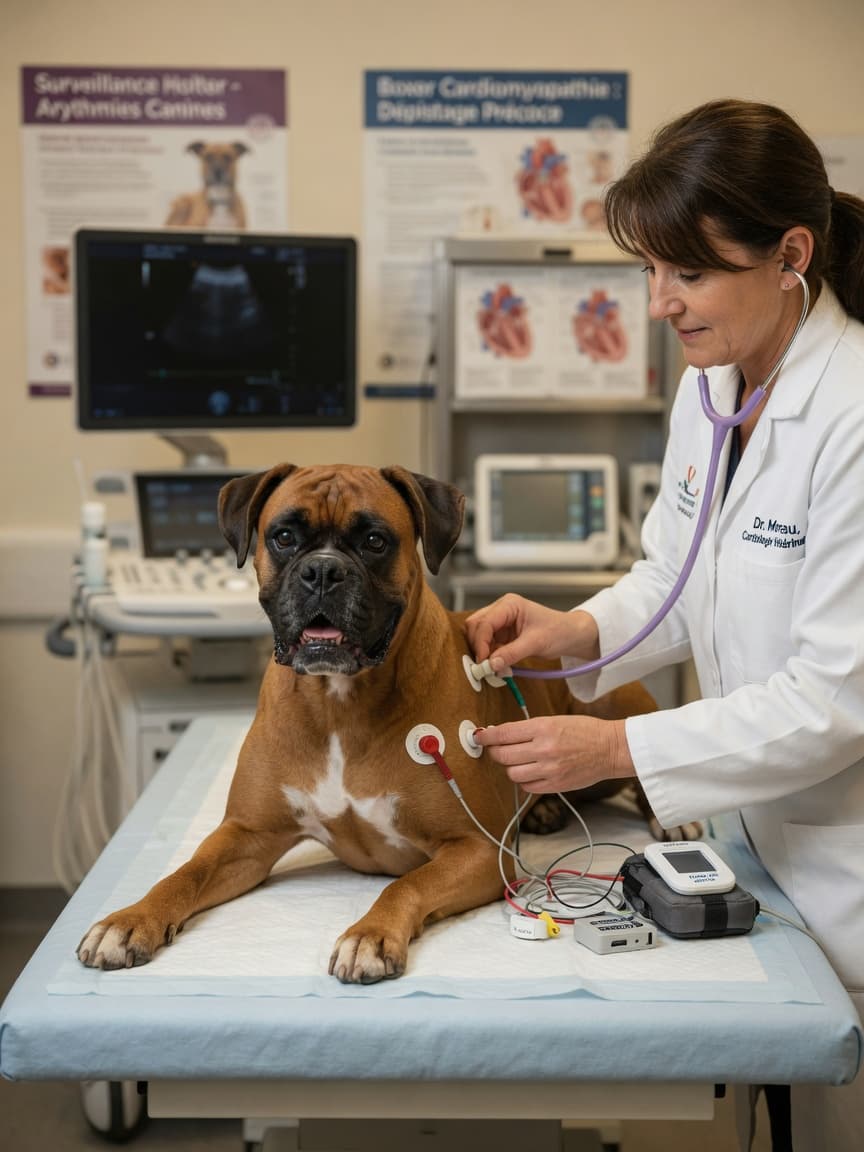
ARVC, commonly referred to as Boxer Cardiomyopathy, is the most serious and distinctive health concern in the breed. This is a heritable disease of the heart muscle in which the normal muscle tissue of the right ventricle is progressively replaced by fatty and fibrous tissue. The result is an abnormal heart rhythm known as a ventricular arrhythmia, which can cause episodes of weakness, collapse, and, in the most severe cases, sudden death without prior warning signs.
Many affected Boxers appear completely healthy between episodes, making detection without specific testing unreliable. A standard resting electrocardiogram (ECG) performed at a veterinary consultation may miss the condition entirely, as dangerous arrhythmias often occur sporadically throughout the day and night.
The gold standard for detecting ARVC in Boxers is Holter monitoring, a 24 to 48 hour continuous ECG recording worn by the dog at home during normal daily activity. Cardiologists typically recommend annual Holter monitoring for all Boxers from the age of two years onwards, regardless of whether the dog appears symptomatic. A DNA test for one of the mutations associated with ARVC is available through laboratories including Laboklin, though it is important to note that a negative DNA result does not completely exclude the disease, as multiple genetic factors are involved.
When significant arrhythmias are detected, treatment is directed by a veterinary cardiologist and may include antiarrhythmic medications such as sotalol or mexiletine, used alone or in combination. All Boxers diagnosed with ARVC should be under specialist cardiology supervision, and owners should be aware that the condition may progress over time.
Aortic and Subaortic Stenosis
Boxers are also predisposed to aortic stenosis and subaortic stenosis, conditions in which the outflow tract from the left ventricle is narrowed, forcing the heart to work harder to pump blood. Mild cases may not require treatment but should be monitored; severe cases carry a risk of sudden death and exercise intolerance. Diagnosis is made by cardiac auscultation, with confirmation and grading by echocardiography (ultrasound of the heart). Breeders committed to cardiac health will have breeding dogs screened by a cardiologist before mating.
Hip Dysplasia
Hip dysplasia is a heritable orthopaedic condition in which the hip joint develops abnormally. In the UK, the BVA/KC Hip Scheme provides radiographic scoring for breeding dogs. Equivalent national schemes are used across continental Europe. Responsible Boxer breeders will have both parents hip-scored before breeding. Maintaining a lean body weight, providing appropriate exercise, and avoiding high-impact activity during puppyhood all reduce the risk of clinical signs developing.
Brachycephalic Features and BOAS
Boxers are considered a moderately brachycephalic breed, meaning they have a shortened skull and face compared to longer-nosed breeds. This conformation can contribute to Brachycephalic Obstructive Airway Syndrome (BOAS), a spectrum of upper airway abnormalities including narrowed nostrils, an elongated soft palate, and a narrowed trachea. Signs of BOAS include noisy breathing, snoring, reduced exercise tolerance, and distress in warm weather. Not all Boxers are affected, but owners should be alert to these signs. A BOAS assessment by a veterinarian or specialist is recommended for any dog showing symptoms. Surgical intervention can dramatically improve quality of life for moderately to severely affected dogs.
Mast Cell Tumours
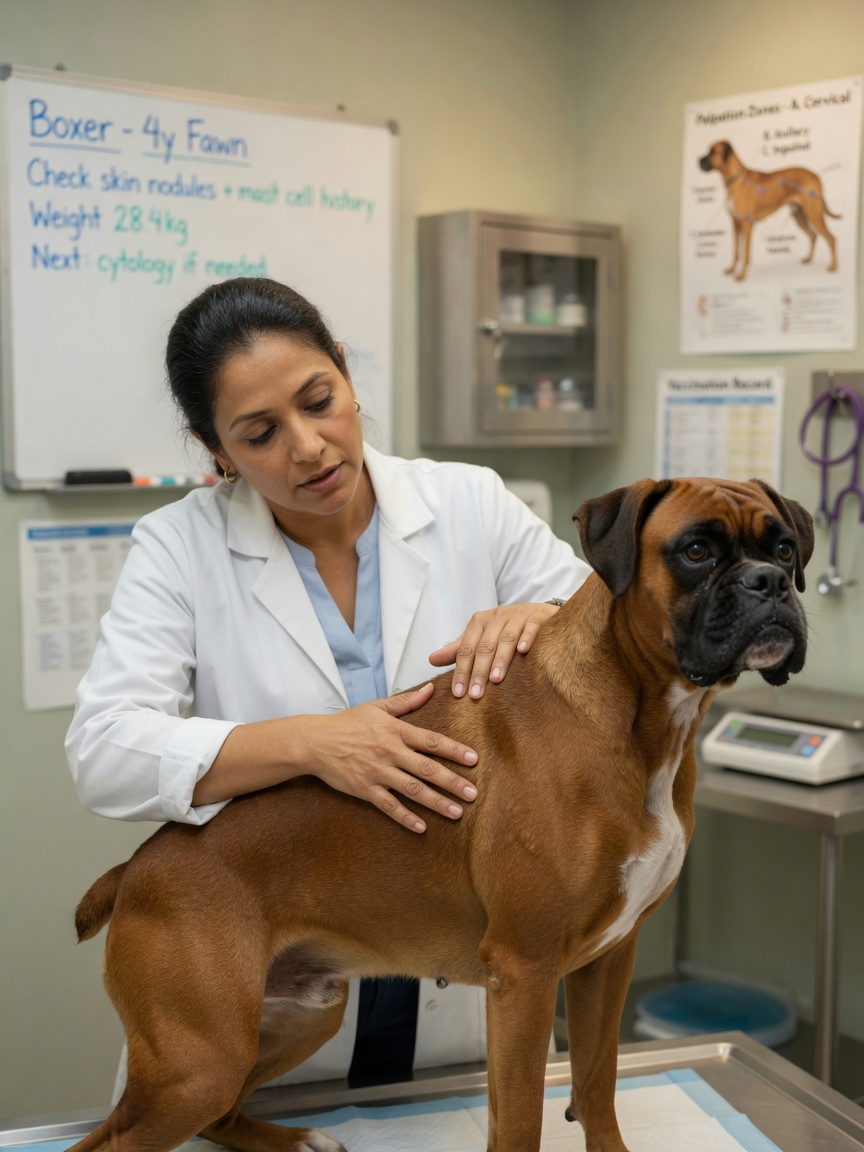
Boxers have a higher incidence of mast cell tumours than most other breeds. These are a type of skin tumour that can range from benign to highly malignant. They often appear as raised skin lumps that may change in size over time. Any new or changing lump on a Boxer should be assessed by a veterinarian without delay, as fine needle aspiration can quickly provide an initial diagnosis. Early detection and surgical removal significantly improve outcomes. Owners should make a habit of regularly running their hands over their Boxer's body to check for new lumps.
Degenerative Myelopathy
Degenerative Myelopathy (DM) is a progressive neurological disease affecting the spinal cord, leading to hind limb weakness and paralysis in later life. A DNA test is available through laboratories including Laboklin and Antagene. Dogs can be tested as clear, carrier, or at-risk. Responsible breeders use DNA testing to minimise the risk of producing affected offspring. There is currently no disease-modifying treatment, but physiotherapy and hydrotherapy can help maintain quality of life in affected dogs.
White Boxers and Deafness
Approximately 20 to 25 percent of Boxers are born white or predominantly white due to the extreme piebald gene. White Boxers are not recognised by the FCI for registration in breeding programmes. They are at significantly increased risk of congenital deafness, as the same gene that produces white colouration can affect the development of the inner ear. A BAER (Brainstem Auditory Evoked Response) test is recommended for white Boxers to determine hearing status in one or both ears. Unilaterally deaf dogs can live normal lives with appropriate management.
Epilepsy
Idiopathic epilepsy, in which no underlying structural or metabolic cause is identified, occurs in the Boxer breed. Seizures may first appear in young to middle-aged adults. Any dog experiencing a seizure should be assessed by a veterinarian promptly to rule out other causes. When idiopathic epilepsy is confirmed, long-term anticonvulsant therapy is usually required, and the condition can often be managed well with appropriate medication and monitoring.
Exercise and Grooming
Boxers require moderate daily exercise, typically around an hour to ninety minutes for a healthy adult. Given their brachycephalic features, exercise should be avoided during the hottest parts of the day in summer, and owners should be vigilant for signs of overheating. Boxers have a short, smooth coat that requires minimal grooming; a weekly brush to remove loose hair and a periodic bath is generally sufficient. Their facial folds should be checked and gently cleaned regularly to prevent skin irritation and infection in the skin creases.
Parasite Control and Preventative Care
European Boxer owners should follow ESCCAP guidelines for the prevention of fleas, ticks, intestinal worms, lungworm, and heartworm. The appropriate protocol varies by region, and your veterinarian can advise based on local parasite prevalence and any travel plans. Tick prevention is particularly important for Boxers exercised in woodland or grassland areas. Annual health checks provide an opportunity to review vaccination status and parasite control alongside cardiac screening.
Finding a Responsible Breeder in Europe
The cardiac health of the Boxer breed depends on breeders prioritising Holter monitoring, DNA testing for ARVC and DM, echocardiographic screening for subaortic stenosis, and hip scoring. When seeking a puppy, request documentation of all relevant parental health tests. Veterinary cardiologist referral networks are available across most of Europe; your general practice veterinarian can provide a referral to a specialist if cardiac concerns arise. For supplies including harnesses, cooling mats for summer, and enrichment products, Zooplus offers delivery across Europe.