
Anesthesia-Free Dog Dental Cleaning: Why Vets Warn Against It
Key Takeaways
- Anesthesia-free dental cleaning only removes visible tartar above the gumline — it cannot treat the disease that forms below it.
- The AVMA and the American Veterinary Dental College formally oppose AFDC as unsafe and ineffective.
- Modern veterinary anesthesia is extremely safe; pre-anesthetic bloodwork and monitoring minimise risk even in older dogs.
- Stress during AFDC can be as harmful to a dog as a brief, well-managed anesthetic event.
- VOHC-approved at-home products — brushing, dental chews, and water additives — are the gold standard for daily oral-health maintenance between professional cleanings.
What Is Anesthesia-Free Dog Dental Cleaning?
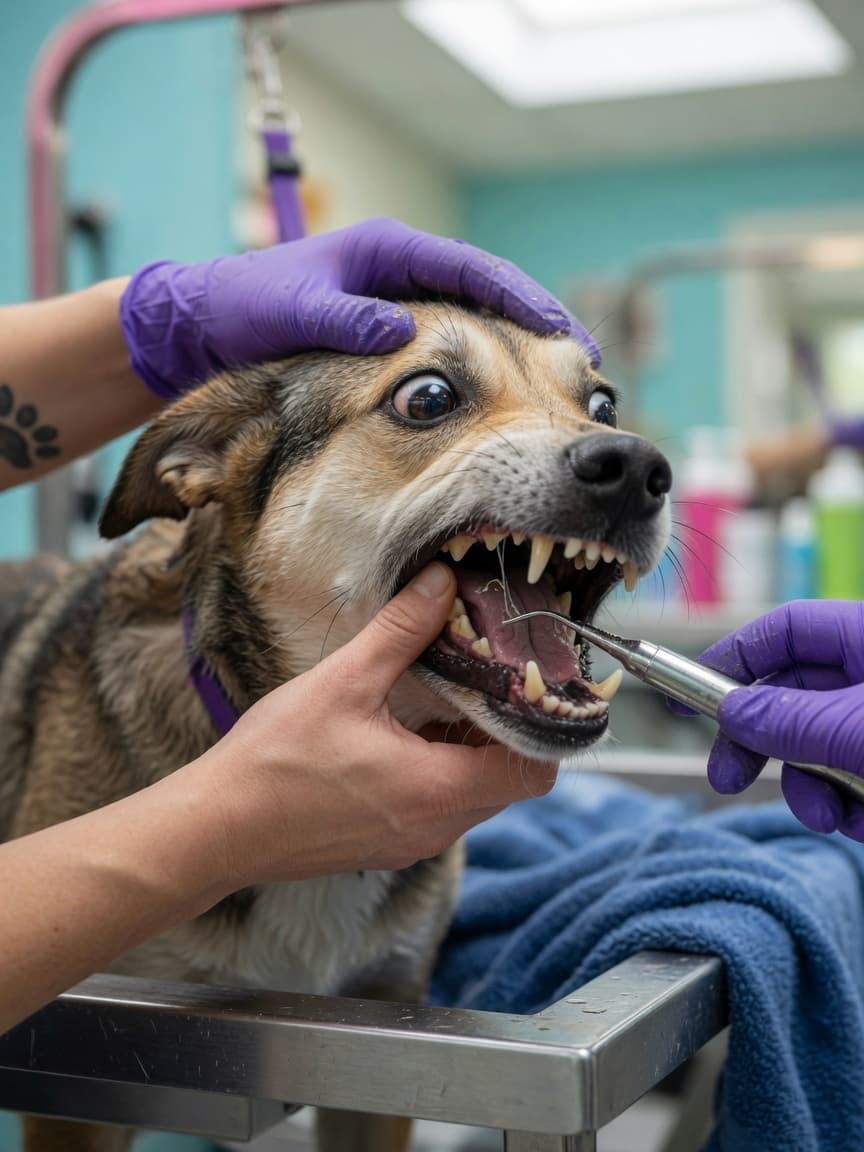
Anesthesia-free dental cleaning — sometimes marketed as "non-anesthetic dental cleaning," "natural dental cleaning," or simply AFDC — is a procedure in which a technician or groomer scales visible tartar from a dog's teeth while the animal is fully conscious, restrained manually or with wraps. Proponents market it as a cheaper, "safer," and less stressful alternative to professional veterinary dental cleaning performed under general anesthesia.
On the surface the appeal is understandable. Anesthesia carries a cost and, in the public mind at least, a risk. A dog that comes home with cleaner-looking teeth after a quick, drug-free appointment feels like a win. The problem is that what you can see on a dog's teeth is almost irrelevant to their actual dental health — and that gap between appearances and reality is where serious disease hides.
Why Anesthesia-Free Cleaning Is So Popular
AFDC has grown rapidly over the past decade, partly driven by social media, wellness trends that default to "natural" options, and genuine (though misplaced) concern about anesthetic risk. Prices for AFDC are typically 50–75 % lower than a proper veterinary dental procedure, making them an attractive option for cost-conscious owners who still want to feel they are caring for their pet's teeth.
Many groomers and pet-spa chains now offer the service alongside baths and nail trims, lending it an air of routine legitimacy. In the United States, because AFDC is sometimes performed by non-veterinary personnel, it can also sidestep the regulatory oversight that governs veterinary medicine — a loophole that has allowed the practice to spread despite professional opposition.
What the Experts Actually Say
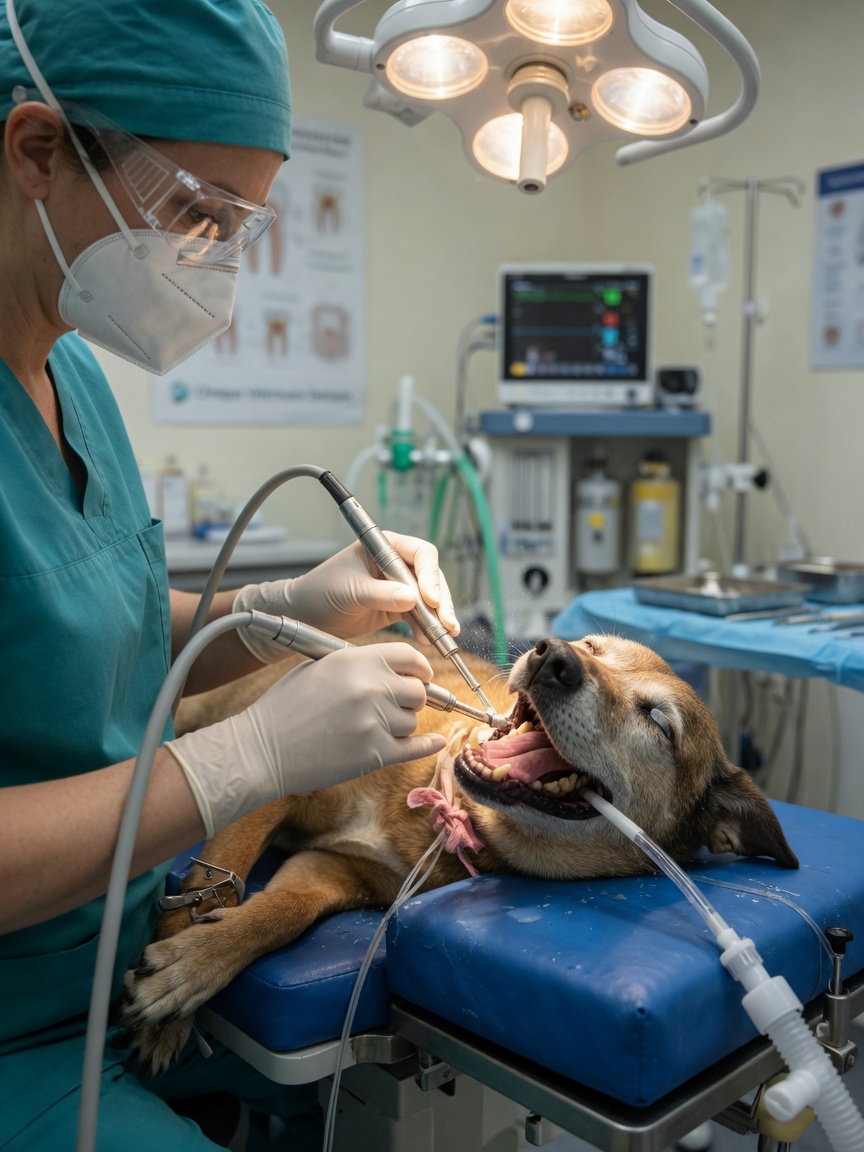
The position of the organised veterinary profession is unambiguous. The American Veterinary Medical Association (AVMA) states that anesthesia is necessary to perform a proper oral examination and dental cleaning, and that procedures performed on conscious animals are considered unacceptable and below the standard of care. The American Veterinary Dental College goes further, noting in its position statement that AFDC is not only ineffective but can cause pain, injury, and lasting psychological harm to dogs.
The American Kennel Club (AKC) echoes these concerns, advising owners to seek fully anaesthetised professional cleanings and to be wary of any practitioner offering dental work on conscious pets. In the UK, the PDSA similarly recommends veterinary-supervised anaesthetic procedures as the only safe route to treating dental disease.
Research published in the Journal of Veterinary Dentistry and indexed on PubMed confirms that periodontal disease — which lives below the gumline — is the most common clinical condition in dogs over three years of age, affecting more than 80 % of the population. No amount of above-the-gumline scraping addresses this.
The concerns have also reached mainstream media. The Guardian's pet health coverage has highlighted how wellness-industry marketing around "natural" pet care sometimes collides head-on with veterinary consensus — dental cleaning being one of the clearest examples.
The Core Problems With AFDC
1. It Is Purely Cosmetic
Scaling visible tartar from the crown of the tooth makes teeth look cleaner, but periodontal disease begins beneath the gumline in the sulcus — the space between tooth and gum. Bacteria in that anaerobic pocket produce toxins that destroy the periodontal ligament, erode bone, and eventually cause tooth loss and systemic infection. Without subgingival (below-the-gumline) curettage, polishing, and probing under anesthesia, this disease progresses unchecked regardless of how white the crowns appear.
2. No Proper Examination Is Possible
A complete oral health assessment requires dental radiographs (X-rays). Studies show that 27.8 % of dental pathology in dogs is invisible to the naked eye and is detectable only on radiographs. A conscious, stressed dog cannot be safely X-rayed, probed at each tooth's six measurement points, or have oral masses, fractured roots, or resorptive lesions identified. AFDC, by definition, skips all of this.
3. Stress and Risk of Injury
Restraining a dog while sharp metal scalers are used in and around its mouth is inherently stressful and dangerous. Dogs that struggle risk lacerations to the gums, tongue, or lips. Even dogs that appear compliant may be in a state of learned helplessness — a stress response where they stop reacting outwardly but experience significant physiological distress including elevated cortisol and heart rate. A 2018 study found that the stress response in dogs undergoing conscious restraint procedures was comparable to or greater than that seen during properly managed anaesthetic events.
4. False Reassurance Delays Real Treatment
Perhaps most dangerously, AFDC gives owners a false sense that their dog's dental health has been addressed. Owners who have paid for a cleaning are less likely to seek veterinary attention, meaning underlying disease progresses — sometimes to the point of tooth-root abscesses, jaw fractures, or bacteraemia affecting the heart, kidneys, and liver — by the time a proper examination is carried out.
What a Proper Veterinary Dental Cleaning Involves
A professional cleaning under general anaesthesia is a medical procedure, not a beautification service. It typically includes: pre-anaesthetic bloodwork to assess organ function; intravenous catheter placement and fluid support; inhalant anaesthesia with continuous monitoring of heart rate, oxygen saturation, blood pressure, temperature, and end-tidal CO₂; full-mouth dental radiographs; periodontal probing at six sites per tooth; supragingival and subgingival scaling; polishing to smooth enamel and slow future plaque adhesion; and, where necessary, extractions, root planing, or other treatments.
Modern veterinary anaesthesia is remarkably safe. A 2018 multicentre study of more than 98,000 anaesthetic events in healthy dogs found an anaesthesia-related mortality rate of approximately 0.05 % — one in two thousand — and for young, healthy patients the figure is lower still. The risk of leaving dental disease untreated for years dwarfs the risk of a single, well-managed anaesthetic event.
Safe At-Home Alternatives: The VOHC Standard
While nothing replaces professional veterinary dental cleaning, daily home care significantly slows the accumulation of plaque and tartar and reduces the frequency at which your dog needs anaesthetic procedures. The gold standard is daily tooth brushing with a dog-safe enzymatic toothpaste — aim for at least five days per week for meaningful effect.
When choosing additional products — dental chews, water additives, dental diets — look for the VOHC (Veterinary Oral Health Council) seal of acceptance. The VOHC independently evaluates products for evidence that they reduce plaque or tartar by at least 10–20 % compared to controls. Only products that pass rigorous clinical trials earn the seal. A current list of accepted products is maintained on the VOHC website.
For a convenient range of VOHC-friendly dental care supplies — enzymatic toothpastes, dental chews, and finger brushes — Zooplus's dog dental care section stocks vet-approved at-home options delivered to your door. Sticking to established brands with VOHC recognition or veterinary endorsement means you are not just masking the problem — you are genuinely supporting your dog's oral health between professional appointments.
If your dog resists brushing, a combination approach works well: dental chews as a daily supplement, a VOHC-accepted water additive, and gradual desensitisation to the toothbrush over several weeks. Browse Zooplus dental care for starter kits that make the transition easier.
How to Find a Legitimate Veterinary Dentist
For dogs with significant dental disease, a board-certified veterinary dentist offers the highest level of care. In the United States, diplomates of the American Veterinary Dental College (AVDC) can be found through the AVDC's public directory. In the UK and Europe, the European Veterinary Dental College (EVDC) maintains an equivalent register. Your general-practice veterinarian can also perform routine anaesthetic cleanings and will refer complex cases when needed.
Red flags to avoid: any provider offering dental cleaning without a prior physical examination; any provider who cannot or will not perform dental radiographs; and any service explicitly marketed as "anesthesia-free" as a selling point rather than a limitation to be overcome.
The Bottom Line
Anesthesia-free dental cleaning is a well-marketed product that delivers cosmetic results while leaving the disease it purports to treat completely untouched. The veterinary consensus is clear, the evidence base is strong, and the risks — both physical and in terms of delayed treatment — are real. Your dog deserves dental care that goes beyond appearances. Talk to your vet about scheduling a proper anaesthetic dental procedure, invest in VOHC-approved daily home care, and don't let attractive pricing or "natural" framing substitute for genuine medicine.
References
- Niemiec BA. "Periodontal disease." Topics in Companion Animal Medicine. 2008;23(2):72–80. PMID: 18342767. Establishes prevalence of periodontal disease in dogs and cats and the necessity of subgingival treatment.
- Brodbelt DC, Blissitt KJ, Hammond RA, et al. "The risk of death: the confidential enquiry into perioperative small animal fatalities." Veterinary Anaesthesia and Analgesia. 2008;35(5):365–373. PMID: 18466167. Landmark study quantifying anaesthetic mortality risk in companion animals, demonstrating overall safety of modern veterinary anaesthesia.