
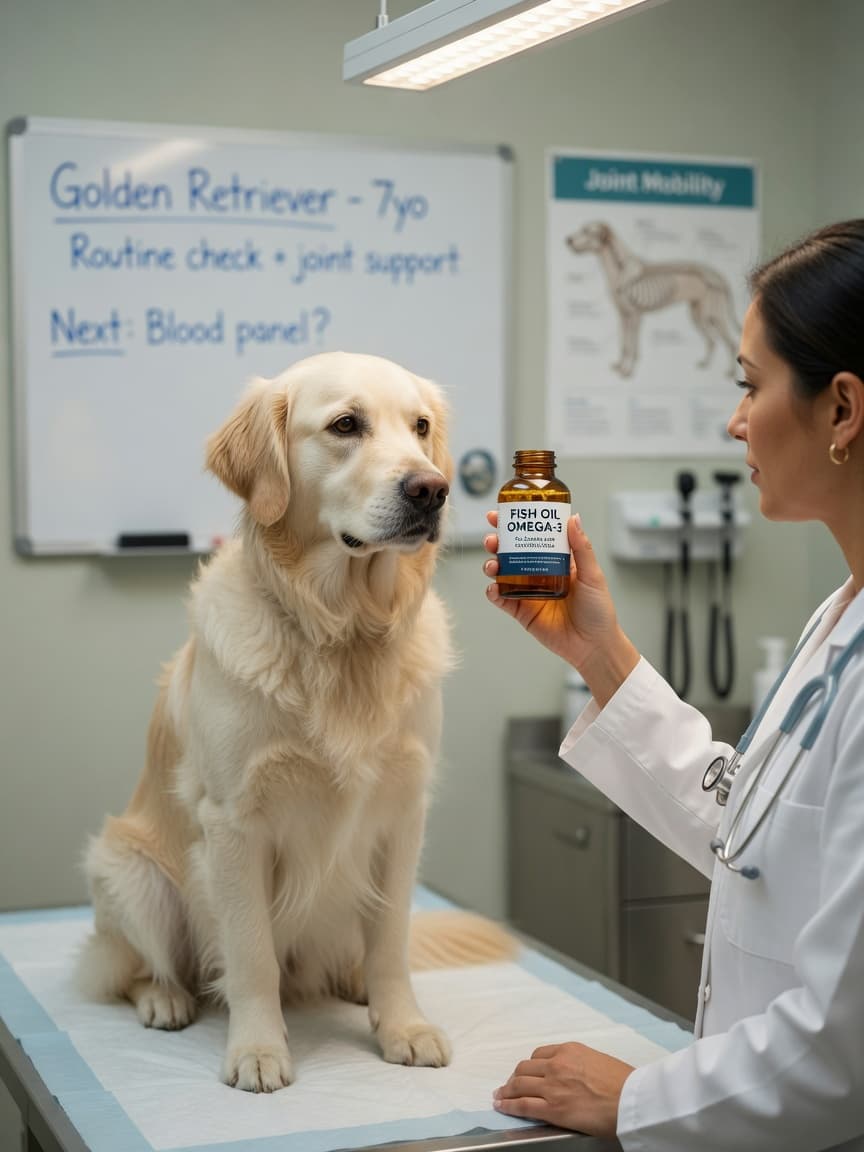
Fischöl für Hunde: Vorteile, Dosierung & beste EPA/DHA-Verhältnisse
Von Julia Wrenfield, Forscherin für Haustiergesundheit | Überprüft Juni 2026
Fischöl ist zu einem der am häufigsten empfohlenen Nahrungsergänzungsmittel in der veterinärmedizinischen Praxis geworden, und das aus gutem Grund. Im Gegensatz zu vielen Haustier-Nahrungsergänzungsmitteln, die auf anekdotischer Evidenz beruhen, wurden Omega-3-Fettsäuren – insbesondere Eicosapentaensäure (EPA) und Docosahexaensäure (DHA) – in kontrollierten Studien zu zahlreichen caninen Gesundheitszuständen untersucht. Dieser Artikel erläutert, was die Wissenschaft tatsächlich sagt, damit Sie eine fundierte Entscheidung für Ihren Hund treffen können.
Was sind EPA und DHA und warum sind sie wichtig?
Die Wirkstoffe von Fischöl sind langkettige mehrfach ungesättigte Fettsäuren. EPA (Eicosapentaensäure) ist vorwiegend entzündungshemmend, während DHA (Docosahexaensäure) ein struktureller Bestandteil von Zellmembranen ist, insbesondere im Gehirn und in der Netzhaut. Beide werden als Omega-3-Fettsäuren klassifiziert.
Hunde können geringe Mengen an EPA und DHA aus Alpha-Linolensäure (ALA) synthetisieren, die in Leinsamen und bestimmten Pflanzenölen vorkommt, aber die Umwandlungsrate ist äußerst schlecht – typischerweise weniger als 5 % bei den meisten Säugetieren. Deshalb ist die direkte Supplementierung aus marinen Quellen weitaus wirksamer als pflanzliche Omega-3-Quellen, um therapeutische Gewebespiegel zu erreichen.
Die meisten kommerziellen Hundefutter enthalten Omega-6-Fettsäuren (aus Hühnerfett, Maisöl) im Überfluss, aber die Omega-3-Spiegel sind niedrig. Das resultierende Omega-6-zu-Omega-3-Verhältnis in vielen Futtermitteln kann 20:1 übersteigen, während die meisten Forscher ein Verhältnis näher bei 5:1 oder 10:1 als physiologisch optimal zur Kontrolle von Entzündungen betrachten.
Evidenzbasierte Vorteile von Fischöl für Hunde
Haut- und Fellgesundheit
Dies ist die Anwendung mit der breitesten klinischen Evidenz. Mehrere randomisierte kontrollierte Studien haben gezeigt, dass die Supplementierung mit EPA und DHA den transepidermalen Wasserverlust reduziert, die Hautbarrierefunktion verbessert und den Pruritus (Juckreiz) bei Hunden mit atopischer Dermatitis verringert. Eine in Veterinary Dermatology veröffentlichte Studie fand signifikante Verbesserungen der Fellqualität und eine Reduktion entzündlicher Hautscores nach 12 Wochen Omega-3-Supplementierung bei Hunden mit umweltbedingten Allergien.
Der Mechanismus ist gut verstanden: EPA konkurriert mit Arachidonsäure um Cyclooxygenase-Enzyme und reduziert die Produktion entzündungsfördernder Prostaglandine (PGE2) und Leukotriene, die allergische Hautreaktionen antreiben.
Unterstützung von Gelenken und Beweglichkeit
Hunde mit Osteoarthritis stellen einen der stärksten Fälle für die Fischöl-Supplementierung dar. Eine bahnbrechende Studie von Roush et al. (2010) – eine randomisierte, kontrollierte Doppelblindstudie – fand heraus, dass Hunde mit Osteoarthritis, die mit einem mit EPA und DHA angereicherten Futter gefüttert wurden, signifikante Verbesserungen der Gewichtslast auf den betroffenen Gliedmaßen im Vergleich zu Kontrollhunden zeigten. Sowohl die von den Besitzern bewerteten Schmerzscores als auch die von Tierärzten bewerteten Lahmheitsscores verbesserten sich.
Die entzündungshemmende Wirkung von EPA reduziert die Entzündung der Synovialflüssigkeit und kann den Knorpelabbau durch Hemmung von Matrix-Metalloproteinasen (MMPs) verlangsamen. Fischöl ist kein Ersatz für das tiermedizinische Schmerzmanagement bei schwerer Osteoarthritis, sondern eine gut unterstützte ergänzende Therapie.
Herz-Kreislauf- und Nierengesundheit
Bei Hunden mit dilatativer Kardiomyopathie (DCM) wurde die Omega-3-Supplementierung mit reduzierter kardialer Kachexie (Muskelschwund), verminderter Produktion entzündungsfördernder Zytokine wie TNF-alpha und IL-1 sowie verbessertem Appetit in Verbindung gebracht. Für DHA wurde speziell gezeigt, dass es in Tiermodellen antiarrhythmische Eigenschaften besitzt.
Bei Hunden mit chronischer Nierenerkrankung (CKD) können Omega-3-Fettsäuren helfen, den glomerulären Hypertonus zu reduzieren und das Fortschreiten der Nierenschädigung zu verlangsamen. Veterinärernährungswissenschaftler empfehlen häufig Fischöl als Teil des renalen Diätprotokolls, obwohl die Evidenz in experimentellen Modellen stärker ist als bei natürlicher caniner CKD.
Kognitive Funktion und Gehirnentwicklung
DHA ist die dominante strukturelle Fettsäure in neuronalen Membranen. Bei Welpen wurde eine ausreichende DHA-Aufnahme während der Entwicklung – sei es über die Ernährung der Mutter oder durch postnatale Supplementierung – mit verbesserter Trainierbarkeit, Sehschärfe und kognitiver Leistung in Verbindung gebracht. Bei älteren Hunden kann DHA helfen, den kognitiven Abbau zu verlangsamen, der mit dem caninen kognitiven Dysfunktion-Syndrom (CDS) einhergeht, analog zur Demenz im Frühstadium beim Menschen.
Wie Sie ein hochwertiges Fischöl-Nahrungsergänzungsmittel auswählen
Nicht alle Fischöle sind gleich. Die folgenden Faktoren sind von erheblicher Bedeutung:
EPA/DHA-Konzentration: Viele Produkte sind verdünnt. Schauen Sie auf die tatsächlichen Milligramm EPA und DHA pro Portion, nicht nur auf den gesamten Fischölgehalt. Eine 1.000-mg-Fischölkapsel kann lediglich 300 mg kombiniertes EPA+DHA enthalten.
Triglycerid- vs. Ethylester-Form: Fischöl in natürlicher Triglycerid-Form (TG) wird besser absorbiert als die Ethylester-Form (EE), die in vielen günstigeren Produkten verwendet wird. Reveresterte Triglyceride (rTG) haben die beste Bioverfügbarkeit von allen. Prüfen Sie das Etikett oder die Angaben des Herstellers.
Oxidation und Frische: Omega-3-Fettsäuren oxidieren rasch. Ranziges Fischöl ist nicht nur weniger wirksam – es kann aktiv schädliche freie Radikale erzeugen. Qualitätsprodukte enthalten Antioxidantien wie Vitamin E (Tocopherole), haben niedrige Peroxidwerte und werden in dunklen, luftdichten Behältern gelagert. Wenn ein Fischöl-Nahrungsergänzungsmittel stark nach Fisch riecht, kann es bereits oxidiert sein.
Schwermetalltests: Meeresfische akkumulieren Quecksilber, PCBs und Dioxine. Seriöse Hersteller veröffentlichen unabhängige Analysezertifikate (CoA), die die Schadstoffgehalte bestätigen. Wild gefangene Kleinfische wie Sardellen und Sardinen tragen in der Regel geringere Schwermetallbelastungen als größere Arten.
Artenquelle: Öle auf Basis von Sardelle, Sardine und Makrele tendieren dazu, von höherer Qualität und nachhaltiger zu sein als Lachsöl, das oft ein Nebenprodukt ist und höhere Oxidationsraten aufweisen kann.
Dosierungsrichtlinien für Hunde
Dosierungsempfehlungen variieren je nach Gesundheitszustand. Die folgenden sind allgemeine Richtlinien aus der veterinärmedizinischen Ernährungsliteratur, ausgedrückt als gesamtes EPA+DHA pro Tag:
- Allgemeine Gesunderhaltung: 20–55 mg EPA+DHA pro kg Körpergewicht pro Tag
- Haut- und Fellerkrankungen: 50–100 mg EPA+DHA pro kg Körpergewicht pro Tag
- Osteoarthritis (entzündungshemmend): 75–100 mg EPA+DHA pro kg Körpergewicht pro Tag
- Herzerkrankung (unter tierärztlicher Aufsicht): 40 mg EPA+DHA pro kg Körpergewicht pro Tag
Für einen 20-kg-Hund, der Hautunterstützung benötigt, würde dies etwa 1.000–2.000 mg kombiniertes EPA+DHA täglich bedeuten – das ist der Gehalt von 3–6 Standard-1.000-mg-Fischölkapseln, abhängig von ihrer EPA/DHA-Konzentration. Berechnen Sie stets auf Basis des EPA+DHA-Gehalts, nicht des gesamten Ölvolumens.
Praktische Tipps zur Supplementierung
Lagern Sie Fischöl nach dem Öffnen im Kühlschrank, um die Oxidation zu verlangsamen. Flüssiges Fischöl kann direkt über das Futter gegossen werden; Kapseln können angestochen und über die Mahlzeiten ausgepresst werden. Führen Sie jedes neue Nahrungsergänzungsmittel schrittweise ein – beginnen Sie in der ersten Woche mit 25 % der Zieldosis und steigern Sie dann wöchentlich bis zur vollen Dosis. Dies reduziert die Wahrscheinlichkeit von Magen-Darm-Nebenwirkungen erheblich.
Überwachen Sie die Stuhlkonsistenz und das Energieniveau Ihres Hundes während der Einführungsphase. Weicher Stuhl deutet oft darauf hin, dass die Dosis zu rasch erhöht wurde, nicht darauf, dass das Nahrungsergänzungsmittel ungeeignet ist.
Zooplus führt eine große Auswahl an Omega-3-Nahrungsergänzungsmitteln in veterinärmedizinischer Qualität für Hunde, darunter Öle auf Sardellen- und Sardinenbasis mit verifizierten EPA/DHA-Konzentrationen.
Fischöl-Nahrungsergänzungsmittel bei Zooplus durchsuchen
- EPA und DHA aus marinem Fischöl sind für Hunde weitaus bioverfügbarer als pflanzliche Omega-3-Quellen (ALA).
- Die stärkste Evidenz unterstützt Fischöl bei Haut-/Fellerkrankungen und Osteoarthritis bei Hunden.
- Dosieren Sie nach EPA+DHA-Gehalt, nicht nach Gesamtölvolumen – die meisten Etiketten weisen dies getrennt aus.
- Wählen Sie Produkte in Triglycerid-Form, die von Dritten getestet wurden, aus kleinen Kaltwasserfischen (Sardelle, Sardine).
- Führen Sie schrittweise ein und lagern Sie im Kühlschrank, um Ranzigkeit zu vermeiden.
- Konsultieren Sie Ihren Tierarzt vor einer hochdosierten Supplementierung, insbesondere wenn Ihr Hund gerinnungshemmende Medikamente erhält oder Probleme mit dem Fettstoffwechsel hat.
- Roush JK, Cross AR, Renberg WC, et al. Evaluation of the effects of dietary supplementation with fish oil omega-3 fatty acids on weight bearing in dogs with osteoarthritis. J Am Vet Med Assoc. 2010;236(1):67-73. PMID: 20043793
- Bauer JE. Therapeutic use of fish oils in companion animals. J Am Vet Med Assoc. 2011;239(11):1441-1451. PMID: 22087720
- Lenox CE, Bauer JE. Potential adverse effects of omega-3 fatty acids in dogs and cats. J Vet Intern Med. 2013;27(2):217-226. PMID: 23406322