
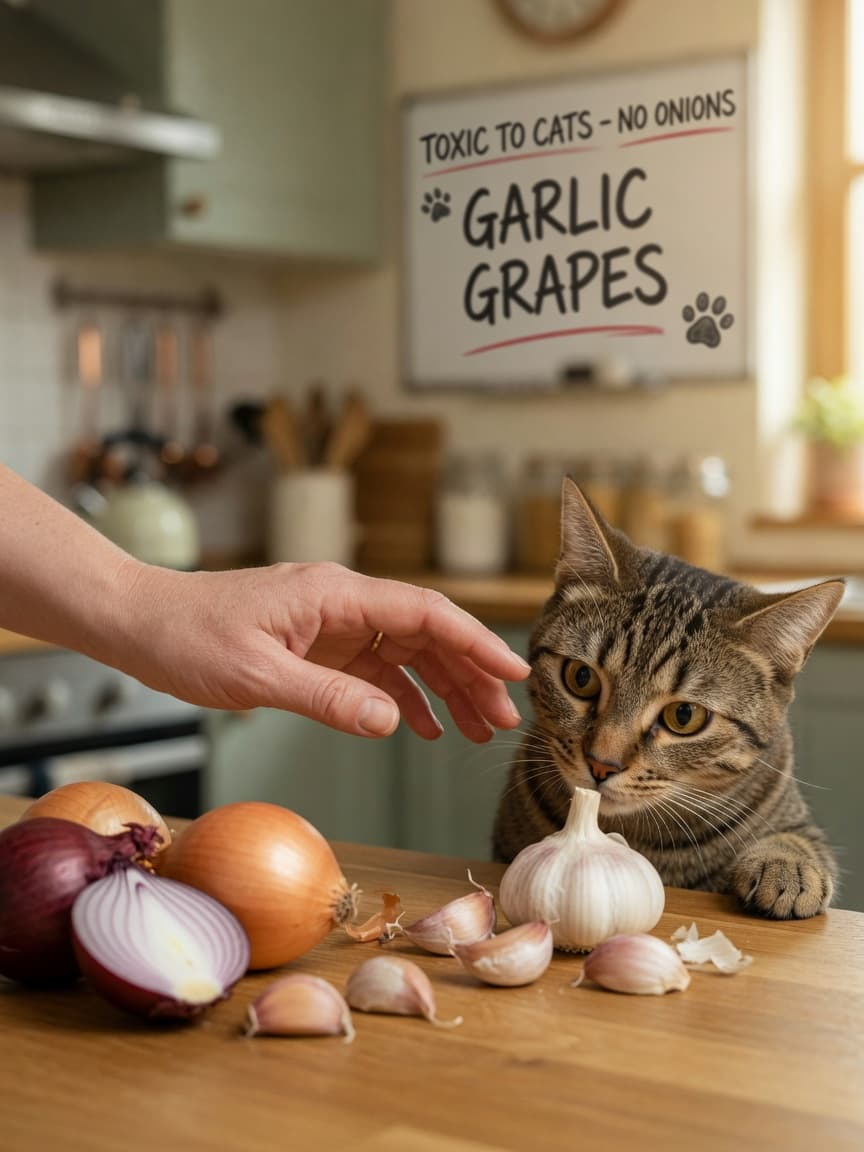
Dürfen Katzen Zwiebeln essen? Nein — Zwiebeln sind in jeder Form giftig für Katzen
Zwiebeln — in jeder Form, roh, gekocht, pulverisiert oder dehydriert — sind giftig für Katzen. Sie gehören zur Familie Allium und enthalten Verbindungen, die die roten Blutkörperchen einer Katze zerstören und eine hämolytische Anämie verursachen, die unbehandelt tödlich sein kann. Selbst kleine Mengen, die über einen längeren Zeitraum wiederholt aufgenommen werden, können sich auf gefährliche Werte anreichern. Wenn Ihre Katze Zwiebeln oder ein anderes Gemüse aus der Allium-Familie gefressen hat, kontaktieren Sie sofort Ihren Tierarzt oder das ASPCA Animal Poison Control Center: (888) 426-4435.
Zwiebeln sind weltweit ein Grundnahrungsmittel der menschlichen Küche. Sie kommen in Suppen, Eintöpfen, Soßen, Brühen, Babynahrung, Snack-Würzungen und unzähligen Fertiggerichten vor. Diese Allgegenwärtigkeit macht sie zu einer der häufigsten Quellen versehentlicher Katzenvergiftungen. Viele Katzenbesitzer sind überrascht zu erfahren, dass die Zwiebel in einem geteilten Stück Huhn, ein Ablecken von Suppenbrühe oder sogar eine Katze, die kommerzielle Babynahrung mit Zwiebelpulver-Aroma gefressen hat, einem potenziell lebensbedrohlichen Toxin ausgesetzt war.
Zu verstehen, warum Zwiebeln gefährlich sind, welche Formen ein Risiko darstellen und wie man eine Vergiftung erkennt und darauf reagiert, könnte das Leben Ihrer Katze retten.
Die Allium-Familie: Alle Mitglieder sind giftig für Katzen
Zwiebeln gehören zur Pflanzengattung Allium, die eine große Bandbreite gängiger Gemüse und Würzmittel umfasst. Jedes einzelne Mitglied dieser Familie ist giftig für Katzen:
- Zwiebeln (Allium cepa) — alle Sorten: gelbe, weiße, rote, Süßzwiebeln, Perlzwiebeln und Frühlingszwiebeln
- Knoblauch (Allium sativum) — sogar noch konzentrierter an Giftstoffen als Zwiebeln
- Lauch (Allium ampeloprasum)
- Schnittlauch (Allium schoenoprasum) — wird oft als Garnitur übersehen, ist aber ebenso gefährlich
- Schalotten (Allium cepa var. aggregatum)
- Lauchzwiebeln / grüne Zwiebeln
- Wilde Zwiebeln und wilder Knoblauch
Es gibt kein sicheres Mitglied dieser Pflanzenfamilie für Katzen. Wenn ein Lebensmittel eine dieser Zutaten enthält — selbst als geringfügiges Würzmittel — muss es vollständig von Ihrer Katze ferngehalten werden.
Wie Zwiebeln Katzen vergiften: Der Mechanismus der Toxizität
Die giftigen Wirkstoffe in Zwiebeln sind Organoschwefelverbindungen, vor allem N-propyl disulfide. Diese Verbindungen werden freigesetzt, wenn Zwiebzellen beschädigt werden — sei es durch Schneiden, Kauen, Kochen oder die Verarbeitung zu Pulver. Sobald sie aufgenommen und in den Blutkreislauf absorbiert wurden, greifen sie die roten Blutkörperchen der Katze auf molekularer Ebene an.
So geschieht Folgendes: N-propyl disulfide oxidiert das Hämoglobin in den roten Blutkörperchen. Hämoglobin ist das eisenhaltige Protein, das Sauerstoff bindet und transportiert. Wenn es oxidiert wird, denaturiert das Hämoglobin und klumpt zusammen, wobei sich abnorme Strukturen bilden, die Heinz-Körper genannt werden — unter dem Mikroskop als dunkle Einschlüsse in den roten Blutkörperchen sichtbar.
Das Immunsystem der Katze — insbesondere die Milz — erkennt diese mit Heinz-Körpern beladenen Zellen dann als abnormal und zerstört sie. Da die roten Blutkörperchen schneller abgebaut werden, als das Knochenmark neue bilden kann, entwickelt die Katze eine hämolytische Anämie: einen gefährlichen Abfall der Zahl funktionstüchtiger roter Blutkörperchen, die im Körper zirkulieren.
Katzen sind für diesen Prozess besonders anfällig im Vergleich zu den meisten anderen Säugetieren. Felines Hämoglobin hat eine molekulare Struktur mit mehr reaktiven Sulfhydrylgruppen als Hunde- oder Humanhämoglobin. Das bedeutet, dass die Thiosulfat-Verbindungen in Zwiebeln bei Katzen schneller und schwerwiegender oxidative Schäden verursachen. Eine Dosis, die bei einem Hund eine leichte Erkrankung verursacht, kann bei einer Katze ähnlicher Größe eine lebensbedrohliche Anämie hervorrufen.
Alle Formen von Zwiebeln sind gleichermaßen gefährlich
Viele Katzenbesitzer glauben fälschlicherweise, dass das Kochen von Zwiebeln sie ungefährlich macht. Das ist völlig falsch. Das N-propyl disulfide und verwandte Thiosulfat-Verbindungen in Zwiebeln sind hitzestabil — sie werden durch Kochen bei keiner Temperatur zerstört oder denaturiert. Ob Zwiebeln angebraten, gekocht, geröstet, karamellisiert oder gebraten werden, die giftigen Verbindungen bleiben vollständig aktiv.
Die folgenden Formen von Zwiebeln sind alle giftig für Katzen:
- Rohe Zwiebel — die am unmittelbarsten erkannte Form, aber Katzen können an weggeworfenen Zwiebelschalen oder -wurzeln kauen
- Gekochte Zwiebel — in Suppen, Eintöpfen, Aufläufen, Pfannengerichten und geteiltem Essen vom Tisch
- Zwiebelpulver — extrem konzentriert; ein Bruchteil eines Gramms kann für eine Katze giftig sein
- Dehydrierte Zwiebel-Flocken — ähnlich konzentriert und gefährlich
- Zwiebel in kommerziellen Lebensmitteln — einige menschliche Babynahrungen, insbesondere fleischaromatisierte Pürees, enthielten historisch Zwiebelpulver und haben bei Katzen, die mit diesen Produkten gefüttert wurden, Vergiftungen verursacht
- Zwiebelbrühe oder -fond — selbst Kochflüssigkeit, die mit Zwiebeln geköchelt hat, behält giftige Verbindungen
Zwiebelpulver und dehydrierte Zwiebel-Flocken verdienen besondere Alarmbereitschaft. Weil der Wassergehalt entfernt wurde, sind diese Formen pro Gramm deutlich konzentrierter als frische Zwiebel. Eine kleine Menge Würzung in einer Marinade, eine Prise Zwiebelpulver in einer Soße oder ein aromatisierter Cracker, den Ihre Katze ableckt, enthält die entsprechende Giftstoffmenge eines viel größeren Volumens roher Zwiebel.
Die Symptome einer Zwiebelvergiftung bei Katzen erkennen
Das Heimtückische an der Zwiebeltoxizität ist, dass Symptome oft erst 1 bis 4 Tage nach der Aufnahme auftreten, zu einem Zeitpunkt, an dem die Zerstörung der roten Blutkörperchen bereits in vollem Gange ist. Warten Sie nicht auf das Auftreten von Symptomen, bevor Sie tierärztliche Hilfe suchen — wenn Sie wissen oder vermuten, dass Ihre Katze Zwiebeln in irgendeiner Form gefressen hat, rufen Sie sofort um Hilfe.
Wenn Symptome auftreten, gehören dazu:
- Ausgeprägte Lethargie — die Katze wirkt erschöpft, möchte sich nicht bewegen und verliert das Interesse am Spiel oder an der Umgebung
- Blasses, weißes oder gelbliches Zahnfleisch — ein klares Zeichen schwerer Anämie; gesundes Zahnfleisch sollte kaugummirosa sein
- Rasches, angestrengtes oder Atmen mit offenem Maul — der Körper kämpft darum, die verminderte Sauerstofftransportkapazität auszugleichen
- Erhöhte Herzfrequenz
- Erbrechen und Durchfall — können in der frühen Phase der Vergiftung auftreten
- Appetitlosigkeit
- Schwäche und stolpernder Gang
- Dunkler Urin — roter, oranger oder brauner Urin entsteht durch Hämoglobin, das von zerstörten roten Blutkörperchen freigesetzt wird (Hämoglobinurie)
- Gelbsucht — Gelbfärbung der Haut, des Zahnfleischs oder der Augenweiße, die auf eine Leberbelastung durch die Verarbeitung der zerstörten Zellen hinweist
- Kollaps — ein schwerer, lebensbedrohlicher Notfall
Selbst wenn Ihre Katze nach dem Verzehr von Zwiebeln völlig normal erscheint, gehen Sie nicht davon aus, dass sie unbeschadet davongekommen ist. Die Verzögerung vor dem Auftreten der Symptome ist häufig. Eine Anämie kann sich unbemerkt entwickeln und dann sehr plötzlich einen Krisenpunkt erreichen.
Kumulative Toxizität: Kleine Mengen über die Zeit sind ebenfalls gefährlich
Ein weiterer kritischer Punkt, den viele Katzenbesitzer übersehen: Die Zwiebeltoxizität bei Katzen kann kumulativ sein. Eine Katze, die regelmäßig kleine Mengen Zwiebel erhält — etwa durch Tischreste, geteiltes menschliches Essen oder kommerzielle Lebensmittel mit versteckten Allium-Zutaten — kann eine hämolytische Anämie entwickeln, selbst wenn keine einzelne Mahlzeit eine große Dosis enthielt. Der Schaden reichert sich allmählich an, bis er eine klinisch gefährliche Schwelle erreicht.
Deshalb ist es unerlässlich, Ihrer Katze nicht nur absichtlich keine Zwiebeln zu geben, sondern auch die Zutatenlisten jedes menschlichen Lebensmittels, das Sie mit Ihrer Katze teilen, sorgfältig zu prüfen und Katzen niemals Zugang zu Küchenabfällen oder unbeaufsichtigten Tellern zu gewähren.
Notfallmaßnahmen: Was Sie jetzt tun sollten
Wenn Ihre Katze Zwiebel gefressen hat — in beliebiger Menge, in beliebiger Form — ergreifen Sie sofort diese Schritte:
- Rufen Sie das ASPCA Animal Poison Control Center an: (888) 426-4435. Rund um die Uhr verfügbar. Es kann eine Beratungsgebühr anfallen, aber die Hinweise, die Sie erhalten, können lebensrettend sein.
- Rufen Sie Ihren Tierarzt oder die nächstgelegene tierärztliche Notklinik an. Teilen Sie mit, was Ihre Katze gefressen hat, wie viel und wann.
- Versuchen Sie nicht, zu Hause Erbrechen auszulösen, ohne ausdrückliche Anweisungen eines Tierarztes — unsachgemäße Methoden können Ihrer Katze schaden oder sie verletzen.
- Bringen Sie die Verpackung oder eine Zutatenliste mit von jedem Lebensmittel, das Ihre Katze verzehrt hat, damit der Tierarzt die Toxindosis genau einschätzen kann.
- Halten Sie Ihre Katze ruhig und warm, während Sie den Transport zum Tierarzt organisieren.
Die Behandlung hängt davon ab, wann die Exposition erfolgte und wie schwer die Anämie ist. Innerhalb der ersten Stunde oder zwei nach der Aufnahme kann ein Tierarzt sicher Erbrechen auslösen, um eine weitere Absorption zu verhindern. Aktivkohle kann verabreicht werden. In schweren Fällen sind Bluttransfusionen, intravenöse Flüssigkeiten und unterstützende Pflege erforderlich, um die Katze zu stabilisieren, während das Knochenmark sich erholt und neue rote Blutkörperchen bildet.
- Zwiebeln und alle Allium-Gemüse (Knoblauch, Lauch, Schnittlauch, Schalotten) sind giftig für Katzen.
- Der Mechanismus: N-propyl disulfide oxidiert felines Hämoglobin und verursacht eine Heinz-Körper-hämolytische Anämie.
- Gekochte Zwiebel ist ebenso giftig wie rohe — Hitze zerstört die Verbindungen nicht.
- Zwiebelpulver ist hochkonzentriert und besonders gefährlich.
- Selbst kleine wiederholte Mengen können sich im Laufe der Zeit auf gefährliche Werte anreichern.
- Symptome können erst 1–4 Tage nach der Aufnahme auftreten.
- Jede Zwiebelexposition = tierärztlicher Notfall. Rufen Sie sofort (888) 426-4435 an.
Ihre Katze schützen: Füttern Sie nur katzengeeignetes Futter
Der sicherste Ansatz besteht darin, Ihre Katze mit einem ausgewogenen, artgerechten kommerziellen Futter zu ernähren und darauf zu verzichten, menschliches Essen zu teilen. Viele menschliche Gerichte enthalten Allium-Zutaten, die nicht offensichtlich sind — Suppen, Bratensoßen, Brühen, Würzungen und verarbeitete Snacks sind häufige versteckte Quellen. Prüfen Sie Zutatenetiketten immer sorgfältig.
Achten Sie auf hochwertiges Katzenfutter, das namentlich genannte Fleischproteine als erste Zutat auflistet, keine künstlichen Zusatzstoffe enthält und frei von Zwiebeln, Knoblauch und anderen Allium-Derivaten ist.
Katzenfutter bei Zooplus ansehen →Die Wahl einer vom Tierarzt empfohlenen, toxinfreien Ernährung ist der wichtigste Schritt, den Sie unternehmen können, um Ihre Katze vor vermeidbaren Vergiftungen zu schützen.
Quellen und weiterführende Literatur
- Cope RB. "Allium species poisoning in dogs and cats." Vet Med. 2005;100(8):562–566.
- Kovalkovicova N, Sutiakova I, Pistl J, Sutiak V. "Some food toxic for pets." Interdiscip Toxicol. 2009;2(3):169–76. PMID: 21217842
- Lee KW, Yamato O, Tajima M, et al. "Hematologic changes associated with the appearance of eccentrocytes after intragastric administration of garlic extract to dogs." Am J Vet Res. 2000;61(6):582–8. PMID: 10850838