
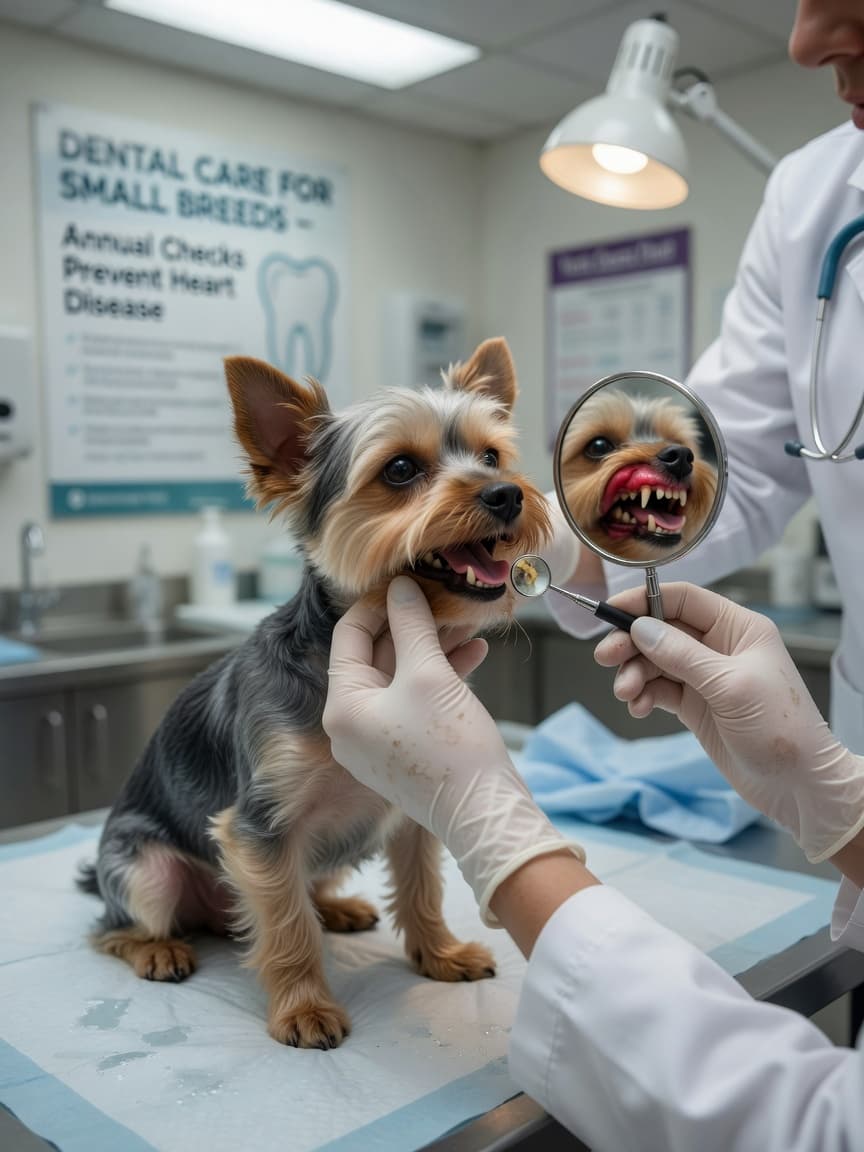
Salud del Yorkshire Terrier: dientes, tráquea y shunts hepáticos
Actualizado en junio de 2026
- Esperanza de vida: 13–16 años
- Principales riesgos para la salud: enfermedad periodontal, colapso traqueal, shunts portosistémicos (shunts hepáticos), luxación de rótula, hipoglucemia
- Pruebas genéticas recomendadas: evaluación de rótulas, prueba de ácidos biliares (cribado de shunt hepático), examen oftalmológico
Los Yorkshire Terrier pueden ser lo bastante pequeños para caber en un bolso, pero tienen una gran personalidad y un conjunto de retos de salud que exigen una tenencia atenta. A pesar de estar entre las razas de perro más longevas —muchos Yorkies llegan a los 14–16 años—, concentran un número notable de afecciones médicas en su diminuto cuerpo. La enfermedad dental, los problemas traqueales y los shunts hepáticos son las afecciones más propias de la raza, mientras que la luxación de rótula y la hipoglucemia completan las preocupaciones clínicas más frecuentes que ven los veterinarios.
Los problemas de salud más frecuentes en los Yorkshire Terrier
La enfermedad periodontal es, con diferencia, el problema de salud más frecuente —y más subestimado— del Yorkshire Terrier. Sus bocas pequeñas provocan un apiñamiento dental severo, lo que acelera la acumulación de placa y la enfermedad de las encías. El colapso traqueal, en el que los anillos de cartílago que sostienen la tráquea se debilitan y se aplanan, es un rasgo distintivo de la raza y causa la característica tos de «graznido de ganso». Los shunts portosistémicos (SPS) —vasos sanguíneos anómalos que evitan el hígado— son más frecuentes en los Yorkshire Terrier que en cualquier otra raza y provocan signos neurológicos y gastrointestinales, a menudo desde cachorros. La luxación de rótula y la hipoglucemia, sobre todo en ejemplares «teacup» muy pequeños y en cachorros, completan la lista de preocupaciones prioritarias.
Enfermedad periodontal

La boca de un Yorkshire Terrier contiene el mismo número de dientes adultos que la de un Gran Danés, comprimidos en una mandíbula de un tamaño ínfimo en comparación. El apiñamiento resultante hace que la comida y las bacterias se acumulen en el margen gingival a un ritmo acelerado, lo que provoca formación de cálculo, gingivitis y, en última instancia, una enfermedad periodontal que puede destruir el hueso que sostiene los dientes. Los estudios demuestran que los perros de razas pequeñas desarrollan una enfermedad periodontal significativa a los tres años de edad en muchos casos. Las consecuencias van más allá de la boca: las bacterias periodontales que entran en el torrente sanguíneo se asocian con enfermedad valvular cardiaca, enfermedad renal e inflamación sistémica. La prevención requiere un cepillado dental diario con una pasta dentífrica enzimática canina (iniciado en la etapa de cachorro para que el perro lo acepte), limpiezas dentales profesionales anuales bajo anestesia a partir de los dos años aproximadamente, y snacks dentales que lleven el sello de aprobación del VOHC (Veterinary Oral Health Council).
Colapso traqueal

El colapso traqueal se produce cuando los anillos de cartílago en forma de C de la tráquea pierden rigidez y se aplanan durante la inspiración, estrechando la vía aérea. En los Yorkies parece tratarse de una anomalía congénita con un fuerte componente hereditario. El síntoma clásico es una tos seca y áspera que suena como un graznido de ganso, que empeora con la excitación, los tirones del collar, el calor y la obesidad. Los casos leves a moderados se manejan médicamente con broncodilatadores (como la teofilina), antitusígenos y control del peso. Es esencial evitar la presión del collar, usando un arnés en su lugar. Los casos graves en perros jóvenes pueden beneficiarse de la colocación de un stent intraluminal por parte de un especialista. La obesidad empeora drásticamente el colapso traqueal al reducir la distensibilidad torácica, por lo que mantener una condición corporal delgada es tanto preventivo como terapéutico.
Shunts portosistémicos (shunts hepáticos)
Un shunt portosistémico es un vaso sanguíneo anómalo que desvía la sangre portal —que transporta nutrientes, toxinas y amoniaco desde el tracto gastrointestinal— alrededor del hígado en lugar de a través de él. Sin el procesamiento hepático, estas sustancias se acumulan en la circulación sistémica y en el cerebro, provocando encefalopatía hepática. Los Yorkshire Terrier presentan la mayor prevalencia de SPS extrahepático congénito de todas las razas. Los cachorros afectados pueden parecer más pequeños que sus hermanos de camada, mostrar un comportamiento extraño después de comer (dar vueltas, vocalizar, ceguera aparente), sufrir molestias gastrointestinales intermitentes y recuperarse lentamente de la anestesia. El diagnóstico se confirma con una prueba de ácidos biliares pre y posprandial, ecografía o angiografía por TC. La ligadura quirúrgica del vaso de derivación es el tratamiento definitivo y ofrece el mejor pronóstico a largo plazo; el manejo médico con una dieta baja en proteínas y lactulosa puede ganar tiempo, pero rara vez es curativo.
Luxación de rótula e hipoglucemia
La luxación de rótula de grado 1–2 (rótulas que se desplazan de forma intermitente) es extremadamente frecuente en los Yorkshire Terrier y en muchos casos no causa problemas a largo plazo. Los grados 3–4, con luxación continua, provocan daño progresivo del cartílago y cojera, y requieren estabilización quirúrgica. La hipoglucemia —descensos peligrosos del azúcar en sangre— aparece con más frecuencia en cachorros y en adultos muy pequeños durante periodos de estrés, ayuno o exposición al frío. Los Yorkies menores de tres meses deben comer cada 4–6 horas; los propietarios deberían tener a mano sirope de maíz o un gel de glucosa para frotarlo en las encías de un perro que muestre signos de hipoglucemia (temblores, debilidad, mirada vidriosa, colapso) mientras contactan con su veterinario.
Prevención y cuidados proactivos
Empieza el cuidado dental desde el primer día: deja que el cachorro mordisquee un cepillo de dientes blando antes de pasar al cepillado. Usa un arnés en lugar de un collar en todos los paseos, de forma permanente. Solicita una prueba de ácidos biliares a los seis meses de edad si observas algún signo neurológico o retraso del crecimiento: el diagnóstico precoz del SPS mejora drásticamente los resultados quirúrgicos. Mantén a los Yorkies «teacup» con un horario de comidas estricto y vigílalos de cerca cuando haga frío. Los exámenes veterinarios anuales deben incluir la evaluación de las rótulas, la auscultación cardiaca y la valoración dental.
Suplementos recomendados para los Yorkshire Terrier
Los ácidos grasos omega-3 (aceite de pescado a 20 mg/kg de EPA+DHA) favorecen la piel y el pelaje de esta raza de pelo fino y aportan beneficios antiinflamatorios sistémicos en perros con enfermedad articular incipiente. En los Yorkies con shunts hepáticos tratados médicamente, la SAMe (S-adenosilmetionina) y el cardo mariano (silimarina) son suplementos hepatoprotectores que muchos internistas veterinarios recomiendan junto con el manejo dietético, siempre bajo supervisión veterinaria. Los snacks dentales con eficacia demostrada en la reducción de la placa son un suplemento diario valioso en una raza en la que la enfermedad dental es casi universal.
Algunos propietarios refieren beneficios del aceite de CBD para las molestias articulares: consúltalo siempre primero con tu veterinario y elige un producto sin THC como Candid Tails.
Para una nutrición y suplementos de alta calidad específicos para la raza, echa un vistazo a la selección de Zooplus, uno de los principales minoristas de productos para mascotas de Europa.
Puntos clave
- La enfermedad periodontal es casi universal en los Yorkies: el cepillado diario desde cachorro y las limpiezas profesionales anuales son esenciales.
- El colapso traqueal provoca una tos característica de graznido de ganso: usa siempre un arnés en lugar de un collar para evitar desencadenar episodios.
- Los shunts hepáticos (SPS) son más frecuentes en los Yorkshire Terrier que en cualquier otra raza; debe realizarse una prueba de ácidos biliares si aparece cualquier signo neurológico.
- La hipoglucemia es un riesgo en cachorros jóvenes y adultos pequeños: mantén un horario de comidas estricto y ten disponible gel de glucosa.
- A pesar de sus numerosos retos de salud, los Yorkies son una de las razas más longevas: los cuidados proactivos dan sus frutos a lo largo de una vida que puede superar los 15 años.
Referencias
- Berent AC, Tobias KM. Portosystemic vascular anomalies. Vet Clin North Am Small Anim Pract. 2009;39(3):513-541. PMID: 19932349
- Niemiec BA. Periodontal disease. Top Companion Anim Med. 2008;23(2):72-80. PMID: 18504046