
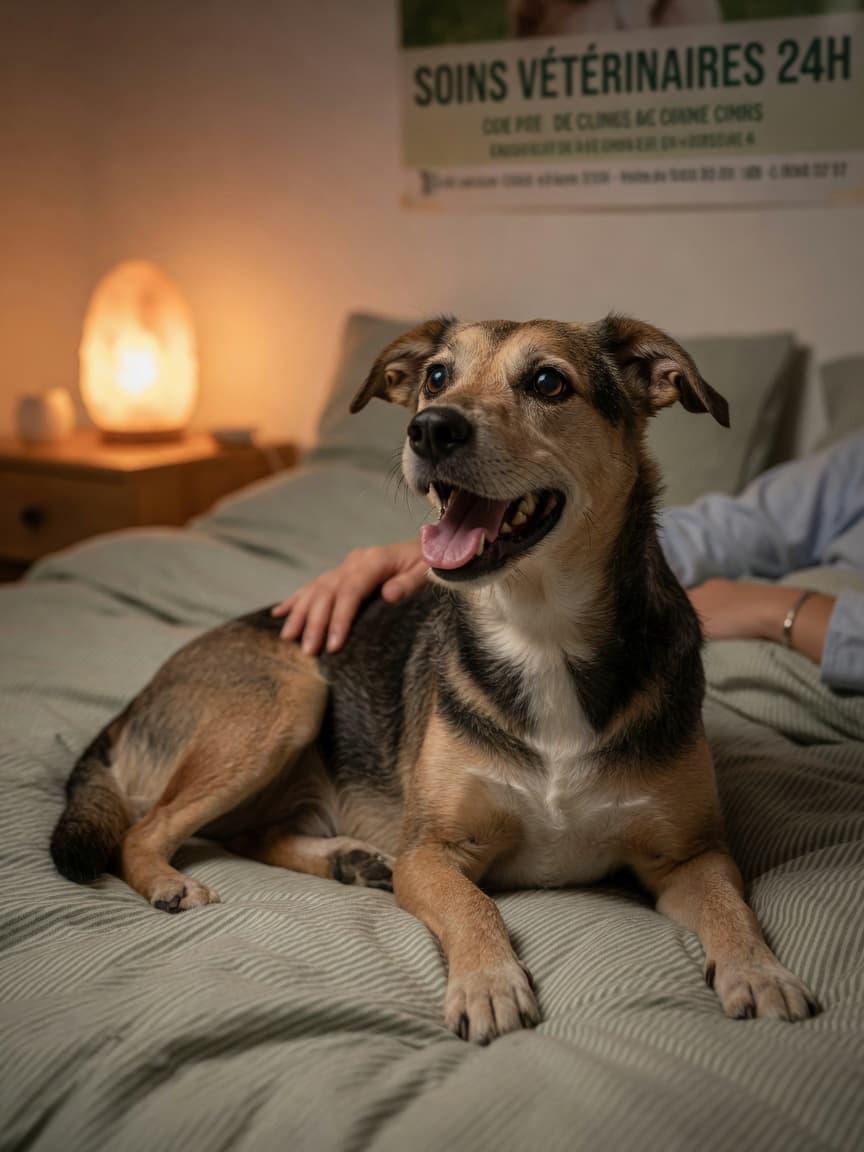
¿Por qué mi perro jadea por la noche?
Actualizado: Junio 2026
Pocas cosas son más inquietantes que despertarse en mitad de la noche por el sonido de tu perro jadeando fuertemente cuando debería estar durmiendo tranquilamente. Los perros jadean para enfriarse — eso es normal. Pero jadear en una habitación fresca, en reposo, en mitad de la noche, no es normal. El jadeo nocturno merece atención porque a menudo indica que algo genuinamente está mal: dolor que es menos distractivo por la noche, ansiedad que se intensifica en la oscuridad, o enfermedad de órganos que interrumpe los patrones normales de descanso. Aquí hay un análisis exhaustivo de qué está sucediendo y qué debes hacer.
Jadeo normal vs. anormal
Primero, una base: el jadeo es el mecanismo principal de los perros para la termorregulación. Los perros no transpiran eficientemente a través de su piel, por lo que mueven rápidamente aire sobre las superficies húmedas de la lengua, paladar y vías respiratorias para evaporar agua y disipar calor. Es completamente normal que un perro jadee después del ejercicio, durante el clima cálido, o en momentos de excitación. El jadeo anormal ocurre cuando no existe un desencadenante obvio — cuando la habitación está fresca, el perro ha estado descansando, y el jadeo es persistente, fuerte, o claramente angustioso para el perro. El jadeo anormal a menudo se acompaña de inquietud, incapacidad para ponerse cómodo, cambios repetidos de posición y paseos. Este patrón nocturno necesita investigación.
1. Sobrecalentamiento
Incluso de noche, un perro puede sobrecalentarse si el dormitorio o el ambiente de sueño es demasiado cálido, si tienen un pelaje doble grueso, o si hay una condición de salud que afecta su capacidad para regular la temperatura. Las razas de hocico plano (braquicefálicas) — Bulldogs Franceses, Pugs, Bulldogs y Boston Terriers — están particularmente en riesgo porque sus vías respiratorias constreñidas hacen que la termorregulación sea ineficiente. Si tu perro duerme cerca de un radiador, bajo mantas pesadas, o en una habitación sin ventilación en verano, el sobrecalentamiento puede ser la causa. Asegura un espacio de sueño fresco y bien ventilado, y proporciona acceso a agua fresca en todo momento. Si se aborda el sobrecalentamiento y el jadeo se resuelve, no se necesita intervención adicional.
2. Dolor e incomodidad física
El dolor es una de las causas más importantes — y más fácilmente pasadas por alto — del jadeo nocturno. Durante el día, la actividad y la distracción enmascaran el dolor crónico, pero por la noche, cuando el perro se acomoda y no hay nada que hacer excepto estar quieto, el dolor se convierte en la experiencia dominante. La artritis es particularmente notoria por este patrón: las articulaciones inflamadas duelen en posiciones sostenidas, y un perro con artritis puede jadear, pasear y cambiar repetidamente de posición toda la noche. Otras fuentes de dolor incluyen enfermedad dental, dolor de órganos internos, enfermedad de disco, cáncer e incomodidad post-quirúrgica. Si tu perro es mayor, nunca ha sido evaluado para artritis, y jadea por la noche, una consulta de manejo del dolor con tu veterinario puede ser transformadora.
3. Ansiedad y síndrome de disfunción cognitiva (CDS) en perros mayores
La ansiedad puede intensificarse por la noche por varias razones: la casa está más silenciosa, el perro es más consciente de los sonidos, y la comodidad de la actividad humana está ausente. La ansiedad por separación que se resuelve cuando el dueño está en la habitación (incluso durmiendo) es una variante. Más específicamente, el síndrome de disfunción cognitiva (CDS) — el equivalente canino de la demencia — es una causa común de jadeo nocturno, inquietud y desorientación en perros mayores de 11 años. Los perros con CDS pueden pasear, vocalizar, parecer confundidos sobre dónde están, no reconocer momentáneamente a personas familiares, e invertir su ciclo sueño-vigilia (durmiendo todo el día, paseando y jadeando por la noche). El CDS no es curable pero es manejable con enriquecimiento ambiental, suplementos dietéticos (triglicéridos de cadena media), y medicamentos como selegilina o melatonina para la interrupción del sueño.
4. Enfermedad de Cushing (hiperadenocorticismo)
La enfermedad de Cushing causa niveles crónicamente elevados de cortisol, y el cortisol tiene una relación compleja con el sueño y el descanso nocturno. Los perros con Cushing frecuentemente jadean excesivamente, día y noche, como parte de su cuadro sintomático general. El cortisol elevado afecta la regulación normal de la respuesta al estrés del cuerpo, causando un estado persistente de "aceleración" incluso cuando el perro debería estar en reposo. Otros signos de Cushing incluyen apariencia de barriga prominente, aumento de bebida y micción, pérdida de pelo (especialmente sobre el tronco), piel delgada o frágil, y pérdida muscular. Si tu perro es de mediana edad a mayor y tiene varios de estos signos junto con jadeo nocturno, la enfermedad de Cushing es un candidato fuerte. Se requiere pruebas hormonales específicas para el diagnóstico.
5. Enfermedad cardíaca y condiciones respiratorias
La enfermedad cardíaca reduce la capacidad del corazón para bombear sangre eficientemente, causando que el líquido se acumule en o alrededor de los pulmones (insuficiencia cardíaca congestiva). Esto hace que la respiración sea laboriosa, y el jadeo es la respuesta compensatoria del perro. Crucialmente, la acumulación de líquido en la insuficiencia cardíaca a menudo es peor cuando el perro está acostado — las fuerzas gravitacionales desplazan el líquido a los pulmones más fácilmente en posición recostada, por lo que el jadeo nocturno y la tos son signos de advertencia temprana de descompensación cardíaca. Otras condiciones respiratorias incluyen enfermedades pulmonares crónicas, bronquitis, y neumonía, todas las cuales pueden causar jadeo nocturno persistente. Si tu perro es mayor, tiene una raza predispuesta a enfermedad cardíaca (como spaniel, labrador, o ciertas razas pequeñas), o tiene antecedentes de soplo cardíaco, la evaluación cardíaca es esencial.
6. Infecciones o inflamación
Las infecciones respiratorias agudas — como la traqueobronquitis infecciosa canina (tos de las perreras) — pueden causar jadeo y tos nocturna. Del mismo modo, la inflamación de las vías respiratorias superiores, la rinitis alérgica, o la enfermedad de las amígdalas pueden intensificarse cuando el perro está acostado. Si el jadeo es relativamente nuevo, va acompañado de tos, secreción nasal, o estornudos, una infección o inflamación aguda es probable. Esto puede mejorar con el tratamiento veterinario.
7. Medicamentos y efectos secundarios
Ciertos medicamentos pueden causar jadeo como efecto secundario. Los corticosteroides (como la prednisona), que se prescriben para alergias, inflamación, o problemas autoinmunitarios, imitan el Cushing's y pueden causar jadeo persistente. Los estimulantes cardíacos y otros medicamentos pueden afectar los patrones de respiración y sueño. Si tu perro comenzó a jadear por la noche poco después de comenzar un nuevo medicamento, discute esto con tu veterinario — no suspendas el medicamento sin orientación, pero pide que se evalúen las alternativas.
Qué hacer: pasos para el diagnóstico y el tratamiento
1. Documenta el jadeo: Mantén un registro simple de cuándo ocurre el jadeo, cuánto dura, si está acompañado de otros signos (tos, vómitos, confusión, incontinencia), y cualquier patrón evidente. Esto ayudará a tu veterinario a identificar la causa.
2. Evalúa el ambiente: Verifica la temperatura de la habitación, la ventilación, y el acceso al agua. Considera si tu perro está durmiendo sobre una superficie que lo mantiene frío (como un piso de baldosas), o si necesita una cama ortopédica si tiene artritis sospechada.
3. Visita a tu veterinario: El jadeo nocturno inexplicado justifica un examen físico completo y, muy probablemente, algunas pruebas de diagnóstico. Un examen físico debe incluir una evaluación cardíaca (escucha de soplos, arritmias), una evaluación pulmonar (escucha de crujidos o sonidos anormales), un examen de salud oral, y una evaluación del estado articular y neuromuscular. Dependiendo de los hallazgos, se pueden recomendar pruebas:
- Análisis de sangre (hemograma completo y panel químico): Detecta infección, enfermedad hepática o renal, y problemas de cortisol suggestivos de Cushing's.
- Pruebas de cortisol: Como la prueba de cortisol salival o la prueba de supresión de dexametasona de dosis baja si se sospecha Cushing's.
- Radiografías de tórax: Revela el tamaño del corazón, el líquido pulmonar, y otras anomalías pulmonares.
- Electrocardiograma (ECG) o ecocardiografía: Evalúa la función cardíaca en detalle si se sospecha enfermedad cardíaca.
- Análisis de orina: Detecta infección del tracto urinario, diabetes, y enfermedad renal.
4. Implementa el tratamiento: Una vez diagnosticada la causa, el tratamiento es específico. Para la artritis, esto puede incluir suplementos de pienso para perros enriquecidos con glucosamina (HolistaPet y otras marcas ofrecen opciones de calidad), fisioterapia, analgésicos, o inyecciones de ácido hialurónico. Para la ansiedad, esto puede incluir desensibilización, enriquecimiento ambiental, o medicamentos como fluoxetina o trazodona. Para el CDS, una combinación de dieta (con triglicéridos de cadena media), melatonina o selegilina, y entorno predecible ayuda. Para la enfermedad cardíaca, los diuréticos, inhibidores ACE, y pienso para perros con bajo sodio son estándar. Para Cushing's, se emplean medicamentos como mitotano o trilostano.
Pienso y nutrición para perros con jadeo nocturno
Si el jadeo está relacionado con la edad (CDS, artritis, enfermedad cardíaca), la nutrición es crucial. Busca pienso para perros de alta calidad diseñado para perros mayores, con:
- Proteína de fácil digestión
- Glucosamina y condroitina para la salud articular
- Ácidos grasos omega-3 para la inflamación y la función cognitiva
- Antioxidantes como la vitamina E y el selenio
- Bajo sodio si hay enfermedad cardíaca
Zooplus ofrece una amplia gama de pienso para perros mayores de marcas confiables, y puedes filtrar por necesidad de salud específica. La consistencia dietética y el pienso de calidad veterinaria pueden retrasar el progreso de muchas condiciones crónicas.
Cuándo es una emergencia
Lecturas relacionadas
Fuentes y lectura adicional
Este artículo se basa en investigación veterinaria revisada por pares y fuentes fiables de salud animal. Explora la ciencia de fondo en nuestra Biblioteca de Investigación.
Related articles
Las 19 Mejores Protectoras de Animales de Países Bajos (2026)
Mejores refugios de animales España: clínicas veterinarias, rescate de mascotas y protectoras con mejores valoraciones Google.
Read more →Las 48 Mejores Protectoras de Animales de Alemania (2026)
Refugios de animales en España: protección de mascotas, veterinarios y pienso. Análisis de clínicas veterinarias certificadas para cuidado animal.
Read more →Las 25 Mejores Protectoras de Animales de Italia (2026)
Mejores refugios y protectoras de animales en España: perros, gatos y mascotas rescatadas. Clínicas veterinarias y asociaciones de protección animal.
Read more →Las 32 Mejores Protectoras de Animales de Francia (2026)
Refugios y asociaciones de animales en España: rescate de mascotas, perros y gatos. Clínicas veterinarias y protectoras verificadas por opiniones.
Read more →Las 8 Mejores Protectoras de Animales de Portugal (2026)
Refugios de animales en España: perros, gatos y mascotas rescatadas por asociaciones y clínicas veterinarias. Ranking de mejores centros de recolha basado en reseñas Google.
Read more →Colapso traqueal en Yorkshire Terrier: Causas, signos y cuidados
Los Yorkshire Terriers son una de las razas más comúnmente afectadas por el colapso traqueal, en gran medida porque el cartílago de su tráquea es naturalmente más blando y más propenso a debilitarse que en perros más grandes. Esto significa que los anillos de cartílago que mantienen la vía aérea abierta pueden aplanarse durante la respiración, causando una tos característica seca y ronca...
Read more →