
When Your Dog Loses the Use of Their Legs
Spinal cord injuries account for some of the most distressing presentations in veterinary neurology. In the United Kingdom alone, intervertebral disc disease — the leading cause of spinal cord trauma in dogs — affects an estimated one in five Dachshunds over their lifetime. Whether the injury stems from a disc herniation, trauma, or a degenerative process, the path from diagnosis to recovery begins with understanding how severely the spinal cord has been affected.
How Vets Grade Spinal Cord Injuries
Veterinary neurologists use a standardised five-grade scale to assess the degree of spinal cord dysfunction. This grading system directly informs both prognosis and treatment decisions, so understanding it helps owners ask the right questions.
The Five-Grade Scale
- Grade 1: Pain only, no neurological deficits. The dog is ambulatory and shows no weakness.
- Grade 2: Ambulatory with weakness and incoordination (ataxia). The dog can still walk but stumbles or knuckles over.
- Grade 3: Non-ambulatory paraparesis. The dog cannot walk but retains some voluntary limb movement.
- Grade 4: Paralysis with intact deep pain perception. The dog cannot move the limbs but still feels a deep pinch stimulus.
- Grade 5: Paralysis with absent deep pain perception. This is the most severe presentation, indicating significant cord damage.
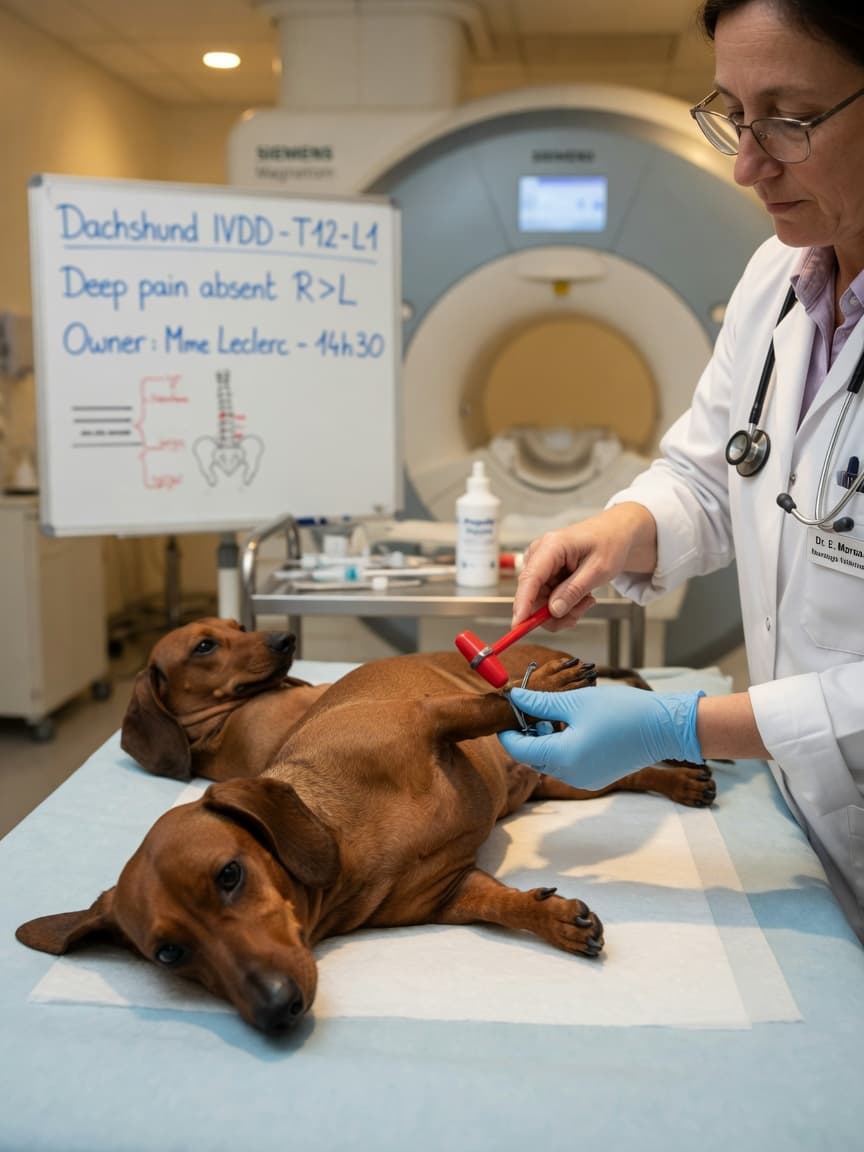
Deep pain perception is assessed by the vet applying firm pressure to the toes and watching for a conscious response — a head turn, vocalisation, or attempt to bite. An absent response at Grade 5 changes the prognosis considerably and usually prompts urgent surgical discussion.
Common Causes and Affected Breeds
Intervertebral disc disease (IVDD) is the predominant cause, occurring in two forms. Type I, common in chondrodystrophic breeds such as Dachshunds, Beagles, and French Bulldogs, involves acute disc extrusion where the nucleus pulposus ruptures into the spinal canal. Type II, seen more often in larger breeds like Labrador Retrievers and German Shepherds, is a slower protrusion of the fibrous outer ring. Traumatic causes — road accidents, falls, and dog fights — can injure any breed and any region of the spine. Degenerative myelopathy, a progressive genetic condition affecting German Shepherds and Corgis in particular, mimics spinal cord injury but is non-compressive in nature.
Diagnostics: Beyond the Physical Examination
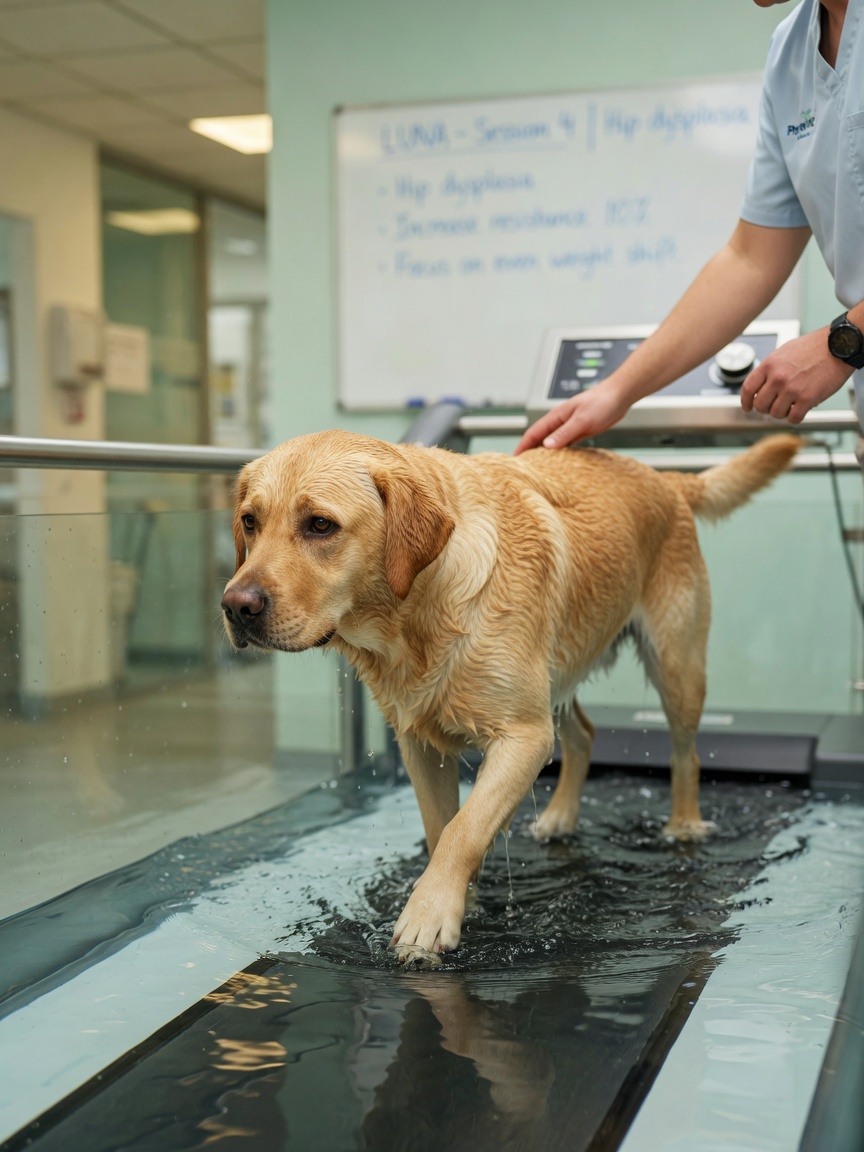
MRI is the gold standard for spinal cord evaluation, offering detailed visualisation of the cord itself, disc material, haemorrhage, and any concurrent swelling. CT myelography remains a practical alternative where MRI is unavailable. Plain radiographs have limited utility for soft-tissue lesions but can identify vertebral fractures or malformations. Accurate localisation of the lesion is essential before surgery is considered, as operating at the wrong spinal segment can worsen outcomes.
Prognosis: What the Evidence Says
Prognosis correlates strongly with grade. Dogs at Grades 1 through 3 treated promptly — either surgically or medically — have recovery rates exceeding 85 to 90 per cent in most published series. Grade 4 dogs who undergo surgery within 24 to 48 hours of losing ambulation recover in approximately 80 to 95 per cent of cases. Grade 5 is where the picture becomes less clear. Dogs who have lost deep pain perception but receive surgery within 12 to 24 hours still have a reasonable chance of recovery, reported at 50 to 60 per cent in some studies. Beyond 48 hours of absent deep pain, recovery rates drop sharply, though individual cases can still surprise.
The Role of Timing
Time to decompression surgery is the single most modifiable prognostic factor the owner can influence. If your dog deteriorates rapidly — moving from walking to complete paralysis within hours — treat this as an emergency. Do not wait for a scheduled appointment.
Rehabilitation After Spinal Cord Injury
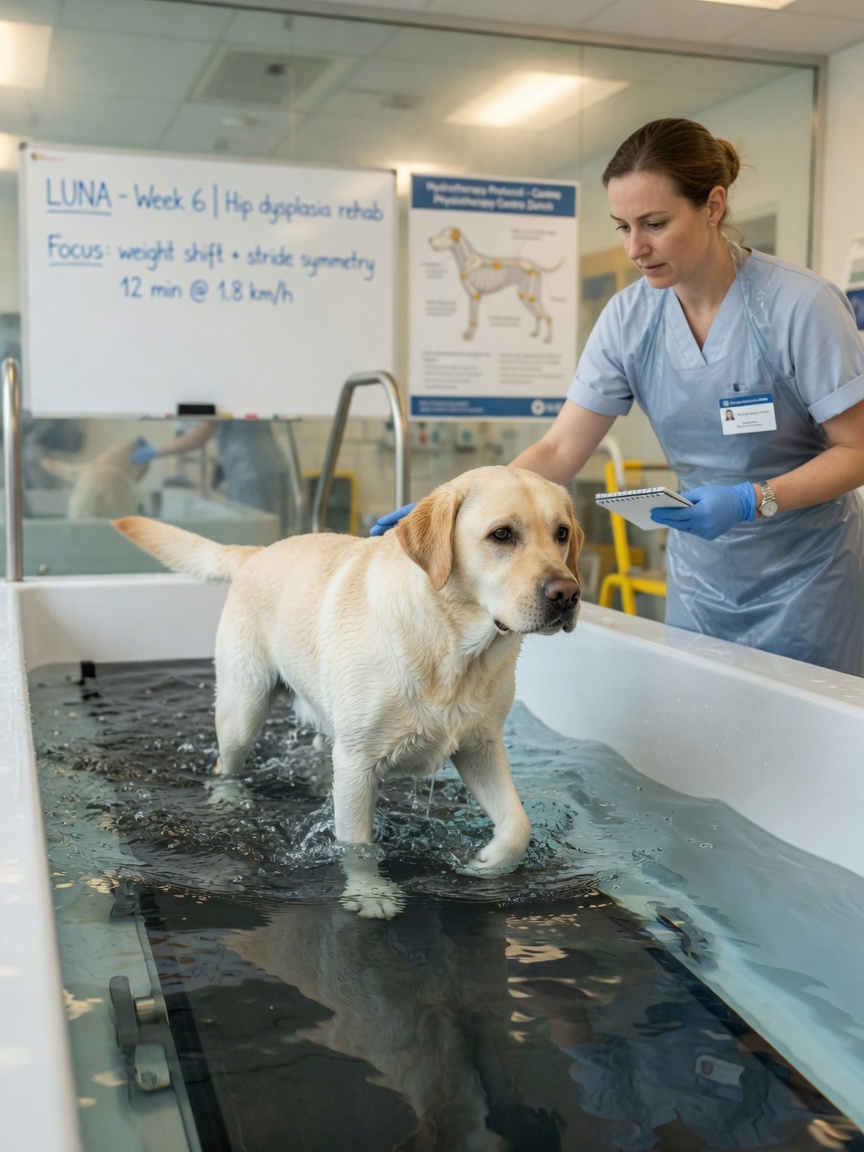
Rehabilitation is no longer an optional add-on; it is an evidence-based component of neurological recovery. Programmes typically include hydrotherapy, particularly underwater treadmill walking, which reduces weight-bearing load while maintaining limb movement and muscle mass. Manual therapy, passive range-of-motion exercises, and neuromuscular electrical stimulation (NMES) are also used to encourage nerve regeneration and prevent muscle atrophy. Bladder management is a critical and often overlooked aspect — dogs with spinal cord injuries frequently cannot void normally, requiring manual expression or catheterisation several times daily until function returns. A qualified veterinary physiotherapist or rehabilitation specialist should guide the programme, adjusting it as the dog progresses. Most recovery, when it occurs, happens within the first eight to twelve weeks, though subtle improvements can continue for six months or beyond.
Wheelchair Carts
For dogs who do not recover full mobility, a well-fitted rear-support cart can restore independence and quality of life significantly. Many dogs adapt to these devices within days and remain active, continent, and apparently content.
Practical Steps for Owners
- Act quickly: rapid deterioration warrants same-day emergency assessment.
- Request MRI or CT myelography to localise the lesion accurately before any surgical decision.
- Ask your vet to explain the grade and what it means for surgical versus conservative management.
- Begin a structured rehabilitation programme as soon as your vet clears it post-operatively.
- Attend to bladder and bowel care meticulously — infection is a preventable complication.
- Set realistic but open-minded expectations: many Grade 4 and some Grade 5 dogs regain function.
Always work with a veterinary neurologist and, where possible, a certified rehabilitation practitioner. Spinal cord injuries are manageable, and for the majority of dogs, a meaningful recovery is a realistic goal when treatment is timely and rehabilitation is sustained.