

Why Dog Food Labels Matter More Than You Think
Most dog owners glance at the front of a food packet and move on. The picture of the golden retriever bounding through a field, the words "natural" or "premium" in large type — these tell you almost nothing about what is actually inside. The genuinely useful information is found in the small print on the back or side of the pack, and it is structured according to legal requirements that most owners have never been shown how to interpret.
In the European Union, pet food labelling is governed by EU Regulation 767/2009. Following Brexit, the UK retained broadly equivalent rules. Understanding these regulations gives you a significant advantage as a dog owner, allowing you to compare foods objectively and cut through marketing language.
The First Thing to Check: Complete or Complementary?
Before anything else, find where the label states whether the food is "complete" or "complementary." This is one of the most important distinctions in pet food law and one of the most commonly misunderstood.
A complete food meets all of a dog's nutritional requirements when fed as the sole diet. You can feed a complete food and nothing else (aside from water) without causing nutritional deficiency — provided you feed the correct amount for your dog's weight and life stage.
A complementary food does not meet all nutritional requirements on its own. It must be combined with other foods to provide a balanced diet. Many treats, mixers, and toppers are complementary foods. Many owners feed complementary foods as the main diet without realising it — a mistake that can cause deficiencies over time. Always check before assuming a food is nutritionally complete.
Mandatory Label Elements Under EU Regulation 767/2009
Every dog food sold in the EU or UK must display the following information by law:
- Product name and species (it must state it is for dogs)
- Net quantity by weight or volume
- A "best before" date
- A batch or lot number for traceability
- The name and address of the manufacturer, packer, or importer
- A statement of whether the food is "complete" or "complementary"
- Instructions for use (recommended daily feeding amounts)
- A list of ingredients in descending order by weight before processing
- Analytical constituents: crude protein, crude fat, crude fibre, moisture, and crude ash
How to Read the Ingredients List
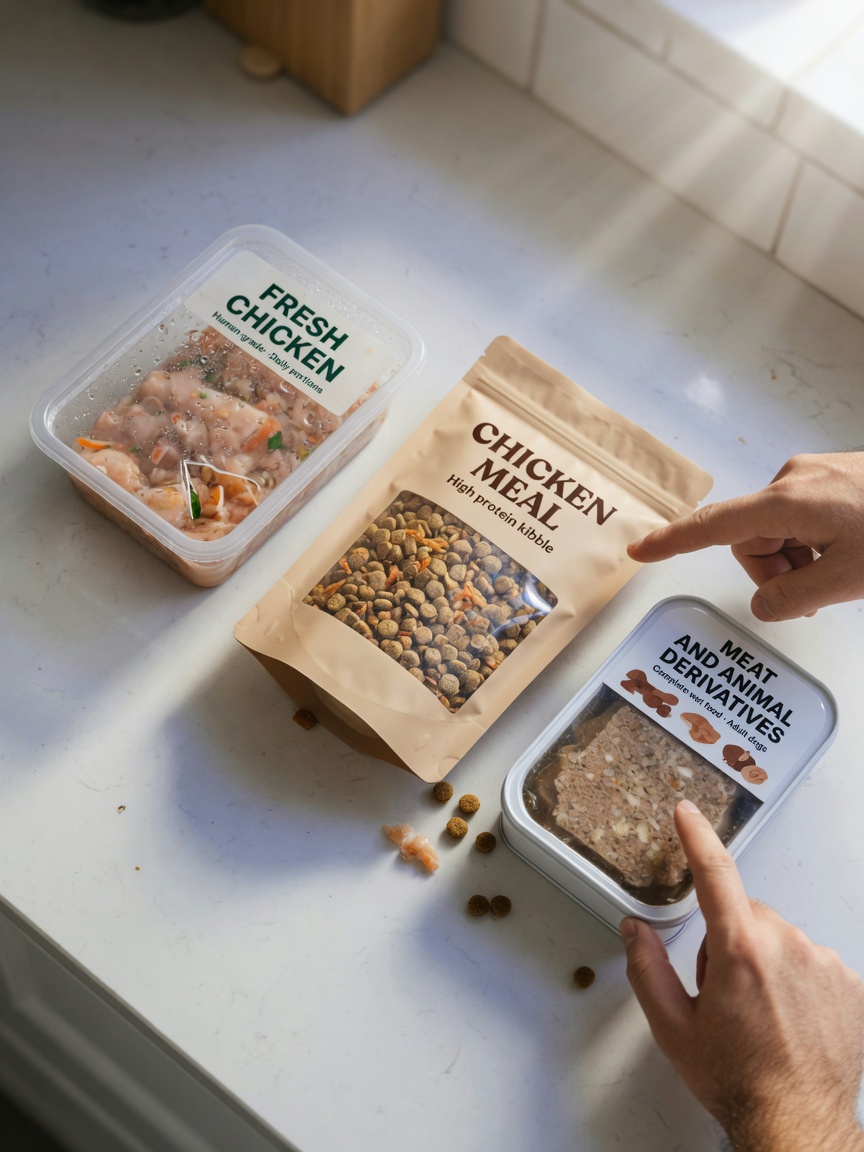
Ingredients are listed in descending order by weight as added before cooking or processing. This sounds straightforward but contains an important subtlety that affects how you interpret the list.
Fresh Meat vs Meal
Fresh or raw meat is listed by its pre-cooking weight, which includes a large amount of water — typically around 70 per cent. So "chicken 40%" sounds impressive, but a significant proportion of that 40% is water that evaporates during cooking. Once cooked, the actual chicken content may be considerably lower than 40%. By contrast, "chicken meal" is a dehydrated ingredient where the water has already been removed. So "chicken meal 25%" may actually deliver more actual chicken protein per 100g of finished food than "chicken 40%" fresh. Neither is inherently better, but understanding this distinction prevents you from being misled by impressive-sounding fresh meat percentages.
Named vs Generic Ingredients
Named protein sources ("chicken," "salmon," "beef") are more transparent than generic terms. "Poultry" could be any bird. "Meat and animal derivatives" is a legal EU category that can include a wide range of animal parts from various species. This is not necessarily harmful — organs and offal are nutritious — but it is less transparent and can change from batch to batch. If you want to know exactly what your dog is eating, look for foods that name specific protein sources throughout the ingredient list.
The "With" Rules
EU Regulation 767/2009 sets minimum percentage requirements for ingredient name claims on packaging:
- "With chicken" — the food must contain at least 4% chicken
- "Chicken dinner" or similar descriptors — minimum 4%
- "Rich in chicken" — minimum 14%
- "Chicken" as the sole ingredient name (e.g., "Chicken for Dogs") — minimum 26%
A product called "Chicken and Rice Dinner" need only contain 4% chicken. Many owners assume a higher proportion based on the name alone. Check the ingredient list to confirm the actual content.
Analytical Constituents
The analytical constituents panel lists five values that must be declared by law:
- Crude protein: total protein content including all nitrogen-containing compounds. Higher is not always better — the quality and digestibility of the protein source matters more than the percentage alone.
- Crude fat: total fat content. Higher fat means more calories per gram.
- Crude fibre: the indigestible plant fibre fraction. Relevant for dogs with digestive issues.
- Moisture: water content. Essential for comparing wet and dry foods on a dry-matter basis.
- Crude ash: the mineral residue after burning — an indicator of bone and mineral content. High ash can sometimes indicate lower-quality ingredients.
Additives and Preservatives
Additives must be declared by category (antioxidants, preservatives, vitamins, minerals) and by name or E number. Natural preservatives such as mixed tocopherols (vitamin E) and rosemary extract are widely used in premium foods. Artificial preservatives such as BHA and BHT have been subject to ongoing debate about long-term safety, though they remain legally permitted in the EU. Checking the additive list is worthwhile if you want to minimise synthetic additives in your dog's diet.
Life Stage Claims
Foods claiming to be formulated for a specific life stage — puppy, adult, or senior — must meet the nutritional profiles set out in FEDIAF guidelines for that life stage. Puppy foods should have higher protein, fat, calcium, and phosphorus to support growth. Senior foods may be lower in phosphorus to support kidney health and adjusted in calorie density. These claims are regulated and meaningful, unlike terms such as "natural" or "premium," which carry no legal definition in pet food.
PFMA Membership and UK Standards
In the UK, the Pet Food Manufacturers Association (PFMA) provides additional guidance and industry standards beyond the legal minimum. PFMA member companies voluntarily adhere to codes of practice on ingredient sourcing, labelling transparency, and nutritional adequacy. Looking for PFMA membership is a useful additional quality indicator when purchasing dog food in the UK.
Putting It All Together
Reading a dog food label well takes a few minutes but becomes quick with practice. Start with complete versus complementary, check that a named protein is the first ingredient, review the analytical constituents for protein and moisture levels relevant to your dog's needs, and look for a FEDIAF or PFMA nutritional adequacy statement. Everything else — the packaging, the lifestyle imagery, the marketing claims — is secondary to these fundamentals.