
The Moment the Lead Unclips
Every year, thousands of dogs are lost, injured, or killed because their owner believed they were reliable off-lead when the evidence suggested otherwise. Off-lead freedom is one of the greatest gifts you can give a dog — but it must be earned through training, not assumed through optimism. Understanding what genuine reliability looks like, and where the process typically breaks down, is the foundation of keeping your dog safe.
What Your Dog Must Know Before the Lead Comes Off
Off-lead walking is not a single skill. It is the product of several trained behaviours working together under real-world conditions.
Recall
A reliable recall means your dog returns to you promptly when called, regardless of what it is currently doing. Not sometimes. Not when there is nothing interesting nearby. A dog that recalls in your garden but not at the park does not have a reliable recall — it has a context-specific response. Testing recall in progressively more distracting environments before removing the lead is essential.
Attention and Proximity
A dog that wanders hundreds of metres away, out of sight or earshot, cannot be recalled effectively even if the recall itself is trained. Teaching a dog to check in voluntarily, and to stay within a reasonable distance, is a prerequisite that many owners overlook entirely. It is built through reinforcement of proximity, not punishment of distance.
Basic Impulse Control
The ability to pause before reacting — to see a squirrel, a cyclist, or another dog and not immediately bolt — is not innate. It develops through consistent training of impulse-control exercises. A dog with no impulse control is unpredictable off-lead regardless of how good its recall appears in calmer moments.
Environments Matter More Than Most Owners Realise
Training is always environment-specific until generalisation is deliberately practised. A dog trained exclusively in a quiet field may perform beautifully until it encounters a busy footpath, livestock, or a group of children running. Each new environment is, in effect, a new test.
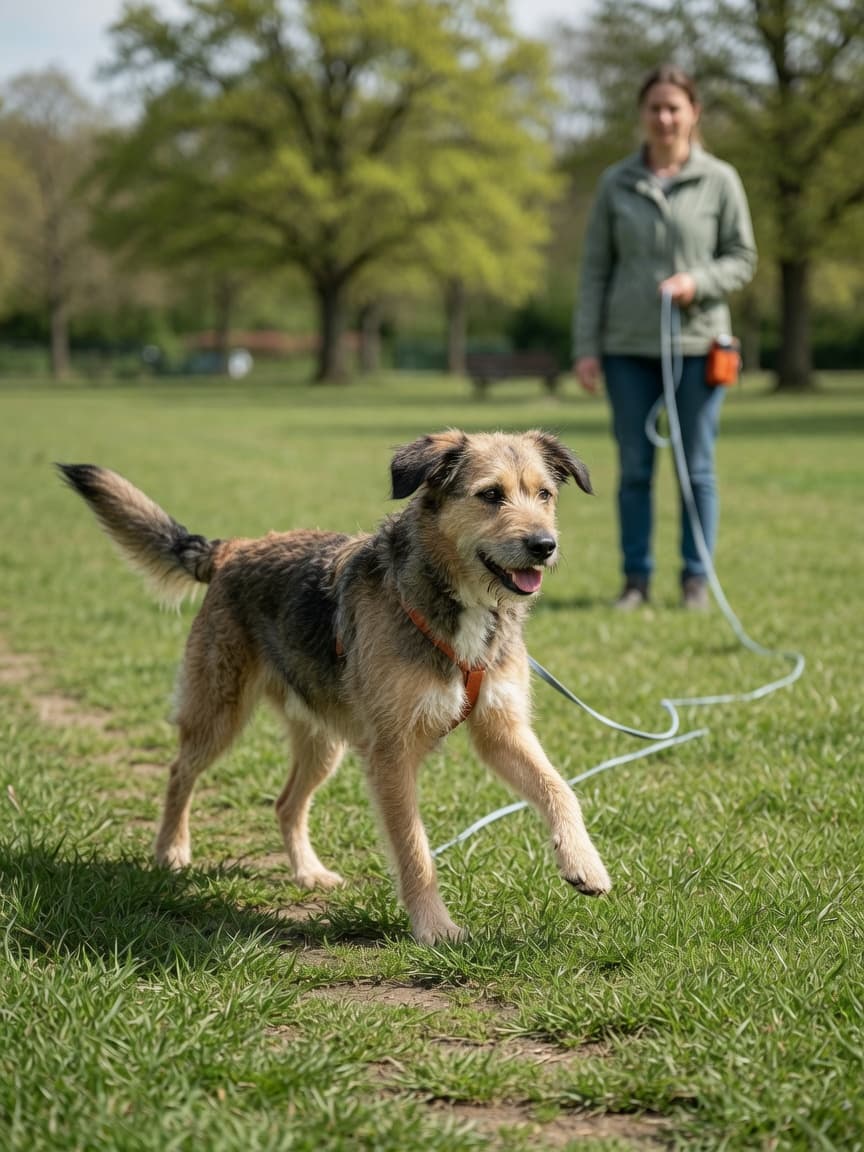
The correct approach is progressive exposure: low distraction first, then gradually increasing complexity. Use a long training line — a lightweight line of ten to twenty metres — during this phase. It allows the dog freedom to explore while giving you the ability to prevent failure. A dog that has never run off in an uncontrolled way is far easier to train than one that has learned the reinforcing experience of disappearing and doing as it pleases.
Where It Typically Goes Wrong
Moving Too Fast
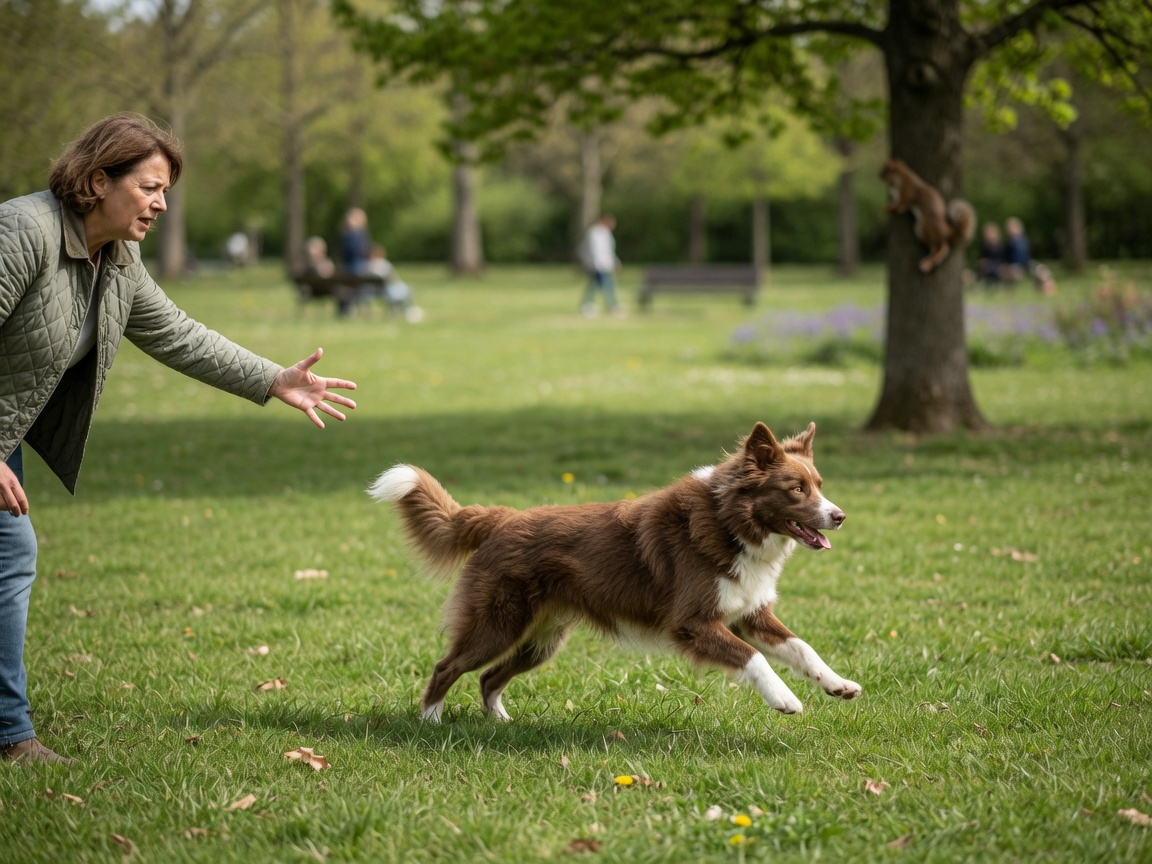
The most common error is removing the lead before training is complete. Owners mistake enthusiasm for reliability, or assume that because a dog comes back when called at home, it will do so in every situation. Real-world distractions — particularly wildlife, other dogs, and traffic — are exponentially more reinforcing than any treat. If the environment is more rewarding than you are, recall will fail.
Poisoning the Recall Cue
If calling your dog back consistently predicts something unpleasant — being told off, having the lead clipped back on at the end of a good run, or being taken home — your dog will start to avoid responding. Every recall should end with something good: a treat, praise, or a moment of play before the lead goes back on. Never call your dog to you to punish it.
Breed and Instinct Blindness
Some breeds have drives that fundamentally complicate off-lead reliability. Sighthounds may be triggered into a chase by fast movement and cover ground too fast to be stopped. Scent hounds follow their nose and become effectively deaf to recall. Herding breeds may attempt to control other animals or children. This does not mean these dogs can never be off-lead, but it means that standard training timelines and assumptions do not apply. Specialist advice is often warranted.
The Long Line: Your Best Training Tool
A long training line is not a compromise — it is an active training tool. It allows a dog to experience the freedom and smells of a proper walk while preventing the self-reinforcing behaviour of ignoring recall and running off. Over time, as reliability builds, the line can be dropped (so it trails on the ground), then shortened, then removed. This graduated process produces far more genuine reliability than removing the lead and hoping for the best.
Long lines should be lightweight, attached to a harness rather than a collar, and never wrapped around hands or fingers. A sudden sprint at the end of a taut line can cause significant injury to both handler and dog.
Practical Steps to Build Off-Lead Reliability
- Establish a clear recall cue — one word or whistle — and never use it until it is conditioned to produce an immediate positive response in low-distraction settings.
- Use high-value, novel treats for recall training: something the dog does not receive at any other time.
- Practise recall ten to twenty times per walk on the long line before removing it.
- Never end a recall by going straight home — recall frequently during a walk, reward, then release again.
- If recall fails three times in a session, return to the long line and reduce distraction levels. Failure rehearsed becomes a habit.
- Consult a reward-based trainer if progress stalls. Off-lead reliability built on punishment-based methods tends to be fragile under pressure.
There is no shortcut to reliable off-lead behaviour, but there is a clear path. Work the process, respect your dog's breed instincts, and resist the urge to rush. A dog that genuinely comes back every time is worth every hour spent getting there.