
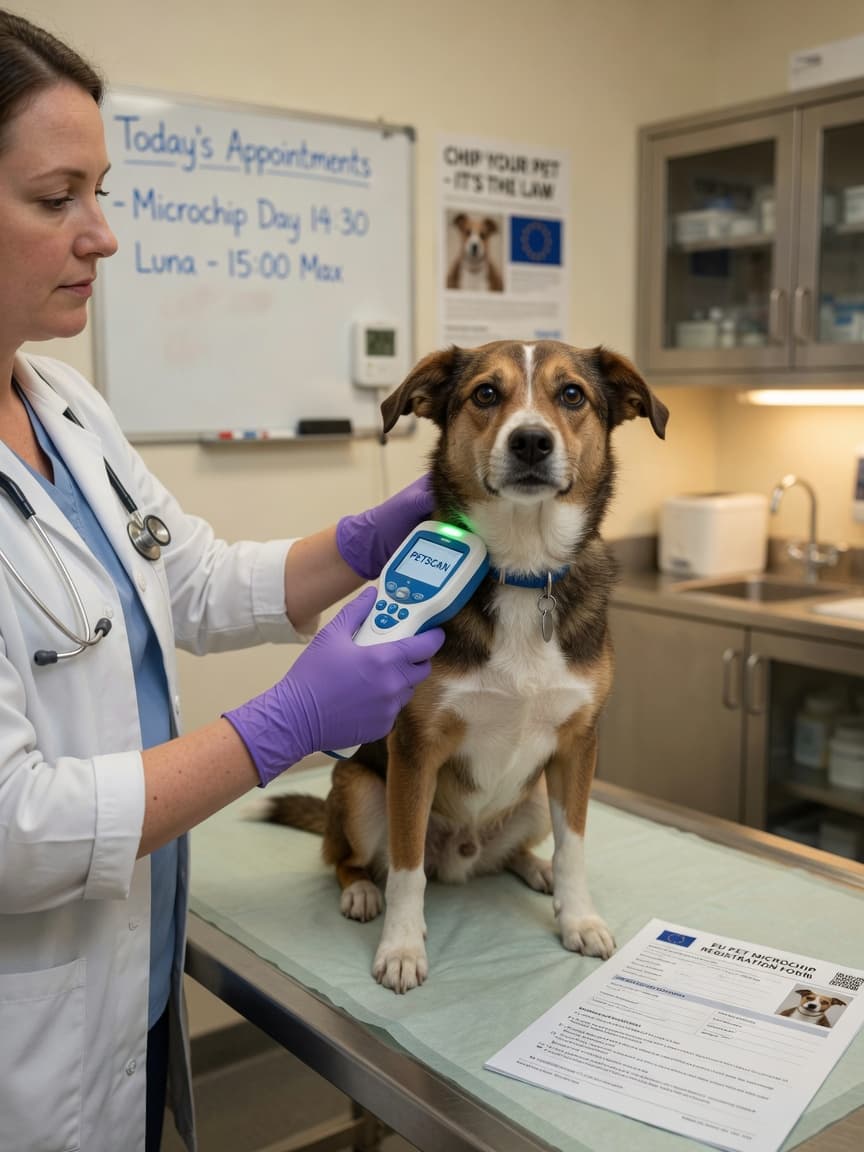
Why Microchipping Matters
A microchip is the most reliable and permanent form of identification available for a pet. Unlike a collar and tag, which can be removed or lost, a microchip is implanted under the skin and remains with the animal for life. When a lost or stray animal is scanned at a vet practice, rescue centre, or by a local authority dog warden, a working chip linked to up-to-date owner details gives the pet its best chance of being reunited with its family.
Across the UK and much of the EU, microchipping is now a legal requirement rather than simply best practice. The rules vary between countries and, in some cases, between regions within the same country. Understanding what the law requires — and what it does not — is important for every pet owner, whether you are at home or travelling abroad.
Microchipping Law in the UK: Dogs
In England, microchipping of dogs has been compulsory since 6 April 2016 under The Microchipping of Dogs (England) Regulations 2015. All dogs must be microchipped before they reach eight weeks of age, and the chip must be registered on a compliant database before the puppy is transferred to a new owner. Scotland and Wales have introduced equivalent legislation with the same practical effect. Northern Ireland has also implemented compulsory dog microchipping through its own regulatory framework.
If a dog is found to be unchipped and its owner is identified, the owner is given 21 days to have the dog microchipped. Failure to comply can result in a fine of up to £500. The requirement applies to all dogs regardless of breed, age, or circumstance — with very limited exceptions for working dogs whose microchipping would interfere with their role, subject to veterinary certification.
Microchipping Law in the UK: Cats
Compulsory microchipping for cats in England was introduced in June 2024 under The Microchipping of Cats and Dogs (England) Regulations 2023. The requirement applies to cats over 20 weeks of age. Cats born before the legislation came into force had a grace period to comply. The same penalty structure applies as for dogs — owners who fail to chip their cat after being given notice can be fined up to £500.
At the time of writing, Wales, Scotland, and Northern Ireland have been consulting on or developing equivalent legislation for cats, but the position differs between the devolved nations. If you own a cat and live outside England, check the current legal position in your part of the UK, as the rules may have changed.
The ISO Standard: What Type of Chip Is Required
Not all microchips are the same. For a chip to be compliant with UK law and internationally recognised for travel purposes, it must meet the ISO 11784/11785 standard. This standard specifies a 15-digit identification number and ensures that the chip can be read by compatible scanners. Most modern veterinary and rescue scanners in the UK and EU are capable of reading ISO-standard chips.
Older chip technologies, including 9-digit and 10-digit chips used in some countries before ISO standardisation, may not be readable by all scanners. If you have a rescue animal or a pet that was chipped abroad, it is worth having the chip checked by your vet to confirm it meets the ISO standard and is readable. For international travel, an ISO-compliant chip is a requirement — a non-standard chip will not be accepted as valid for an Animal Health Certificate or EU entry documentation.
Database Registration: The Critical Step

The microchip itself does nothing unless it is linked to accurate, up-to-date contact details on a recognised database. In the UK, owners must register their pet's chip on a government-compliant database. Several databases operate in the UK, including Petlog (run by the Kennel Club), Microchip Central, PetScanner, and others. Each database holds records that can be accessed by vets, rescue centres, and local authorities when a stray or injured animal is brought in.
One ongoing problem in the UK is that chips are sometimes registered on one database while the animal's new owner updates their details on a different database — creating a situation where different databases hold conflicting or partial records. This is sometimes called database hopping and can significantly delay reunification of lost pets with their owners. When you acquire a new pet, confirm which database the chip is registered on and ensure your contact details are current on that specific database. Services such as PetScanner and the UK's animal reuniting database systems can help identify which database holds a given chip record.
Changing Ownership: Whose Responsibility Is It?
When a dog or cat changes hands — whether through sale, rehoming, or gifting — the seller or transferor is responsible for ensuring the database record is updated to reflect the new owner's details. The new owner should confirm with the database that the transfer has been completed and that their name, address, and contact number are correctly recorded. Failure to update the database after a change of ownership is a common reason why lost pets cannot be returned to their current owners.
If you are selling a litter of puppies or kittens, each animal must be chipped and registered in your name before transfer. Buyers should receive written confirmation of which database holds the record and how to transfer ownership.
Microchipping Laws Across the EU
There is no single EU-wide law requiring microchipping of companion animals. Each member state sets its own rules, though most have introduced mandatory chipping for dogs at minimum, and a growing number are extending requirements to cats. The following gives a broad overview of the position across key countries, though owners should always verify current rules with local authorities or a vet in the relevant country.
- Germany: microchipping is mandatory for dogs in most federal states (Bundesländer), with requirements varying slightly by state.
- France: microchipping (or tattoo, though chips are preferred) is mandatory for all dogs. Cats have been subject to mandatory identification in some departments, with broader requirements expanding over time.
- Spain: mandatory microchipping for dogs in all regions. Several autonomous communities also require cats to be chipped.
- Netherlands: mandatory microchipping for dogs and cats.
- Ireland: mandatory microchipping for dogs under national dog control legislation.
- Italy: mandatory microchipping for dogs. Some regions extend this to cats.
- Belgium: mandatory microchipping and registration for dogs and cats.
In countries where microchipping is required, failure to comply can result in fines, and unchipped animals may be impounded if found straying. If you are moving to another EU country with a pet, research the local registration requirements — some countries require re-registration on a national database even if the animal is already chipped and registered in the UK.
Chip Failure and Migration
Microchip failure is rare but does occur. Chips can occasionally migrate from their original implantation site — typically between the shoulder blades — and may be found elsewhere on the body during scanning. In some cases, a chip may stop functioning. An annual scan at your routine veterinary check-up is a simple way to confirm that the chip is in place, readable, and returning the correct identification number. If a chip is found to have failed, a new one can be implanted and registered.
The Evidence for Microchipping
Studies and data collected by rescue centres and local authorities consistently show that microchipped pets are significantly more likely to be reunited with their owners than those without chips. A chip alone is not sufficient — it must be paired with current database registration — but together they represent the most effective identification system available for companion animals. The law in the UK reflects this evidence, and the expansion of requirements to include cats acknowledges that cats are lost in significant numbers every year and benefit equally from permanent identification.