ForPetsHealthcare
Dogs

How Do Dogs Get Heartworm Disease?

By Julia WrenfieldUpdated September 11, 20264 min read
Evidence-based · Sources checked
{"en": "Dog receiving veterinary examination for heartworm disease screening and prevention", "es": "Perro recibiendo examen veterinario para detecci\u00f3n y prevenci\u00f3n de enfermedad del gusano del coraz\u00f3n", "fr": "Chien subissant un examen v\u00e9t\u00e9rinaire pour le d\u00e9pistage et la pr\u00e9vention de la dirofilariose", "de": "Hund wird veterin\u00e4rmedizinisch untersucht zur Vorsorge gegen Herzwurmerkrankung", "nl": "Hond ondergaat veterinair onderzoek voor screening en preventie van hartwormenziekte", "pt": "C\u00e3o recebendo exame veterin\u00e1rio para triagem e preven\u00e7\u00e3o de doen\u00e7a do verme do cora\u00e7\u00e3o", "it": "Cane sottoposto a visita veterinaria per lo screening e la prevenzione della filariosi cardiaca"}

Heartworm disease is one of the most serious parasitic conditions affecting dogs across Europe and beyond. Yet despite its severity, many pet owners remain unsure about how their beloved companions contract this life-threatening illness. Understanding the transmission route is the first step towards protecting your dog. Unlike some infections that spread directly between animals, heartworm requires a specific vector—the mosquito—making prevention both straightforward and essential.

The Mosquito: The Disease Vector

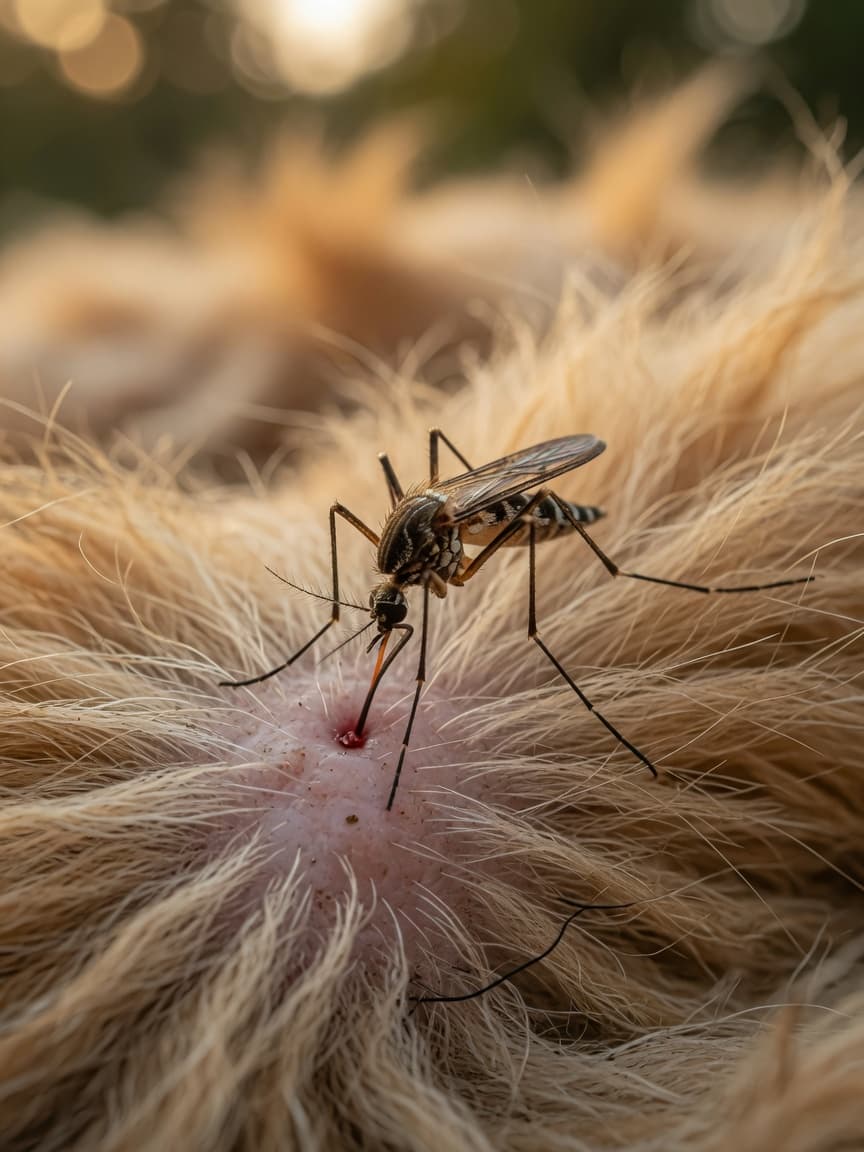
A mosquito hovering near a golden retriever's face during dusk, illustrating the insect vector of heartworm disease transmission.

Heartworm disease cannot be transmitted directly from dog to dog. Instead, mosquitoes serve as the essential intermediary host. When a mosquito bites an infected dog, it ingests microscopic larvae called microfilariae from the dog's bloodstream. These larvae develop within the mosquito over 10-14 days, transforming into infectious third-stage larvae.

When this infected mosquito subsequently bites another dog, the larvae enter through the bite wound and begin their journey through the dog's body. This is why heartworm prevention focuses so heavily on mosquito control and protection.

How Infection Develops in Dogs

Once larvae enter a dog's body, they travel through the bloodstream over several weeks:

  1. Larvae migrate through subcutaneous tissues and body cavities
  2. They reach the heart and pulmonary arteries approximately 6-8 weeks post-infection
  3. Adult worms develop and reproduce, potentially living 5-7 years if untreated
  4. Female worms release microfilariae into the bloodstream, completing the cycle

This progression means infected dogs may show no symptoms initially, allowing the disease to advance silently whilst parasites establish themselves in the heart.

Geographic Risk and Seasonal Factors

A dog sitting in a Mediterranean landscape near standing water during bright sunlight, illustrating the warm climate conditions that support heartworm-carrying mosquito populations.

Heartworm prevalence varies significantly across Europe. Mediterranean regions, including southern France, Spain, Italy, and Greece, experience higher transmission rates due to warmer climates that support mosquito populations year-round. Northern European countries face lower risks, though cases do occur.

Seasonal factors also influence infection risk. Mosquito activity peaks during warmer months (May through October in most of Europe), meaning dogs face greatest exposure during summer. However, in heated indoor environments, mosquitoes can survive throughout winter, necessitating year-round vigilance in some situations.

Risk Factors for Your Dog

Certain circumstances increase your dog's susceptibility to heartworm infection:

  • Frequent outdoor exposure, particularly near standing water where mosquitoes breed
  • Travel to endemic regions during mosquito season
  • Living in warmer climates with extended mosquito seasons
  • Lack of preventative treatment
  • Extended time spent outdoors during dawn and dusk when mosquitoes are most active

Recognition and Prevention

Early-stage heartworm infection often produces no observable symptoms. As the disease progresses, you may notice coughing, lethargy, exercise intolerance, and difficulty breathing. Regrettably, by the time symptoms appear, significant cardiac damage may have already occurred.

Prevention is infinitely preferable to treatment. Your veterinary surgeon can prescribe preventative medications suitable for your dog's age, weight, and health status. These work by eliminating larvae before they mature into adult worms capable of causing harm.

Key Takeaways

Heartworm disease transmission depends entirely on mosquito populations. Your dog contracts the infection exclusively through mosquito bites—never through direct contact with other dogs. Given that prevention is straightforward and remarkably effective, consulting your veterinary surgeon about appropriate preventative strategies is the most important step you can take. Whether your dog lives in a high-risk Mediterranean region or a cooler northern area, understanding local transmission patterns and maintaining consistent prevention protocols will keep your cherished companion safe from this potentially devastating disease.

#how do dogs get heartworm disease#dog health#dog nutrition#forpetshealthcare

Sources & further reading

This article is based on peer-reviewed veterinary research and reputable animal-health sources. Explore the underlying science in our Research Library.

Related articles

The 19 Best Animal Shelters in the Netherlands (2026)

the Netherlands's animal shelters, rescue associations and refuges save thousands of dogs, cats and other animals every year, almost always on tiny budgets and volunteer power. To build the most objective ranking possible, we analysed public Google reviews across more than 56 registered animal-prote…

Read more →

The 48 Best Animal Shelters in Germany (2026)

Germany's animal shelters, rescue associations and refuges save thousands of dogs, cats and other animals every year, almost always on tiny budgets and volunteer power. To build the most objective ranking possible, we analysed public Google reviews across more than 152 registered animal-protection o…

Read more →

The 25 Best Animal Shelters in Italy (2026)

Italy's animal shelters, rescue associations and refuges save thousands of dogs, cats and other animals every year, almost always on tiny budgets and volunteer power. To build the most objective ranking possible, we analysed public Google reviews across more than 121 registered animal-protection org…

Read more →

The 32 Best Animal Shelters in France (2026)

France's animal shelters, rescue associations and refuges save thousands of dogs, cats and other animals every year, almost always on tiny budgets and volunteer power. To build the most objective ranking possible, we analysed public Google reviews across more than 89 registered animal-protection org…

Read more →

The 8 Best Animal Shelters in Portugal (2026)

Portugal's animal shelters, rescue associations and municipal centros de recolha save thousands of dogs, cats and other animals every year, almost always on tiny budgets and volunteer power. To build the most objective ranking possible, we analysed public Google reviews across more than 86 registere…

Read more →

Yorkshire Terrier Collapsing trachea: Causes, Signs & Care

Yorkshire Terriers are one of the breeds most commonly affected by collapsing trachea, largely because their windpipe cartilage is naturally softer and more prone to weakening than in larger dogs. This means the rings of cartilage that hold the airway open can flatten during breathing, causing a cha…

Read more →
Disclaimer:This article is for informational purposes only and does not constitute veterinary advice. Always consult a qualified veterinarian for your pet's health concerns.

Free newsletter

Pet health tips, straight to your inbox

Weekly science-backed advice for dog & cat owners. No spam, unsubscribe anytime.