
Great Dane Breed Overview
The Great Dane is one of the tallest dog breeds in the world, with males standing up to 86 cm at the shoulder and weighing between 50 and 90 kg. Despite the English name, the breed is German in origin — its official German name is Deutsche Dogge. Recognised by the Kennel Club in the Working Group, Great Danes are known for their gentle, affectionate nature, which has earned them the popular nickname "gentle giant."
Sadly, the Great Dane's lifespan is one of the shortest of any dog breed, typically between 7 and 10 years. This makes preventive healthcare, early detection of disease and an informed owner especially important. Anyone considering a Great Dane should understand the significant health challenges this breed faces.
Temperament and Lifestyle Needs
Great Danes are calm, affectionate dogs that form close bonds with their families. They are generally good with children and other animals when properly socialised from puppyhood, though their sheer size demands that socialisation and basic obedience training begin early. An unsocialised or poorly trained Great Dane presents a significant management challenge simply by virtue of its size. They can be stubborn, so consistency in training is essential.
Despite their size, Great Danes do not require excessive exercise — moderate daily activity is sufficient. They do, however, need significant indoor living space. They are not suited to small flats, and they should not be left alone for long periods. Their short, smooth coat requires minimal grooming.
Gastric Dilatation-Volvulus (Bloat)
GDV — commonly called bloat — is the single greatest health threat to Great Danes, who have the highest risk of any breed. In GDV, the stomach fills with gas (dilatation) and then twists on its axis (volvulus), trapping the contents and cutting off blood supply to the stomach wall and surrounding organs. Without emergency surgical intervention, GDV is fatal within hours.
The signs of GDV include unproductive retching (the dog tries to vomit but nothing comes up), a visibly distended abdomen, restlessness, excessive drooling, a hunched posture and, as the condition progresses, collapse. If you see these signs in a Great Dane, go to an emergency veterinary clinic immediately. There is nothing that can be done at home.
Prevention: Prophylactic Gastropexy
Prophylactic gastropexy — a surgical procedure in which the stomach wall is permanently attached to the abdominal wall — is strongly recommended for Great Danes. The procedure does not prevent the stomach from filling with gas, but it prevents the stomach from twisting (volvulus), which is the life-threatening element. It can be performed at the same time as neutering, adding minimal additional risk. Evidence clearly demonstrates that gastropexy dramatically reduces GDV mortality in high-risk breeds. For Great Danes, this is not a minor consideration — it is a potentially life-saving decision.
The Raised Feeding Bowl Controversy
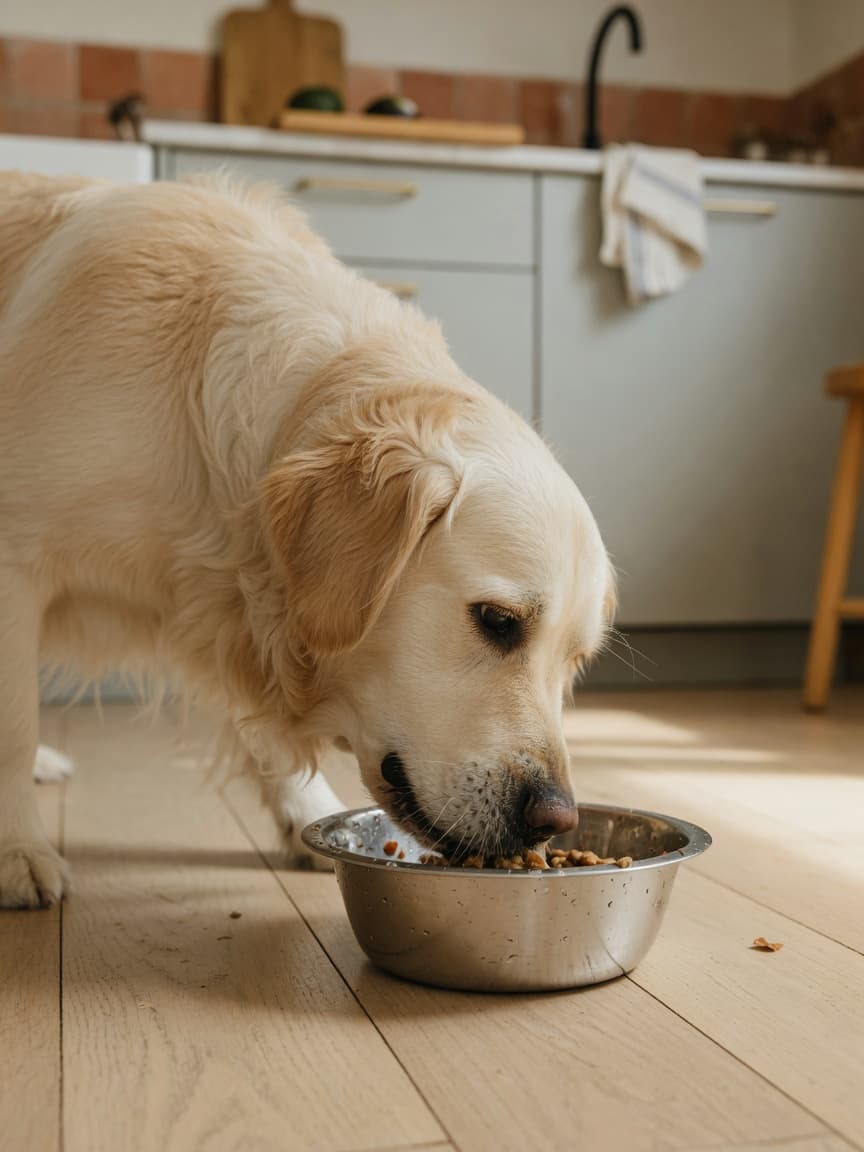
For many years, raised feeding bowls were widely recommended for large and giant breeds on the basis that they might reduce the risk of GDV. Current evidence does not support this advice. A large study from Purdue University actually found that raised feeding bowls were associated with an increased risk of GDV in large and giant breed dogs. The current guidance from the majority of veterinary institutions is to feed Great Danes from a bowl placed on the floor or at a low height. This is a commonly misunderstood topic, and owners who have been given the opposite advice should discuss it with their vet.
Other evidence-based risk reduction strategies include feeding two or three smaller meals per day rather than one large meal, and avoiding vigorous exercise for one to two hours before and after feeding.
Dilated Cardiomyopathy (DCM)
Dilated cardiomyopathy is extremely common in Great Danes. In this condition, the heart muscle weakens and the heart chambers enlarge, reducing the heart's ability to pump blood effectively. This leads to congestive heart failure and potentially life-threatening arrhythmias, particularly atrial fibrillation. The disease may be present and progressing for a considerable time before any outward signs are apparent.
Annual cardiac examination — including auscultation and echocardiography — is recommended for Great Danes from a young age. Medical management includes pimobendan (which improves heart function), ACE inhibitors and diuretics. There is likely a genetic component to DCM in Great Danes, and some research has explored a possible link with taurine metabolism in large breeds, though this remains an area of ongoing investigation.
Wobbler Syndrome (Cervical Spondylomyelopathy)
Wobbler syndrome describes a group of conditions affecting the cervical spine (neck) that result in spinal cord compression. Great Danes are among the most frequently affected breeds, typically developing an osseous-associated form in which bony changes in the vertebrae compress the spinal cord. The characteristic sign is a wobbly, uncoordinated gait in the hindlimbs — sometimes described as the dog appearing drunk. Management can be medical or surgical depending on severity.
Osteosarcoma (Bone Cancer)
Large and giant breeds are significantly more likely to develop osteosarcoma than smaller dogs, and Great Danes are at particular risk. Osteosarcoma most commonly affects the limbs, with the distal radius (just above the wrist) being the most frequently affected site. Signs include sudden lameness and localised swelling over a bone.
Osteosarcoma is an aggressive tumour. Standard treatment involves limb amputation combined with chemotherapy, and even with treatment the prognosis is guarded — median survival times are typically in the region of 10 to 12 months. Early detection and prompt veterinary assessment of unexplained lameness is therefore important.
Bone and Joint Conditions in Young Dogs
Hypertrophic osteodystrophy (HOD) is a painful inflammatory condition affecting the metaphyses (growth plates) of long bones in rapidly growing puppies. Great Danes are among the breeds most commonly affected. Affected puppies show severe lameness, fever and reluctance to move. The condition is managed with rest and anti-inflammatory medication and generally resolves, though it can recur. Panosteitis — sometimes called growing pains — is another condition causing shifting lameness in young large-breed dogs; it is self-limiting.
Great Danes are also susceptible to hip dysplasia, elbow dysplasia and osteochondrosis dissecans of the shoulder. BVA/KC hip scoring is recommended for breeding animals.
Feeding Great Dane Puppies
How a Great Dane puppy is fed during its first year has long-term consequences for its musculoskeletal health. Feeding a diet too high in calcium, or over-supplementing, accelerates bone growth in ways that increase the risk of developmental orthopaedic disease. Very high-protein puppy foods can have a similar effect. The goal is controlled, steady growth — not the fastest possible growth rate. Large-breed puppy food, formulated to support slower, steadier development, is appropriate. Avoid supplementing calcium unless a vet specifically recommends it.
Living With a Great Dane
Great Danes need space, companionship and an owner who is genuinely committed to their care. Their short coat is low-maintenance, but their size means everyday logistics — transport, vet visits, housing — require forward planning. They are sensitive to cold. Given the range of serious health conditions described above, pet insurance taken out from puppyhood is strongly advisable, as veterinary costs for a Great Dane can be substantial.