
How Horse Teeth Work
Unlike humans, horses have hypsodont teeth — teeth that are tall in reserve crown and erupt continuously throughout the horse's life to compensate for the wear caused by grinding fibrous forage. A horse's molar teeth may have a reserve crown of up to eight centimetres at birth, which gradually erupts over the horse's lifetime. This continuous eruption means that dental problems develop progressively over time and require regular professional intervention to manage.
Horses are heterodont, meaning they have different types of teeth serving different functions. The incisors at the front of the mouth are used for grasping and cutting grass, while the premolars and molars (cheek teeth) form a grinding surface called the occlusal table, which breaks down fibrous plant material through a lateral chewing motion. This lateral movement, combined with continuous eruption, is the underlying reason why dental abnormalities are so common in domesticated horses.
Why Sharp Points Develop
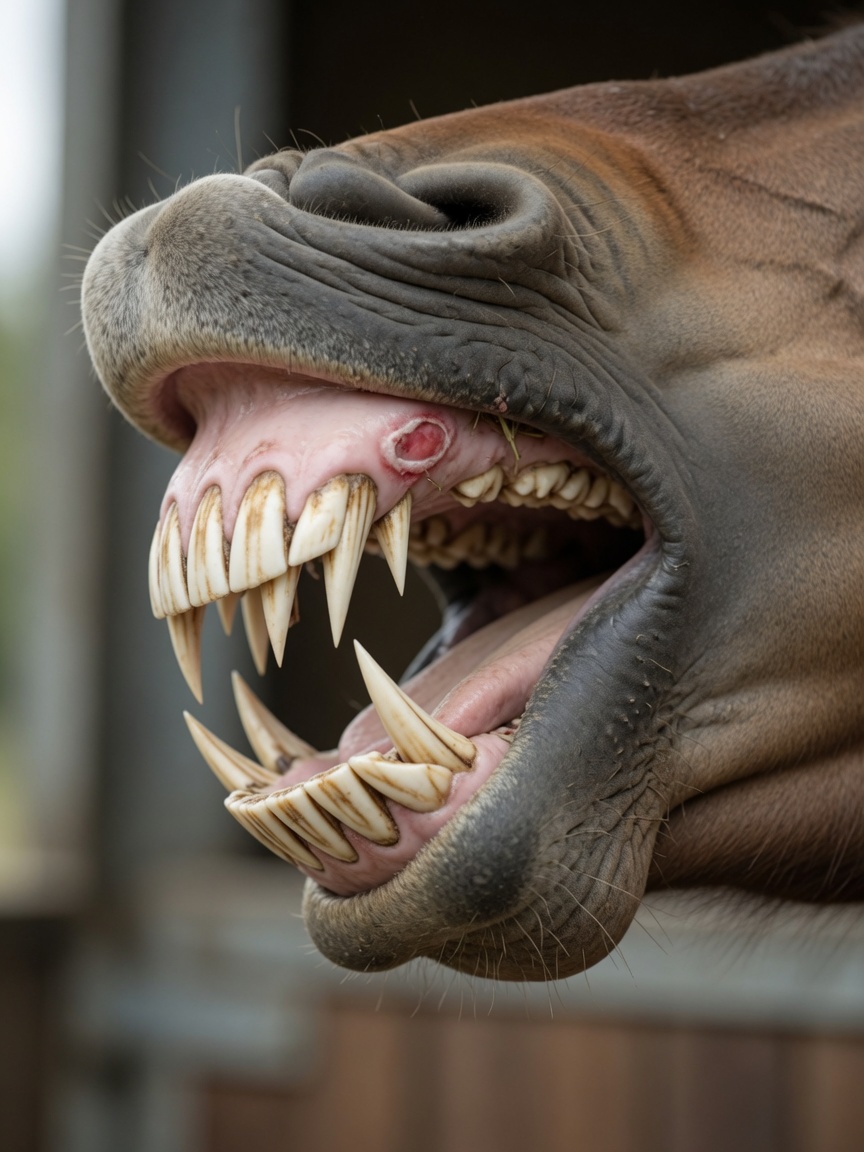
Horses chew in a slightly angled, elliptical motion. Because the upper jaw (maxilla) is wider than the lower jaw (mandible), the outer edges of the upper cheek teeth and the inner edges of the lower cheek teeth are not fully worn by the opposing surface. Over time, these unworn edges develop into sharp enamel points. On the upper cheek teeth, these points form on the outer (buccal) edge, pressing into the cheeks and causing painful ulcers. On the lower cheek teeth, sharp points develop on the inner (lingual) edge, lacerating the tongue.
These ulcers cause considerable pain during eating and when a bit is in place, leading to resistance, head-tossing, and reduced performance. Horses often begin to eat more slowly, drop partially chewed food (a sign known as quidding), or lose weight despite adequate feeding.
Hooks, Ramps, and Other Common Problems
Beyond sharp points, several other dental abnormalities commonly affect horses:
- Hooks: Overgrowths that develop at the front of the upper first cheek tooth (106/206) or the back of the lower last cheek tooth (311/411) when the upper and lower rows do not align perfectly. Hooks restrict the normal sliding jaw motion and can cause significant pain
- Ramps: Sloped overgrowths on the lower cheek teeth, often associated with a step mouth pattern
- Step mouth: When one tooth overgrows into the gap left by a missing or worn opposing tooth, creating an uneven occlusal table that progressively worsens
- Wave mouth: An undulating pattern across the cheek teeth arcade, common in older horses
- Diastemata: Gaps between adjacent teeth that accumulate food, leading to periodontal disease and significant pain
Wolf Teeth
Wolf teeth are small, rudimentary first premolars (premolar 1) that erupt just in front of the first cheek tooth in the upper jaw, and occasionally the lower jaw. They are vestigial teeth with little functional purpose and are present in approximately seventy per cent of horses to varying degrees. Wolf teeth are highly variable in size and position — some are large and well-rooted, whilst others are tiny, partially erupted, or entirely blind (unerupted beneath the gum).
Wolf teeth commonly interfere with bit placement and contact. Even if they appear small, they can cause significant discomfort when the bit presses against them or causes the overlying gum to rub. For this reason, wolf teeth are routinely extracted before a young horse enters work. This is a minor surgical procedure performed by a vet or a qualified equine dental technician (EDT) under local anaesthesia or light sedation.
Floating: What It Involves
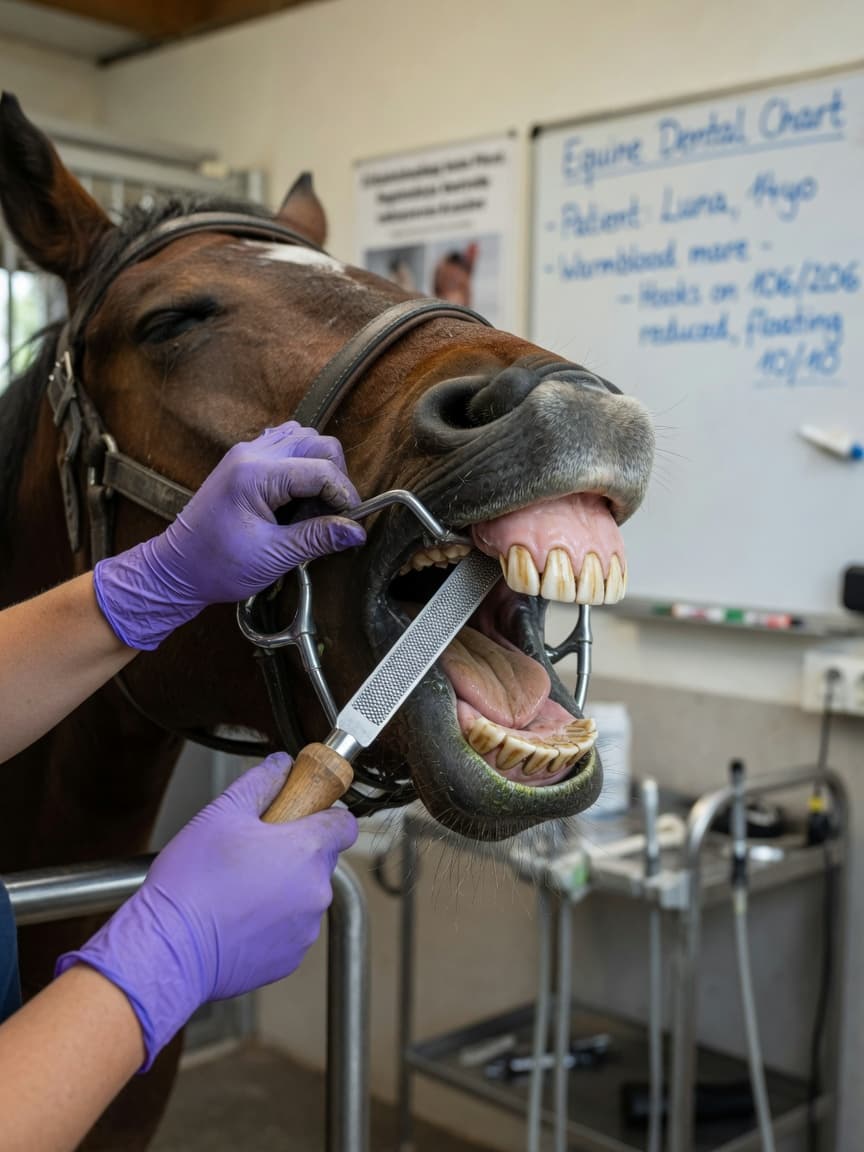
Floating is the process of smoothing or reducing sharp points, hooks, and other overgrowths on the cheek teeth using a rasp or file. The term comes from the masonry technique of smoothing plaster. In equine dentistry, it refers to filing the occlusal surface and edges of the cheek teeth to restore a balanced, comfortable mouth.
Hand Rasps vs Power Tools
Traditionally, floating was performed entirely with long-handled manual rasps. Skilled practitioners can achieve excellent results with hand rasps, and many experienced equine dental technicians continue to prefer them for maintenance work. However, power floating tools — motorised rotary rasps — have become increasingly prevalent and allow more precise reduction of severe overgrowths, hooks, and ramps that would be difficult or impossible to address manually. Power tools require careful use, as excessive reduction of the reserve crown can cause long-term problems. Sedation is typically required for power floating to ensure the horse remains still and the procedure is safe and comfortable.
Who Should Perform Equine Dentistry?
In the UK, equine dental work is carried out by either veterinary surgeons or registered equine dental technicians (EDTs). The British Horse Society (BHS) and the British Equine Veterinary Association (BEVA) recommend using EDTs registered with the British Association of Equine Dental Technicians (BAEDT) or the Worldwide Association of Equine Dentistry (WWAED). Registered EDTs have undergone formal training and examinations to demonstrate competency. They are legally permitted to perform routine dental maintenance but must refer cases requiring diagnosis, sedation, or extraction to a vet. Any concerning findings, such as tooth fractures, infected teeth, or significant periodontal disease, should always be assessed by a veterinary surgeon.
Signs of Dental Pain: Quidding and Beyond
Quidding is one of the most recognisable signs of dental discomfort. It occurs when a horse repeatedly drops balls of partially chewed hay or haylage from the mouth, having failed to swallow them. Other signs that may indicate dental problems include:
- Slow eating or reluctance to eat hard feed or long forage
- Dropping grain or mash from the mouth
- Weight loss despite adequate feeding
- One-sided chewing or tilting the head during eating
- Nasal discharge from one nostril (can indicate tooth root infection)
- Resistance to bitting, head-tossing, or rein contact issues
- Facial swelling below or above the eye line
How Often Should Teeth Be Checked?
Most adult horses benefit from a dental examination every six to twelve months. Young horses between two and five years of age, who are actively shedding deciduous (milk) teeth and erupting permanent teeth, should be seen every six months as retained caps and eruption problems are common during this period. Older horses, particularly those over fifteen, should also be seen more frequently as their teeth become shorter, more fragile, and prone to complex problems including loose teeth, diastemata, and periodontal disease. Your vet or EDT will advise the appropriate interval based on your horse's individual dental status.