
What Are Ear Mites?
Ear mites — caused by the microscopic arachnid Otodectes cynotis — are one of the most common causes of ear irritation in cats and dogs across Europe. Though tiny (just 0.3–0.5 mm in length), these parasites can cause enormous discomfort and, if left untreated, pave the way for painful secondary bacterial and yeast infections that are considerably harder to resolve.
Despite their name, ear mites do not live exclusively inside the ear canal. They can be found on the outer body surface as well, and this is part of what makes them so easily transmissible between animals. Understanding the life cycle, recognising the signs early, and choosing the right treatment are all key to resolving an ear mite problem quickly and preventing it from recurring.
The Ear Mite Life Cycle
Otodectes cynotis completes its entire life cycle on the host animal in approximately 21 days. The cycle begins when eggs are laid by adult females, usually stuck to the lining of the ear canal with a secretion. Eggs hatch into six-legged larvae after around four days. These larvae feed on skin debris and ear secretions before moulting into an eight-legged protonymph, then a deutonymph, and finally into sexually mature adults. The entire process from egg to reproducing adult takes roughly three weeks under normal conditions.
Adult male mites will attach to deutonymphs before they moult into their final form — a behaviour that helps explain how rapidly populations can grow once an infestation takes hold. A single infested animal can carry thousands of mites at different life stages simultaneously, and the constant feeding and movement generate the intense irritation that defines this condition.
How Ear Mites Spread
Ear mites are highly contagious between animals. Transmission occurs through direct physical contact — shared sleeping spaces, play, and grooming are all efficient routes. In multi-pet households, the infestation will almost always spread from one animal to all others unless all pets are treated simultaneously. This is one of the most important points of management: treating only the symptomatic pet while leaving others untreated virtually guarantees that the problem will return.
Ear mites can survive off the host for short periods (a few days under suitable conditions), so bedding and soft furnishings in a heavily infested household may transiently harbour mites. However, environmental survival is far less prolonged than with fleas, meaning that household spraying is rarely necessary if all animals are treated effectively.
Unlike some parasites, ear mites do not typically infect humans. Occasional transient skin reactions have been reported in owners with very close contact with heavily infested animals, but established human infestation is extremely rare.
Clinical Signs: Recognising an Ear Mite Infestation

The signs of ear mite infestation can be unmistakeable — but they can also be confused with other causes of ear disease, particularly yeast otitis and bacterial infection. Distinguishing between them accurately is important, as the treatments differ considerably.
Classic Ear Mite Signs
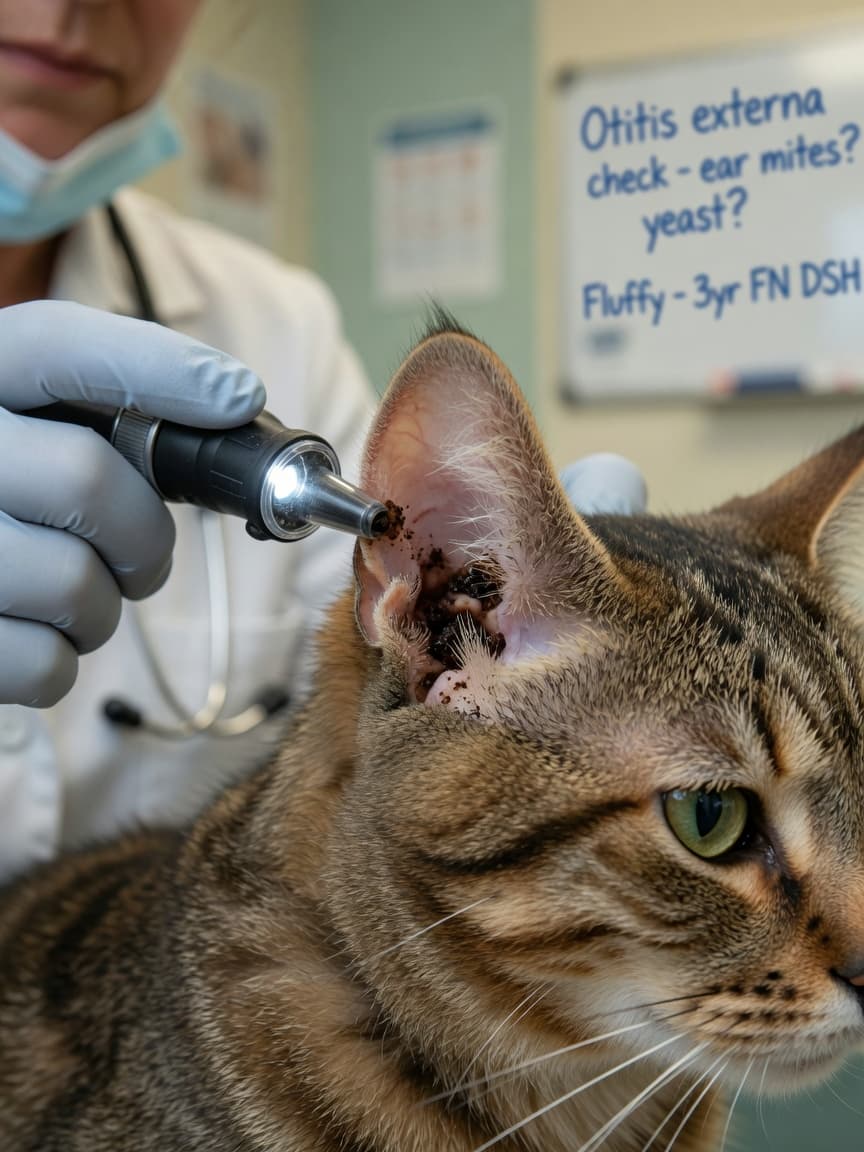
- Dark, crumbly discharge in the ear canal — often described as resembling dark coffee grounds or dry, dark wax. This discharge is a mixture of earwax, dried blood, mite faeces, and debris.
- Intense head shaking — often vigorous and frequent, sometimes forceful enough to cause an aural haematoma (blood blister on the ear flap) in severe cases.
- Scratching at the ears and around the head — often with both hind feet simultaneously in dogs, or using the hind leg in cats.
- Redness and inflammation of the ear canal and outer ear (pinna).
- Excoriation and hair loss around the base of the ear from repeated scratching.
- Odour — a mild, musty smell is common with ear mites; a strongly unpleasant or cheesy odour is more suggestive of secondary bacterial infection.
Distinguishing Ear Mites from Other Ear Conditions
Ear mites tend to produce a dark, dry, crumbly discharge rather than the creamy, yellow, or brownish wet discharge more typical of yeast or bacterial otitis. Yeast infections (Malassezia otitis) often have a characteristic sweet or musty odour and are associated with moisture, allergies, or anatomical factors such as heavy, pendulous ears. Bacterial infections tend to produce a foul-smelling, purulent discharge.
Accurate diagnosis requires veterinary examination. Your vet will use an otoscope to visualise the ear canal and look for moving white specks (the mites themselves), and may take a swab for microscopic examination — a technique called tape preparation — where ear debris is pressed onto adhesive tape and examined under a microscope to confirm mite presence.
Treatment Options
Several effective treatments are available for ear mites in dogs and cats.
Systemic Spot-On Treatments
- Stronghold (selamectin) — a spot-on treatment applied to the back of the neck that distributes through skin oils and reaches the ears. Licensed in Europe for the treatment of ear mites in both cats and dogs. Stronghold also provides flea control, making it a convenient option for multi-parasite management.
- Advocate (imidacloprid/moxidectin) — whilst primarily used for flea and lungworm prevention, Advocate also carries a label claim for ear mite treatment in cats and dogs in many European countries.
Ear-Specific Treatments
- Otodex Veterinary Ear Drops — available without prescription in many European countries and provide symptomatic relief alongside antiparasitic action. Suitable for mild infestations in otherwise healthy adult animals.
- Prescription ear preparations containing ivermectin, milbemycin, or thiabendazole may be recommended by your vet for more severe cases or where secondary infection is present.
In cases where significant secondary infection has developed, your vet may prescribe antibiotic or antifungal ear drops in addition to the antiparasitic treatment. Never assume that an ear problem is mites and self-treat without diagnosis, particularly if your pet is in significant pain, if there is a ruptured eardrum (head tilt, marked imbalance, reluctance to eat), or if the discharge is heavily purulent.
Treating All Pets in the Household
This point cannot be overemphasised: in any household with multiple cats, dogs, or a combination of both, all animals must be treated simultaneously even if only one appears symptomatic. Cats, which may harbour ear mites with minimal outward signs, are a common source of reinfestation in households where only the dog is treated. A single monthly application of Stronghold to all pets in the home is one of the most straightforward ways to eliminate ear mites and reduce the risk of reinfestation.
Maintenance Ear Care and Prevention
Once the mite infestation has been cleared, maintaining clean, healthy ears reduces the risk of both recurrence and secondary infection. Gentle ear cleansers suitable for regular use are available from veterinary clinics and online pet retailers such as Zooplus, which stocks a range of maintenance ear cleaners from reputable brands. These help remove wax and debris without disturbing the natural ear environment.
In multi-pet households, keeping all animals on a year-round parasite prevention programme that covers ear mites — such as monthly Stronghold — is the most reliable preventive approach. Regular veterinary ear checks, particularly for breeds predisposed to ear problems (Cocker Spaniels, Basset Hounds, cats with folded ears), will help catch any recurrence early before it becomes an established problem.