
Dog Roundworms: Symptoms, Treatment & Zoonotic Risk to Humans
By Julia Wrenfield, Pet Wellness Researcher
Roundworms are among the most common intestinal parasites in dogs worldwide. Toxocara canis, the dog roundworm, infects a very high proportion of puppies — sometimes approaching 100% in populations without preventative treatment. Understanding this parasite's complex lifecycle, its routes of transmission, and its potential impact on human health is essential for every dog owner and anyone who shares environments with dogs.
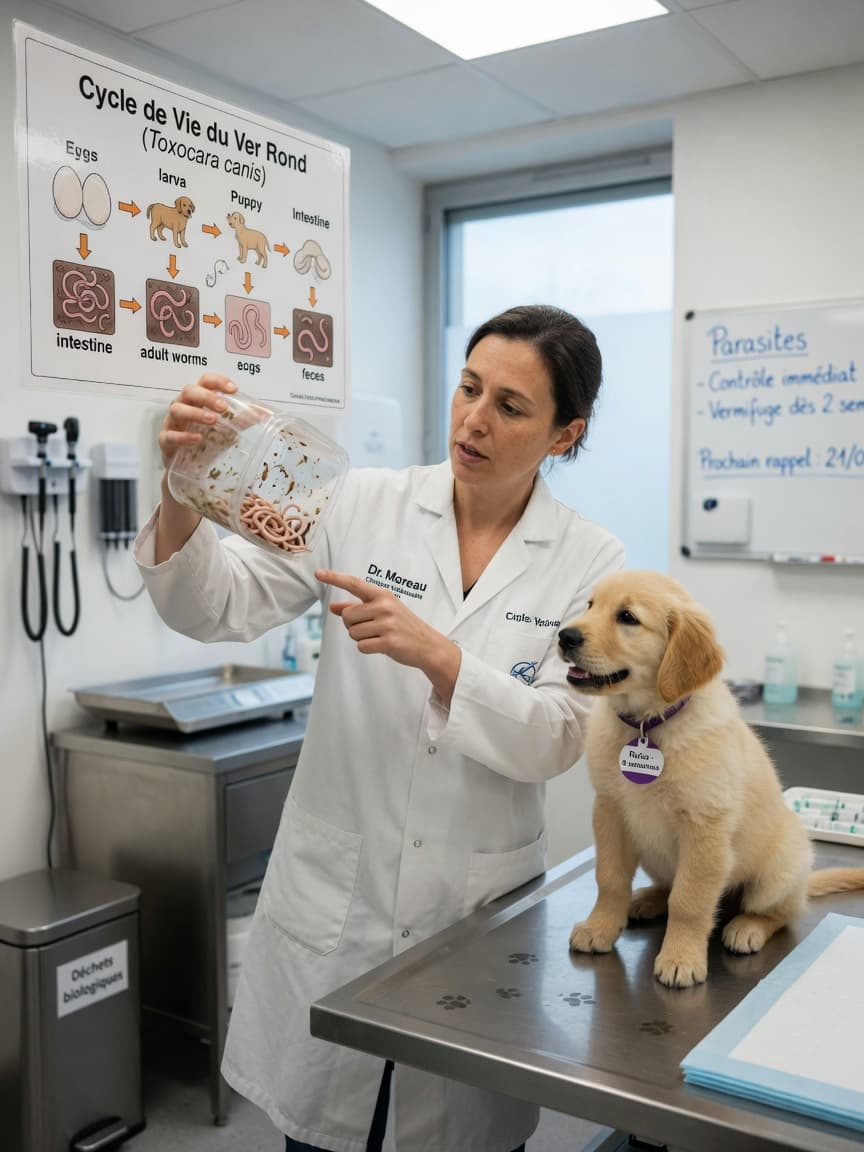
Lifecycle of Toxocara canis: Extraordinarily Complex
Toxocara canis has one of the most complex life cycles of any common pet parasite, involving multiple transmission routes and the unique phenomenon of vertical transmission from mother to pup.
- Egg to L3 larvae: Adult female worms in the dog's intestine produce thousands of eggs daily, shed in faeces. In the environment, eggs embryonate over 2–4 weeks to become infective third-stage larvae (L3). Crucially, these larvae can remain viable in soil for years — they are resistant to desiccation and many common disinfectants.
- Ingestion and hepato-tracheal migration (puppies and young dogs): When a young dog ingests infective eggs, larvae hatch, penetrate the gut wall, and migrate via the liver and lungs. Larvae are coughed up, swallowed, and mature into adults in the small intestine. This is the primary route of intestinal infection in dogs under 3 months.
- Somatic migration (older dogs): In older, immunocompetent dogs, larvae migrate to tissues (liver, muscle, brain) and encyst, causing little or no clinical disease. These encysted larvae are arrested in development and can remain dormant for years.
- Vertical (transplacental) transmission: During pregnancy, hormonal changes reactivate encysted larvae, which migrate across the placenta to infect developing pups before birth. This is why virtually all puppies are born with roundworm larvae or infected very shortly after birth.
- Transmammary transmission: Larvae are also shed in the bitch's milk, infecting suckling pups during the first few weeks of life.
This extraordinary biology means that even a bitch with no detectable faecal egg shedding who has been regularly wormed can still produce infected puppies. A landmark review in Parasitology Research (PubMed) outlines the epidemiology and public health implications of Toxocara canis globally, underscoring the scale of environmental contamination in urban areas.
Paratenic Hosts and the Ecological Spread
An additional layer of complexity: many animals (rodents, rabbits, earthworms, cockroaches) serve as paratenic hosts. When they ingest infective eggs, larvae encyst in their tissues. When a dog eats these animals, it acquires a roundworm infection. Dogs that hunt, scavenge, or consume raw prey are at elevated risk through this route.
Clinical Signs in Dogs

Clinical signs depend heavily on the dog's age, immune status, and worm burden:
- Puppies with heavy burdens: Pot-bellied appearance, dull coat, poor growth, vomiting, diarrhoea, coughing (during pulmonary larval migration). Severe infections can cause intestinal obstruction or perforation — potentially fatal. Visible worms (resembling spaghetti, 5–18 cm long) may appear in vomit or faeces.
- Adult dogs: Often asymptomatic, even with moderate burdens. Intermittent vomiting or loose stools may occur. Encysted larvae in tissues cause no clinical signs.
- Puppies during larval lung migration: "Verminous pneumonia" — coughing, nasal discharge, and respiratory distress. Often mistaken for kennel cough.
The American Kennel Club provides clear guidance on recognising roundworm signs in puppies and when to seek veterinary care urgently.
Zoonotic Risk: The Human Health Dimension
The public health importance of Toxocara canis cannot be overstated. Humans become infected by accidentally ingesting infective eggs — from contaminated soil, unwashed vegetables grown in contaminated ground, or direct contact with faeces. Children are most at risk due to hand-to-mouth behaviour and play in sandpits or parks where infected dogs defecate.
In humans, larvae cannot complete their normal lifecycle. Instead, they wander through tissues causing two important syndromes:
- Visceral Larva Migrans (VLM): Larvae migrate through internal organs, causing fever, cough, hepatomegaly (enlarged liver), and eosinophilia (elevated eosinophils in blood). Most cases resolve, but severe infections can be life-threatening.
- Ocular Larva Migrans (OLM): A single larva migrating into the eye can cause granulomatous inflammation, retinal detachment, and permanent blindness. OLM typically affects one eye and can be mistaken for retinoblastoma in children. The ASPCA highlights OLM as a compelling reason why responsible dog deworming is a community health issue.
Seroprevalence surveys in Europe and the US show that a significant proportion of the human population has been exposed to Toxocara antigens at some point. A 2024 investigation by The Guardian found high levels of roundworm egg contamination in UK urban parks, reinforcing the link between inadequate pet parasite control and human health risk.
Diagnosis and Treatment in Dogs
Diagnosis is by faecal flotation, identifying characteristic eggs under microscopy. False negatives are possible — a single test may miss a low-level infection. Larvae in tissues are not detectable by faecal testing.
Treatment options:
- Fenbendazole: Highly effective, well-tolerated, safe in pregnant bitches and very young puppies. Often given for 3 consecutive days.
- Pyrantel pamoate: Widely available, safe for puppies from 2 weeks of age.
- Milbemycin oxime, moxidectin, ivermectin: Included in many broad-spectrum monthly parasite preventatives.
For breeding bitches, treating with fenbendazole daily from day 40 of pregnancy through 2 weeks post-whelping significantly reduces pup infection burden. Puppies should be dewormed from 2 weeks of age, repeated every 2 weeks until 8 weeks, then monthly to 6 months.
Prevention and Public Responsibility
- Deworm all dogs regularly — the ESCCAP recommends deworming adult dogs at least 4 times per year in normal-risk situations, more frequently in high-risk dogs (hunters, those with access to prey animals, those living with young children or immunocompromised people).
- Always pick up dog faeces immediately — eggs are not infective when first shed and require 2–4 weeks in the environment to become so. Prompt removal breaks the contamination cycle.
- Wash hands thoroughly after contact with dogs, soil, or potentially contaminated surfaces.
- Keep children's sandpits covered when not in use.
- Wash vegetables from garden soil thoroughly before consuming.
Key Takeaways
- Toxocara canis infects virtually all puppies via transplacental and transmammary routes — treat puppies from 2 weeks of age.
- Infective eggs persist in soil for years and contaminate parks, gardens, and sandpits.
- In humans, larvae cause Visceral or Ocular Larva Migrans — the latter can cause permanent blindness, especially in children.
- Routine year-round deworming of dogs is both a veterinary and public health responsibility.
- Prompt faecal pickup in public spaces is the single most impactful action dog owners can take to reduce environmental contamination.