

The Head Tilt: More Than Just Adorable
Few canine behaviours trigger as many camera clicks as the head tilt. A dog cocking its head to one side, ears perked, eyes wide, is one of the most disarming sights in the animal world. But behind that endearing gesture lies a combination of sensory mechanics, anatomy, and learned social behaviour — and in some cases, a medical warning sign that should not be ignored.
Why Dogs Tilt Their Heads: The Scientific Explanations
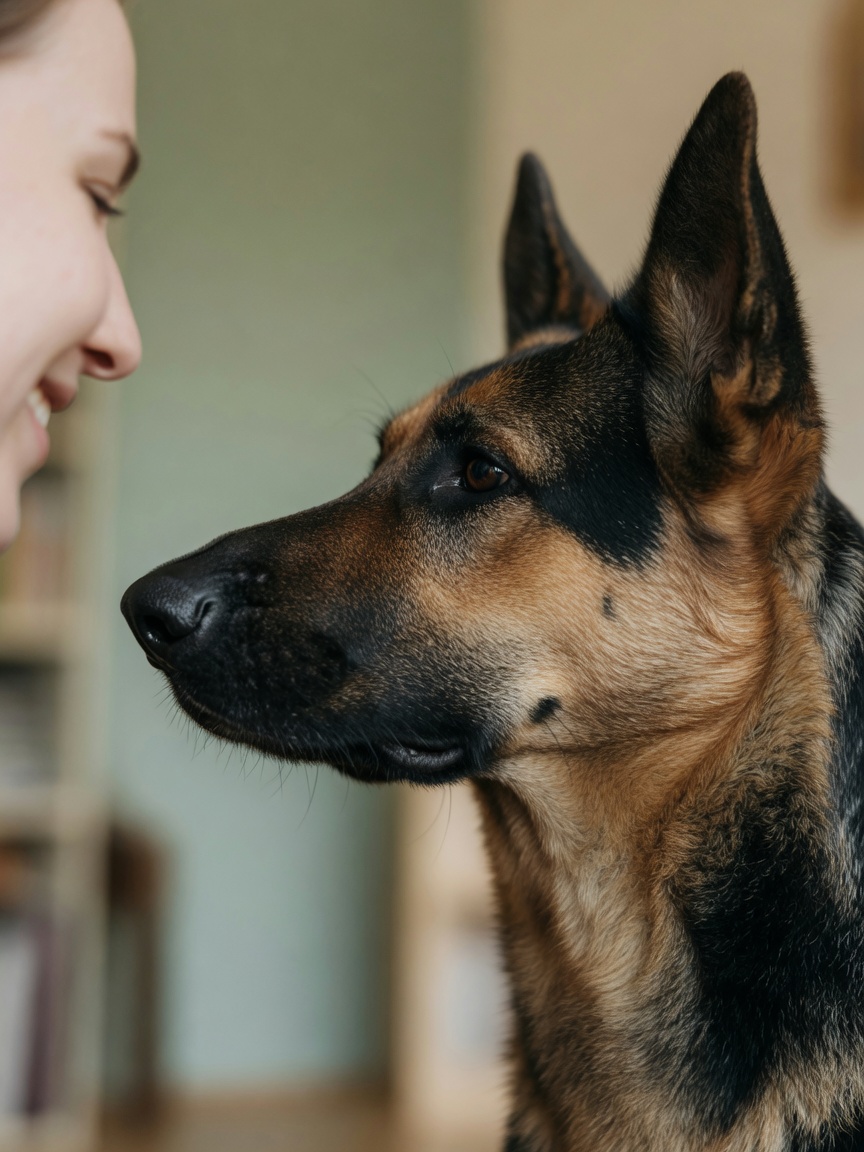
Sound Localisation
Dogs hear across a far wider frequency range than humans, and they can move each ear independently to help pinpoint the source of a sound. When a dog tilts its head, it shifts the position of each ear relative to the sound source, giving the brain slightly different arrival times for the sound wave in each ear. This tiny difference in timing — known as interaural time difference — helps the dog calculate direction and distance with greater precision. The head tilt is, in effect, a fine-tuning mechanism for the dog's built-in sonar.
The Muzzle Problem and Stanley Coren's Research
Canine psychologist Stanley Coren proposed an influential explanation for the head tilt that goes beyond sound. Dogs with longer muzzles — such as Border Collies, German Shepherds, and Greyhounds — may tilt their heads to see around their own snout. The protruding muzzle can partially block the lower portion of a dog's visual field, making it harder to read facial expressions and lip movements when looking at a human face straight on.
Coren conducted a survey of dog owners and found that dogs with flat faces — brachycephalic breeds such as Pugs, French Bulldogs, and Boxers — tilted their heads significantly less frequently than dogs with longer muzzles. This supports the theory that the tilt is partly a visual compensation strategy, allowing the dog to get a clearer view of a human's face and mouth by moving the muzzle out of the line of sight.
A Learned Attention Behaviour
The third explanation is simple conditioning. Dogs are acutely sensitive to human reactions, and a head tilt reliably produces enthusiastic responses — laughing, cooing, photographing, and giving treats. Over time, many dogs learn that tilting their head when a human is speaking results in positive reinforcement, and the behaviour becomes more frequent and pronounced. This is not manipulation in any calculating sense; it is ordinary associative learning. The dog tilts, good things happen, so the dog tilts more.
The three explanations are not mutually exclusive. Most head tilts probably involve all three factors operating together: the dog is processing sound, clearing its visual field, and responding to a social cue that it has learned produces a rewarding outcome.
Breed Differences in Head Tilting
As Coren's research suggests, breed anatomy plays a meaningful role. Brachycephalic breeds — those with shortened skulls and flattened faces — have little to no muzzle to block their view, so the visual compensation argument applies less strongly to them. Long-nosed breeds such as Collies, Dachshunds, and Labradors tend to exhibit the tilt more visibly and more frequently. Working breeds that are highly attuned to human communication, such as Border Collies and Golden Retrievers, are also observed to tilt more often, possibly because they are more focused on reading human facial cues.
When a Head Tilt Is a Medical Emergency
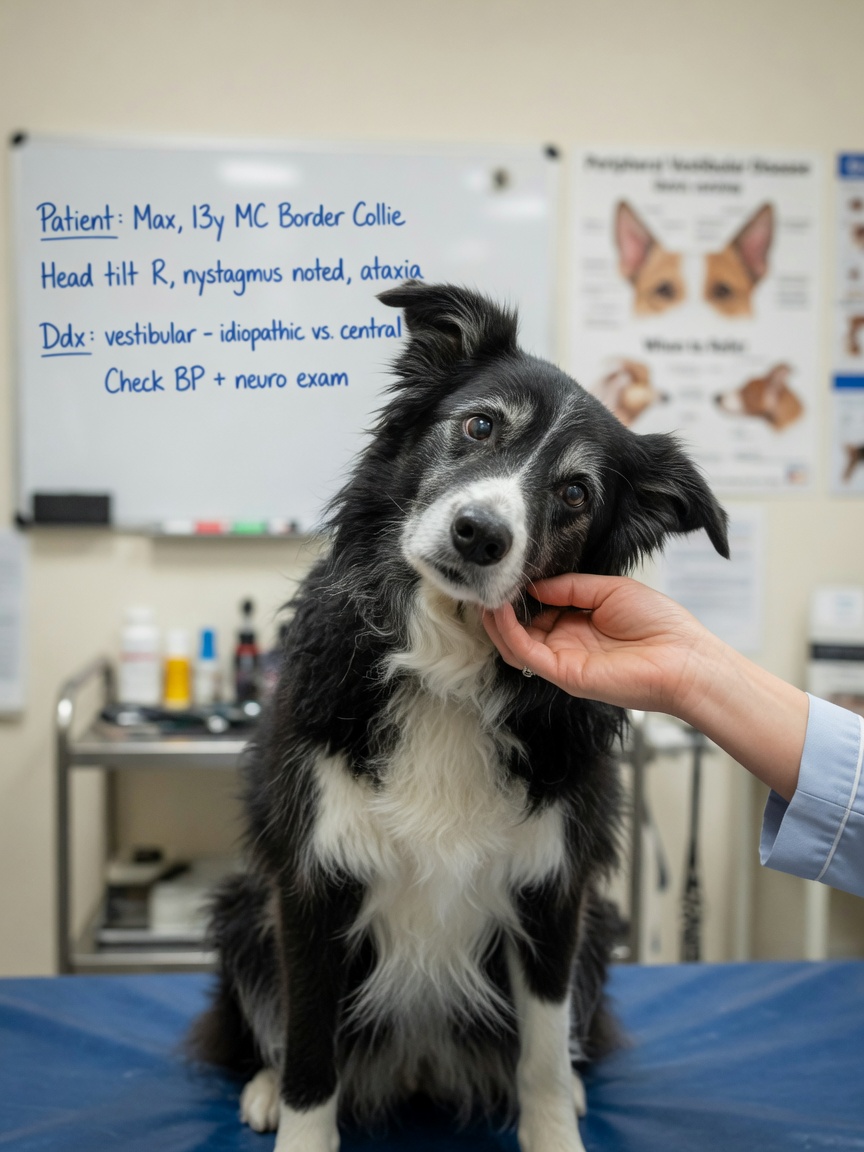
The behaviours described above involve a dog briefly tilting its head in response to a sound or interaction, then returning to a normal posture. A medical head tilt is something entirely different. If your dog is holding its head persistently to one side — not as a response to a stimulus, but as a fixed, constant posture — this requires urgent veterinary assessment.
Idiopathic Vestibular Syndrome
The most common cause of sudden-onset medical head tilt in dogs, particularly older dogs, is idiopathic vestibular syndrome. The vestibular system — a network of structures in the inner ear and brainstem — is responsible for the sense of balance and spatial orientation. When it is disrupted, the dog loses its normal equilibrium and holds its head tilted to the affected side.
Idiopathic vestibular syndrome typically comes on very suddenly, often overnight. Owners frequently describe finding their dog unable to stand, falling to one side, or circling. Other characteristic signs include nystagmus — a rapid, involuntary flickering of the eyes from side to side or in a rotary pattern — vomiting due to the sensation of motion sickness, and a reluctance or inability to walk in a straight line. The episode can look catastrophic and is often mistaken for a stroke.
The reassuring news is that idiopathic vestibular syndrome in dogs usually resolves on its own within two to four weeks, with supportive care. However, it is impossible to distinguish it from a stroke or brain tumour without proper examination, so veterinary assessment the same day is essential.
Ear Infections
Otitis media or interna — infection of the middle or inner ear — can affect the vestibular apparatus and cause a persistent head tilt, along with scratching at the ear, pain when the ear is touched, and sometimes discharge. Ear infections require antibiotic treatment and, depending on severity, may need further investigation including imaging.
Brain Lesions and Other Causes
Less commonly, a persistent head tilt can result from a brain tumour, inflammatory brain disease, or a true stroke (ischaemic or haemorrhagic). These conditions generally produce additional neurological signs alongside the head tilt, such as altered consciousness, weakness in the limbs, or severe behavioural changes. An MRI scan is the gold standard for diagnosing intracranial causes.
How to Tell the Difference
The key question is whether the tilt is transient or persistent. A dog that briefly tilts its head when it hears an unfamiliar noise or when you pick up its lead and then resumes normal posture is displaying the normal, benign behaviour. A dog whose head remains tilted continuously — especially if it is also falling over, has flickering eyes, is vomiting, or seems disoriented — is showing a medical sign and should be seen by a vet the same day.
Senior dogs are at higher risk of idiopathic vestibular syndrome and should be monitored more carefully. If in doubt, err on the side of caution and contact your veterinary practice. A brief phone call to describe the symptoms will allow the team to advise whether the dog needs to be seen urgently.
Summary
The head tilt that melts hearts across social media is a genuine piece of canine cognition — a way for dogs to hear better, see better, and connect with the humans they live with. Understanding the science behind it adds a new layer of appreciation for a behaviour that might otherwise seem purely decorative. And knowing when the same gesture signals something more serious could one day prove to be genuinely important for your dog's health.