
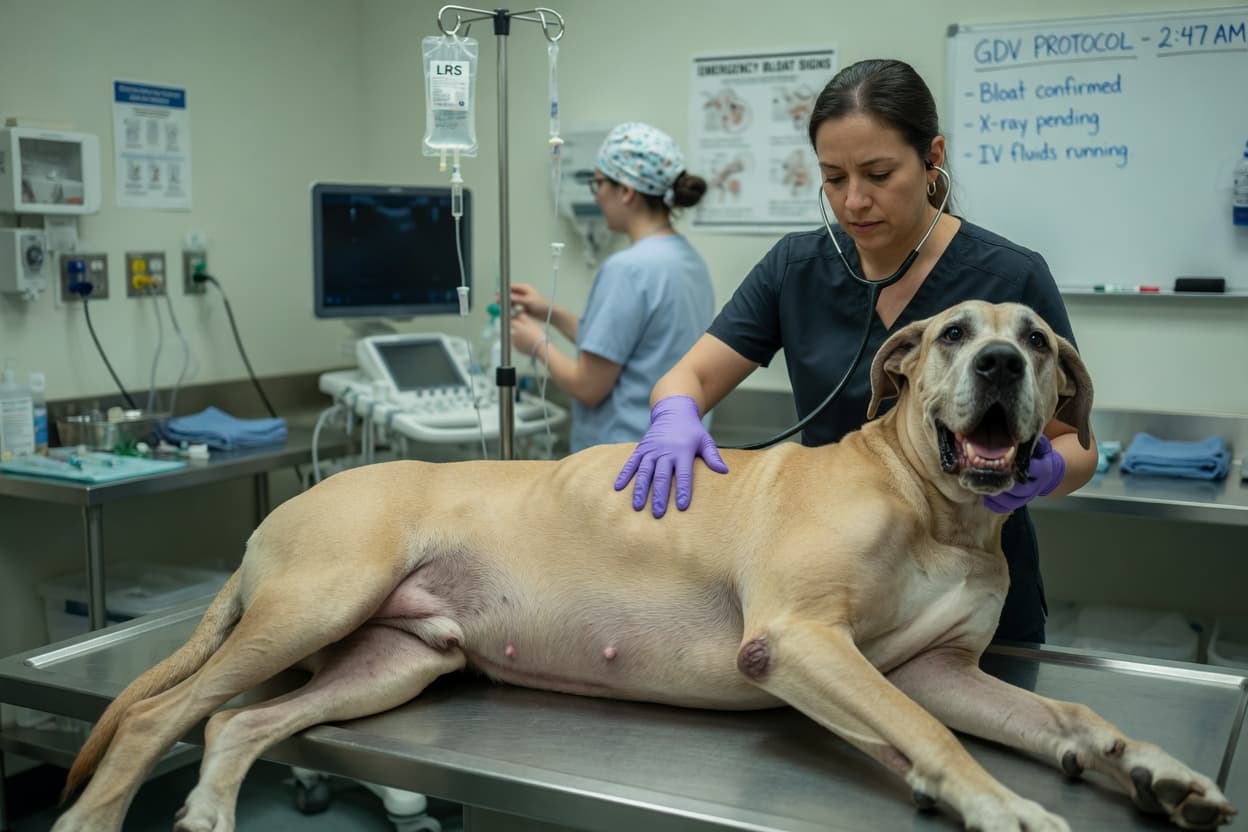
What Is Dog Bloat (GDV)?
Gastric dilatation-volvulus — commonly known as bloat, or GDV — is one of the most serious and rapidly life-threatening emergencies in veterinary medicine. It occurs in two stages that often happen together. First, the stomach fills with gas, fluid, or food and becomes severely distended (dilatation). Second, the distended stomach twists on its own axis (volvulus), sealing off both the entry and exit points and trapping the contents inside.
Once the stomach twists, the consequences are catastrophic. The blood supply to the stomach wall is cut off, causing the tissue to begin dying within minutes. The distended stomach presses on the large veins in the abdomen, dramatically reducing blood flow back to the heart and causing circulatory shock. The spleen, which is attached to the stomach, is also pulled out of position and its blood supply compromised. Without emergency surgical intervention, GDV is fatal — and it can kill a healthy dog within one to two hours of the stomach twisting.
If you suspect your dog has GDV, call your vet immediately. Do not wait to see if things improve. Do not wait until morning. Call now.
Which Breeds Are Most at Risk?
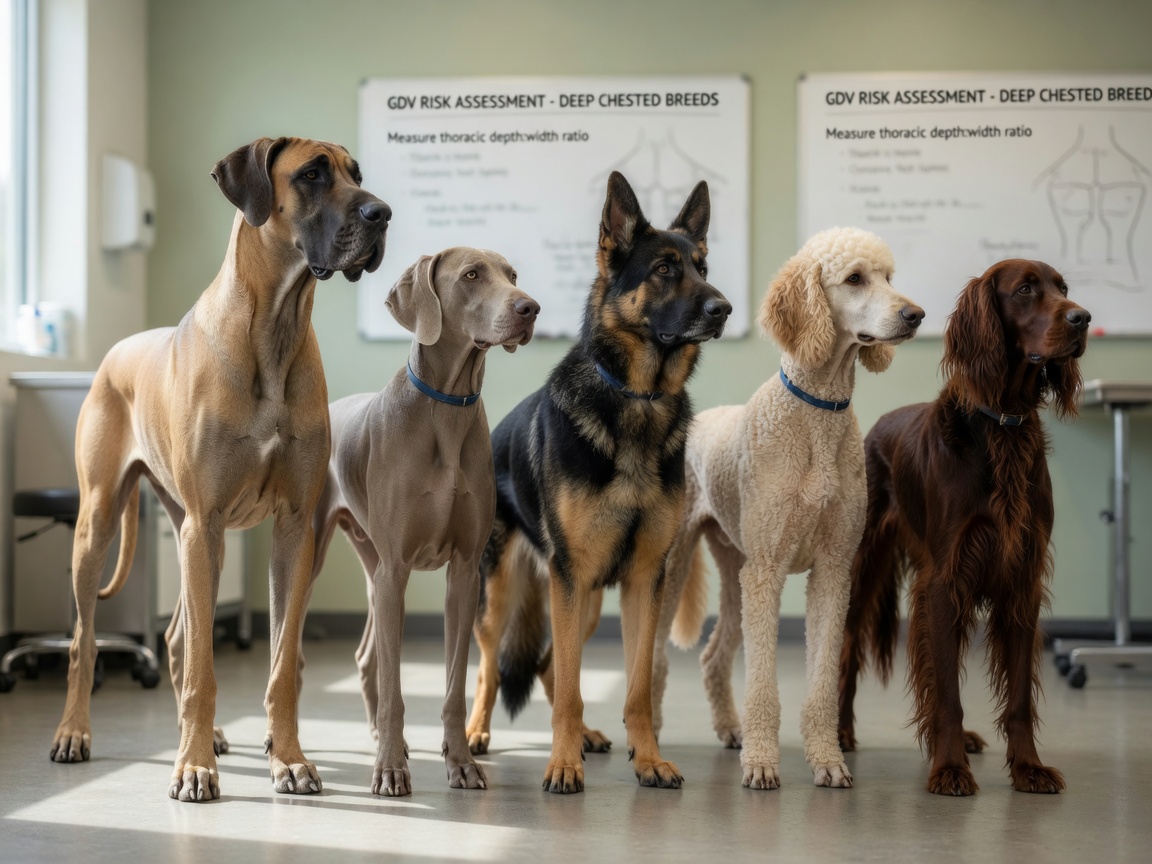
GDV affects large and giant breeds with deep, narrow chests far more frequently than small or medium-sized dogs. The anatomy of the deep chest allows the stomach more room to move and twist. The breeds at highest risk include:
- Great Danes — the highest risk of any breed; studies suggest a lifetime risk of over 40 per cent
- Weimaraners
- German Shepherds
- Standard Poodles
- Irish Setters and Gordon Setters
- Dobermann Pinschers
- Rottweilers
- Bloodhounds
- Basset Hounds
- Saint Bernards
Middle-aged to older dogs are at greater risk than young dogs, and male dogs are more commonly affected than females. Dogs that eat quickly, eat from elevated bowls (though research on this is mixed), are fed one large meal a day, or exercise vigorously immediately after eating may have an increased risk. A family history of GDV is also a significant risk factor.
That said, GDV can and does occur in smaller breeds and mixed-breed dogs. No dog is entirely exempt, which makes recognising the signs essential for all dog owners.
Recognising the Signs of GDV
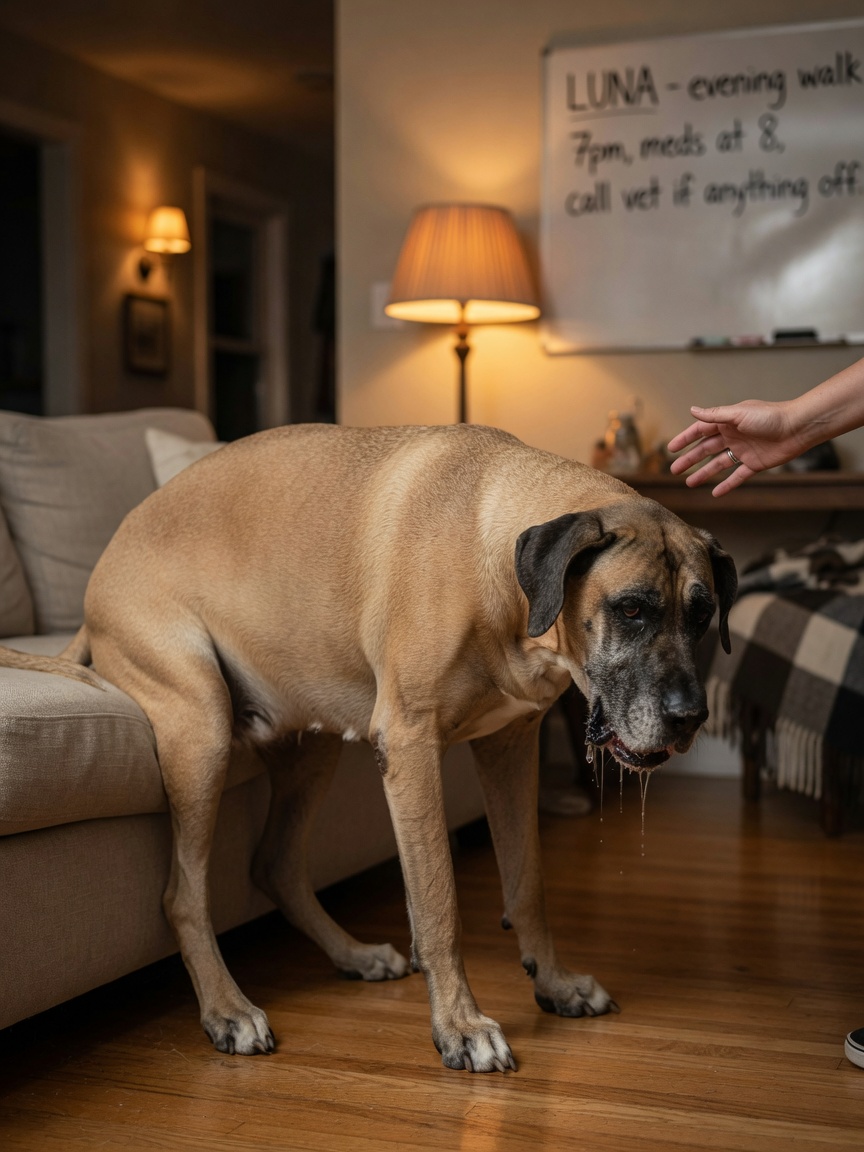
The signs of GDV come on suddenly, often in the evening or at night, and progress rapidly. Knowing what to look for and acting immediately could save your dog's life.
Early Signs
- Unproductive retching — your dog is trying to vomit but producing nothing, or only small amounts of frothy saliva
- Visible distension of the abdomen, particularly on the left side behind the ribcage
- Restlessness, pacing, or an inability to settle
- Signs of discomfort or pain, such as hunching, looking at the abdomen, or whimpering
- Excessive drooling
Signs of Rapid Deterioration
- The abdomen becoming very tight and drum-like — if you tap it gently, it may sound hollow
- Pale, white, or grey gums indicating shock
- Rapid, shallow breathing
- Weakness, staggering, or collapse
- Rapid heart rate
The crucial warning sign is unproductive retching combined with a distended abdomen. This combination is GDV until proven otherwise. Call your vet immediately — do not wait to see if more symptoms develop.
Why You Cannot Treat GDV at Home
There is absolutely nothing that can be done for GDV outside of a veterinary clinic. No home remedy, no positioning, no massage, no waiting it out. The only treatment that saves a dog's life is emergency surgery, and even with prompt treatment, survival rates depend heavily on how quickly the dog receives care.
During surgery, the vet will decompress the stomach, return it to its correct position, and assess whether any part of the stomach wall or spleen has died and needs to be removed. In the majority of cases, a procedure called gastropexy is performed at the same time — the stomach is permanently attached to the abdominal wall to prevent it from twisting again in the future. Without gastropexy, GDV has a recurrence rate approaching 80 per cent.
Before surgery can take place, the dog will receive intravenous fluids to treat shock and stabilise the cardiovascular system. The speed with which this stabilisation happens — and the speed with which surgery follows — is directly linked to outcome. Dogs that arrive at the vet within one to two hours of the stomach twisting have significantly better survival rates than those that arrive later.
If You Suspect GDV: Exactly What to Do
- Call your vet immediately. Tell them you suspect GDV and that you are on your way. This is a declared emergency — they will prepare for your arrival.
- If your regular vet is closed, call the emergency out-of-hours service or the nearest emergency veterinary clinic right away. Do not wait until morning.
- Drive directly to the vet. Keep your dog as calm and still as possible during transport.
- Do not attempt to feed your dog, give water, or try to relieve the bloating yourself.
- Do not stop to research symptoms further — every minute spent delaying reduces the chance of survival.
Prophylactic Gastropexy: Prevention for High-Risk Breeds
For breeds with the highest lifetime risk of GDV — particularly Great Danes, Weimaraners, and Irish Setters — many vets now recommend a preventive procedure called prophylactic gastropexy. This involves surgically attaching the stomach to the abdominal wall before GDV ever occurs. It does not prevent the stomach from bloating with gas, but it prevents the deadly twist.
Prophylactic gastropexy can often be performed at the same time as another planned procedure such as spaying or neutering, which reduces the additional anaesthetic risk. If you own a large, deep-chested breed, speak with your vet about whether this procedure is appropriate for your dog. The conversation is well worth having — one surgery performed electively is far safer, and far less costly in every sense, than emergency surgery performed in the middle of the night on a dog in shock.
The Bottom Line
GDV is not a condition where a "wait and see" approach is ever appropriate. The signs are distinctive, the progression is rapid, and the outcome without surgery is always fatal. If your dog is retching unproductively and their belly looks swollen, call your vet immediately — and get in the car. Acting fast is the only thing that saves lives when GDV strikes.