
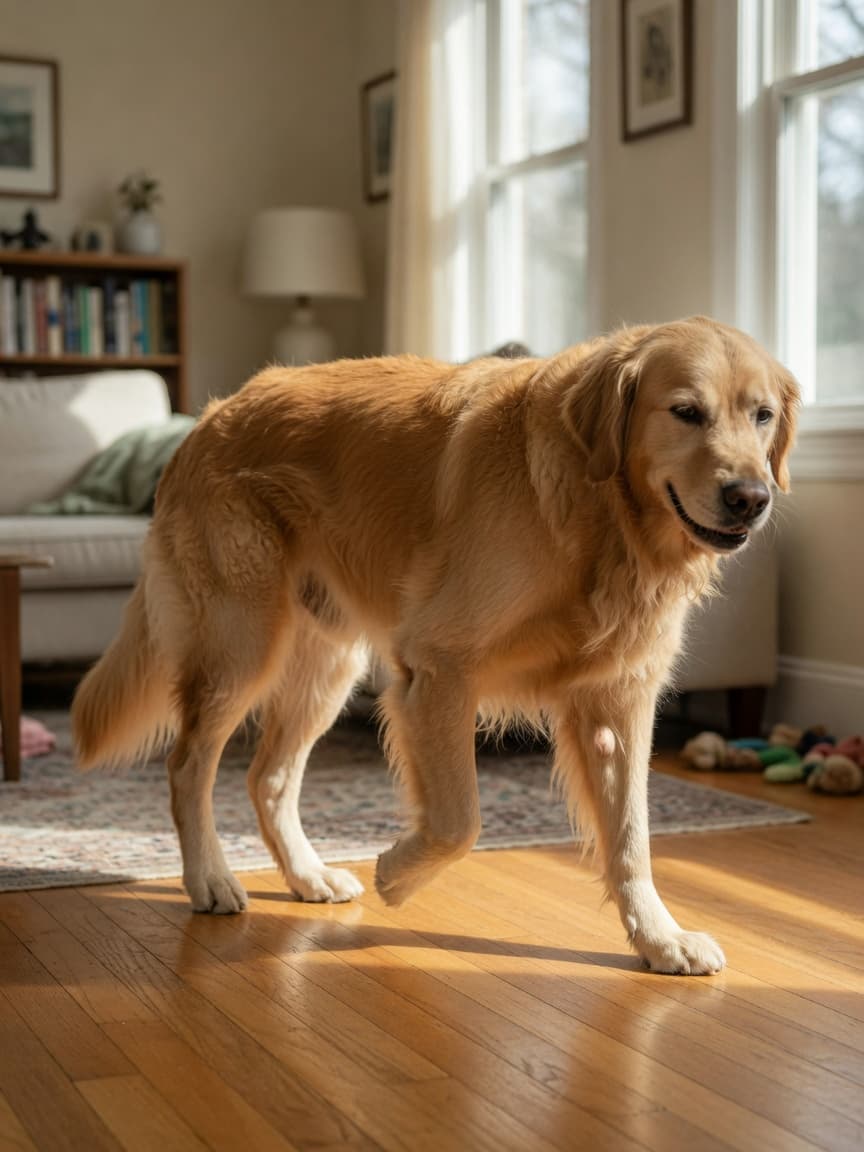
What Is Canine Cranial Cruciate Ligament Rupture?
Canine cranial cruciate ligament rupture, commonly abbreviated as CCLR, is the most frequently diagnosed orthopaedic injury in dogs. The cranial cruciate ligament (CrCL) runs inside the stifle joint — the canine equivalent of the human knee — and plays a critical role in stabilising the joint during movement. When this ligament ruptures, the tibia can slide forward relative to the femur, causing instability, immediate pain, and rapid progression of osteoarthritis.
It is important to use correct terminology here. In human medicine, this structure is referred to as the anterior cruciate ligament (ACL). In dogs, the correct anatomical term is the cranial cruciate ligament (CrCL), and the condition is called CCLR. The two terms are not interchangeable, and many owners are understandably confused when they encounter both in veterinary discussions.
Unlike many sporting injuries in humans, CCLR in dogs is often a degenerative process rather than a purely traumatic one. The ligament weakens progressively over time due to a combination of genetic predisposition, conformation, immune-mediated factors and chronic wear. Partial tears frequently precede complete rupture, sometimes by months or even years. This explains why a dog may appear to trip or slip when the ligament finally fails completely.
Signs of Cruciate Ligament Rupture
The clinical presentation depends on whether the tear is partial or complete. A complete rupture typically causes sudden, severe non-weight-bearing lameness — the dog will hold the affected hindlimb off the ground and appear acutely distressed. In contrast, a partial tear often presents as intermittent lameness that worsens after exercise and appears to improve with rest, only to recur.
Over time, muscle wasting becomes apparent in the affected hindlimb, particularly around the thigh. Swelling of the stifle joint — known as stifle effusion — is also a common finding. Owners often notice that their dog sits with the affected leg pointing outward rather than tucked neatly under the body.
Predisposed Breeds
Whilst any dog can develop CCLR, certain breeds are significantly over-represented. Labrador Retrievers and Golden Retrievers are among the most commonly affected, along with Rottweilers, Newfoundlands, Staffordshire Bull Terriers, Mastiffs, Boxers, and West Highland White Terriers. A steeper angle of the tibial plateau — the top surface of the tibia — is a known conformational risk factor, as it places greater mechanical stress on the ligament during normal weight-bearing.
Diagnosis
Veterinary diagnosis begins with an orthopaedic examination. The cranial drawer test involves stabilising the femur while attempting to move the tibia forward; abnormal forward movement confirms ligament disruption. The tibial thrust test similarly assesses joint stability by flexing the hock and feeling for forward movement of the tibia. Both tests are highly reliable in cases of complete rupture but can be less definitive in partial tears or in very muscular dogs.
Radiographs (X-rays) are essential to assess the degree of osteoarthritis already present and to measure the tibial plateau angle, which influences surgical planning. Partial tears can be genuinely difficult to confirm without arthroscopy — minimally invasive camera examination of the joint — which also allows direct assessment of the menisci.
Meniscal Injury
The medial meniscus — a C-shaped cartilage cushion inside the stifle — is commonly damaged at the time of ligament rupture or in the weeks that follow. A damaged meniscus produces a characteristic clicking sound during movement, which many owners notice. At the time of surgery, the meniscus must be carefully assessed; if damaged, a partial meniscectomy (removal of the torn portion) or meniscal release is performed. Leaving a damaged meniscus untreated leads to ongoing pain and joint deterioration.
Surgical Options
TPLO — Tibial Plateau Levelling Osteotomy
TPLO is the most commonly performed procedure for CCLR at specialist referral centres in the United Kingdom. A curved cut is made through the tibia and the tibial plateau is rotated to reduce its angle, eliminating the cranial tibial thrust force that destabilises the joint when the CrCL is absent. The bone is then secured with a specialist plate and screws. TPLO requires referral to an orthopaedic surgeon and carries a higher cost than simpler techniques, but outcomes in large and giant breed dogs are consistently excellent. Most dogs return to full function within 16 weeks.
TTA — Tibial Tuberosity Advancement
TTA works on a different biomechanical principle. Rather than altering the tibial plateau angle, it advances the tibial tuberosity — the bony prominence at the front of the tibia where the patellar ligament attaches — to redirect the forces acting on the joint. A bone spacer, plate and screws are used to secure the advanced position. TTA also produces good functional outcomes and is another option discussed at referral level, though TPLO currently dominates UK practice.
Extracapsular Repair (Lateral Suture / TightRope)
Extracapsular repair involves placing a strong synthetic suture outside the joint to mimic the stabilising function of the CrCL. The suture is anchored to the lateral aspect of the stifle and creates a mechanical restraint against tibial thrust. This is a less invasive and less costly procedure than TPLO or TTA. It is generally considered most appropriate for dogs weighing under 15 to 20 kg. In small dogs, outcomes are very good. In larger breeds, long-term results are less predictable, though some dogs do well.
Conservative Management
Rest and anti-inflammatory medication alone are not an appropriate long-term strategy for dogs weighing over 15 kg. Research consistently demonstrates that outcomes are significantly worse in larger dogs managed without surgery — progressive joint instability accelerates osteoarthritis and causes ongoing pain. Conservative management may be appropriate for very small dogs and, in some cases, cats. For most medium to large breed dogs, surgical stabilisation offers the best long-term quality of life.
Recovery and Rehabilitation
Recovery following TPLO or TTA typically involves 12 to 16 weeks of strictly restricted exercise, with a gradual return to full activity guided by the surgeon. Physiotherapy and hydrotherapy play an important role in rebuilding muscle strength and joint mobility, and specialist canine rehabilitation practitioners are widely available in the UK.
One critically important consideration is the contralateral limb. Research suggests that up to 60% of dogs that rupture one cruciate ligament will rupture the opposite ligament within two years. Weight management is therefore essential — excess body weight dramatically increases the load on every joint. Keeping the dog lean is one of the most effective long-term interventions an owner can make.
Osteoarthritis will progress in the affected stifle regardless of which surgical technique is used, but stabilisation significantly slows this progression and reduces pain. With appropriate management, most dogs live comfortable, active lives following CCLR surgery.