

The Animal That Tells You Nothing
Chameleons are among the most extraordinary animals kept as pets — and among the most unforgiving of husbandry errors. They are prey animals whose entire survival strategy in the wild depends on appearing normal and invisible. In captivity, this instinct means a chameleon will mask illness until it is critically ill. Owners who wait for obvious signs of distress are frequently too late. Knowing what to look for — and what drives the two most common conditions — is the difference between intervention and loss.
Metabolic Bone Disease in Chameleons
Metabolic bone disease is widespread in chameleons, particularly in veiled and panther chameleons, which make up the majority of the captive population. The mechanism is the same as in other reptiles: insufficient calcium absorption, driven by inadequate UVB lighting, poor dietary calcium, or an imbalanced ratio of calcium to phosphorus. In chameleons, however, the consequences manifest quickly and severely.
Early signs — easy to miss
- Slight reluctance to climb or reduced activity on upper branches
- Subtle tremor in the limbs during movement
- Difficulty holding onto branches — unexpected falls
- A slight curve developing in the spine or tail
Advanced signs
- Visibly swollen or bowed limbs
- A rubbery jaw that cannot close properly
- Inability to maintain grip; the animal rests on the floor of the enclosure
- Seizures in severe cases
Prevention
Chameleons require high-output UVB — a linear tube of at least T5 HO specification positioned correctly within the enclosure, replaced every six months. Feeder insects should be gut-loaded with calcium-rich foods for 24 hours before offering, and dusted with calcium powder on most feedings and a vitamin supplement weekly. Any chameleon showing tremors or grip problems should be seen by a reptile vet immediately; with calcium supplementation and corrected husbandry, early MBD can be reversed, but advanced cases carry a poor prognosis.
Dehydration: A Silent Emergency
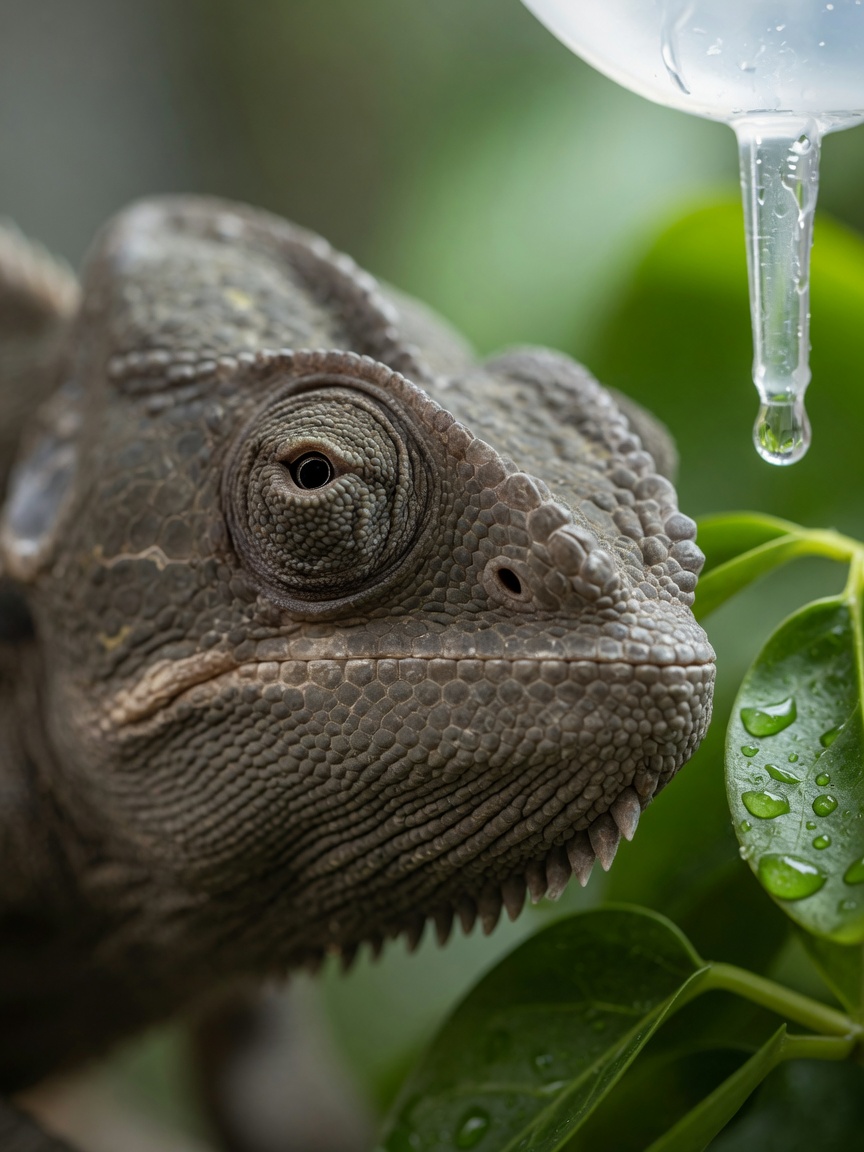
Dehydration is responsible for a substantial proportion of chameleon deaths in captivity, yet it is routinely underestimated. Chameleons do not drink from standing water. In the wild, they drink droplets of water from leaves and branches — and most will not drink from a bowl regardless of how thirsty they become. If your enclosure does not replicate this, the animal is chronically under-hydrated.
Signs of dehydration in chameleons
- Sunken eyes — one of the most reliable visible indicators
- Urates (the white part of droppings) that are orange or yellow rather than white
- Wrinkled or loose skin that does not snap back quickly when gently tented
- Lethargy, darkened colouration, and reduced movement
- Decreased urination and very dark urine
Hydration strategies that work
A drip system — a container with a small hole above the enclosure directing slow drips onto leaves — encourages most chameleons to drink. Automated misting systems that run two or three times daily for two to three minutes each provide humidity and drinking opportunities simultaneously. Ensure the enclosure dries out between mistings; stagnant wet conditions invite respiratory infection. A chameleon showing signs of moderate to severe dehydration needs veterinary rehydration — typically via subcutaneous or intracoelemic fluids — rather than a home remedy.
Why Chameleons Hide Illness
Understanding the prey-animal psychology of chameleons is essential for responsible ownership. A chameleon that appears weak, pale, or unsteady will be targeted by predators in the wild. The instinct to suppress visible signs of illness is therefore deeply embedded. In practice, this means your chameleon may be significantly unwell before showing signs that would trigger concern in a dog or cat.
Behavioural changes are often the earliest signal: a chameleon spending more time at the bottom of the enclosure, failing to reach its usual basking spots, eating less consistently, or reacting minimally to stimuli it normally responds to. A daily visual check — noting position, colour, eye brightness, and behaviour — is the most reliable early warning system an owner has. Weigh your chameleon weekly if possible using a digital kitchen scale; even small downward trends are informative.
Enclosure Requirements That Prevent Most Problems
The majority of health crises in chameleons are rooted in incorrect housing. These animals need tall, well-ventilated mesh enclosures — not glass tanks, which trap humidity and restrict airflow. A veiled chameleon adult requires a minimum of 60 cm wide by 60 cm deep by 120 cm tall. The enclosure should be densely planted with live, non-toxic plants — pothos, hibiscus, and weeping fig are popular choices — to provide cover, visual security, and additional moisture on leaves. Temperatures should range from 25–27°C at mid-level with a basking spot of 32–35°C at the top, dropping to 18–20°C overnight. Cooler nights are not a problem; a cold, wet enclosure is.
What to Do If You Are Worried
- Do not wait for things to worsen — if something seems off, act within 24–48 hours
- Find a reptile-experienced vet before acquiring a chameleon; these animals are not suitable for owners without access to specialist veterinary care
- Keep a written log of feeding, drinking, weight, and droppings — it will be invaluable information for your vet
- Sunken eyes, grip failure, orange urates, or floor-sitting are red flags requiring same-day veterinary contact
- Never add a second chameleon to the enclosure — these are solitary animals and cohabitation causes extreme chronic stress that directly worsens all the conditions described above