
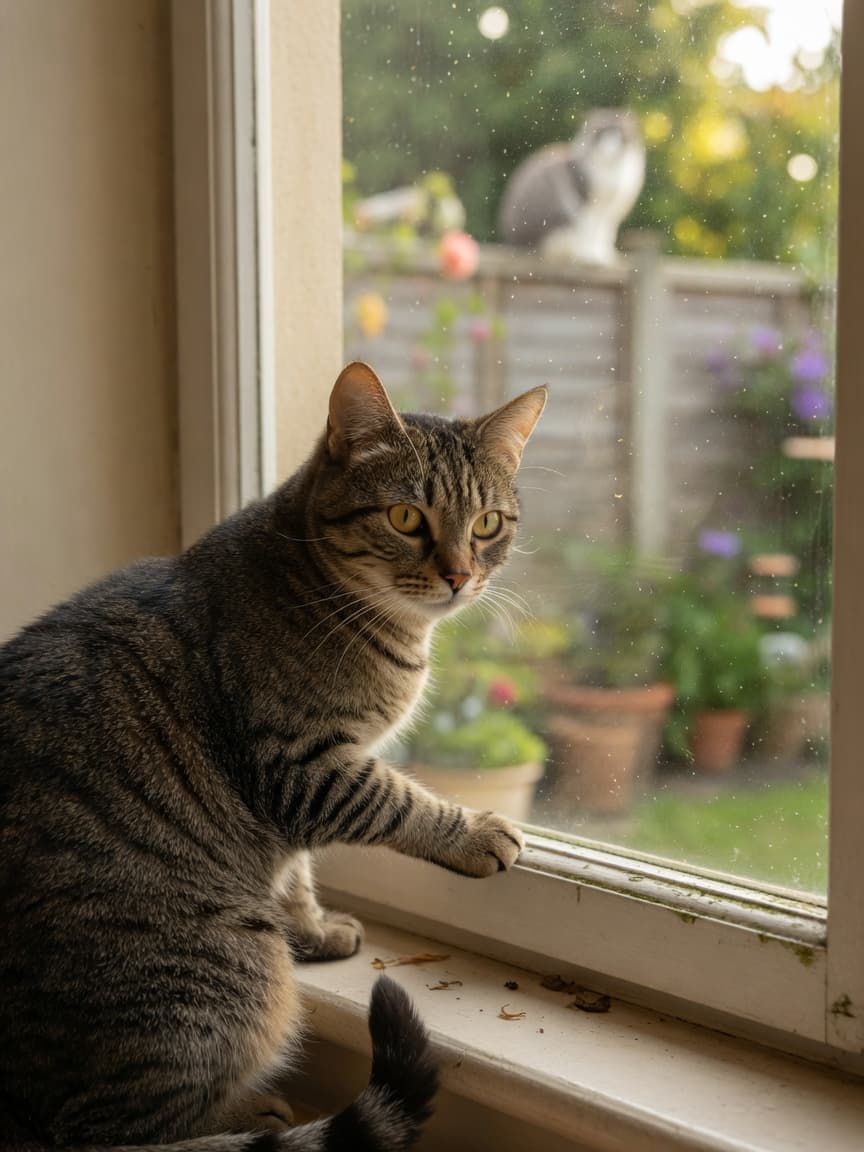
Why Cats Are Territorial by Nature
Unlike dogs, which evolved as pack animals, cats are fundamentally solitary hunters. This distinction, rooted deep in feline evolutionary history, underpins almost every territorial behaviour we observe in domestic cats today. According to the International Society of Feline Medicine (ISFM), the domestic cat (Felis catus) retains the same territorial instincts as its wild ancestor, the African wildcat, even after thousands of years of living alongside humans.
Understanding these instincts is not merely academic. It helps owners interpret behaviours that might otherwise seem baffling or problematic — and it forms the foundation of responsible, feline-friendly care.
Core Territory vs Home Range: What Is the Difference?
Feline ethologists distinguish between two overlapping spatial concepts: the core territory and the home range.
- Core territory is the area a cat defends most actively. For an indoor cat, this is usually the home itself — particularly sleeping spots, feeding areas, and preferred resting locations. The cat will mark this space and actively repel intruders.
- Home range is the broader area a cat moves through during daily activity. Outdoor cats may have a home range extending to several hectares, though this varies considerably by sex, neutering status, and population density.
International Cat Care notes that these territories are not fixed; they shift with seasons, changes in the local cat population, and the individual cat's confidence. Indoor-only cats have smaller but no less intensely felt territories, which is why environmental enrichment is so important for their wellbeing.
Urine Marking vs Spraying: Not the Same Thing
Many owners use the terms interchangeably, but there is a meaningful distinction. Standard urine marking involves a cat squatting and depositing urine on a horizontal surface — this is normal toileting behaviour that also leaves a chemical signature. Spraying, by contrast, is a deliberate scent-communication behaviour: the cat stands upright, tail held vertically and quivering, and directs a small jet of urine onto a vertical surface such as a wall, door frame, or piece of furniture.
Spraying is more common in unneutered males but occurs in females and neutered cats too, particularly under stress. ISFM guidance highlights that spraying rates in neutered cats are significantly lower — neutering reduces the behaviour in around 90% of males and 95% of females — but it does not eliminate the motivation entirely. A cat that sprays is communicating: advertising its presence, signalling reproductive status, or expressing anxiety.
If a previously house-trained cat begins spraying indoors, a veterinary check is always warranted to rule out a urinary tract infection before addressing behavioural causes.
Facial Rubbing (Bunting): The Friendly Face of Territory

Not all territorial marking is aggressive or anxiety-driven. When your cat rubs its cheeks, chin, or the top of its head against you, furniture, or door frames, it is depositing facial pheromones — chemical signals produced by glands around the face. This behaviour, known as bunting, creates what International Cat Care describes as a familiar, reassuring "scent profile" within the home environment.
Bunting directed at a human is generally a positive social signal — an indication that the cat considers you part of its social group and is comfortable in your presence. Encouraging this behaviour by allowing cats to rub against your hand creates a positive feedback loop of trust and familiarity.
Scratch Marking: Visual and Olfactory Signals Combined

Scratching serves a dual purpose that is often underappreciated. Yes, it maintains claw condition and provides a satisfying physical stretch — but it also leaves behind both a visual mark (the shredded surface) and a scent mark from the interdigital glands located between the toes. A scratch post therefore functions as a bulletin board: other cats (and the same cat on return) can detect who has been there and when.
This is why cats often scratch in prominent locations — near entrances, windows, or the centre of a room. Providing appropriate scratching surfaces in these areas, rather than trying to redirect the cat to a hidden corner, is far more effective. ISFM recommends offering both vertical and horizontal scratching options, as individual cats show strong preferences.
Multi-Cat Households: When Territories Collide
The domestic environment creates an artificial situation that cats did not evolve for: sharing a space with unrelated conspecifics. International Cat Care's research into cat social behaviour confirms that while cats can and do form social bonds, forced cohabitation between incompatible individuals is a leading source of chronic stress and associated health problems, including idiopathic cystitis and over-grooming.
Key principles for multi-cat households include:
- Resource multiplication: Provide one litter tray per cat plus one extra, and ensure food stations, water points, and resting spots are distributed so that no single cat can guard all of them simultaneously.
- Vertical space: Cat trees, shelves, and wall-mounted platforms allow cats to separate themselves vertically, reducing the need for direct conflict.
- Pheromone support: Synthetic facial pheromone products such as Feliway Classic, available from Zooplus, can help reduce tension in multi-cat homes by promoting a sense of familiarity and security. Feliway MultiCat is specifically formulated to support harmony between cats sharing the same space.
Introducing a New Cat: A Structured Approach
ISFM and International Cat Care both emphasise that the introduction of a new cat should never be rushed. A structured, gradual process dramatically improves the chances of long-term compatibility.
- Stage one — scent introduction: Keep the new cat in a separate room for at least one to two weeks. Exchange bedding between resident and newcomer so both can become familiar with the other's scent without direct contact.
- Stage two — visual contact: Allow brief, supervised sightings through a baby gate or cracked door. Observe body language carefully for signs of fear or aggression.
- Stage three — supervised interaction: Allow short, controlled access to shared spaces, always ensuring the resident cat has plenty of escape routes and high perches available.
Patience is the single most important factor. Some cats take weeks; others take months. Forcing the timeline is the most common mistake owners make and can set the relationship back significantly.
Supporting Your Cat's Territorial Needs
Rather than viewing territorial behaviour as a problem to be suppressed, a feline-informed approach treats it as a legitimate need to be channelled appropriately. Providing adequate space, resources, scratching posts, and where needed, pheromone support, allows cats to feel secure without resorting to conflict or stress-related health issues. Zooplus stocks a wide range of enrichment products — from multi-tiered cat trees to puzzle feeders — that help indoor cats express natural territorial and exploratory behaviours in a safe, constructive way.
When territorial behaviours escalate or change suddenly, always consult a veterinarian with a feline interest, or seek referral to a qualified behaviourist accredited by a recognised body. Early intervention is almost always more effective than waiting for problems to become entrenched.