
Cat Spraying: Causes, How to Stop It & Cleaning Guide
By Julia Wrenfield, Pet Wellness Researcher
You walk into your living room and catch that unmistakable sharp, pungent odor. Your cat has sprayed — again. Cat spraying is one of the most frustrating behaviors owners deal with, yet it is also one of the most misunderstood. The good news: with the right approach, you can dramatically reduce or eliminate it entirely.
Spraying vs. Urinating Outside the Litter Box: What's the Difference?
These two behaviors are often confused, but they are distinct — and the distinction matters because the solutions differ.
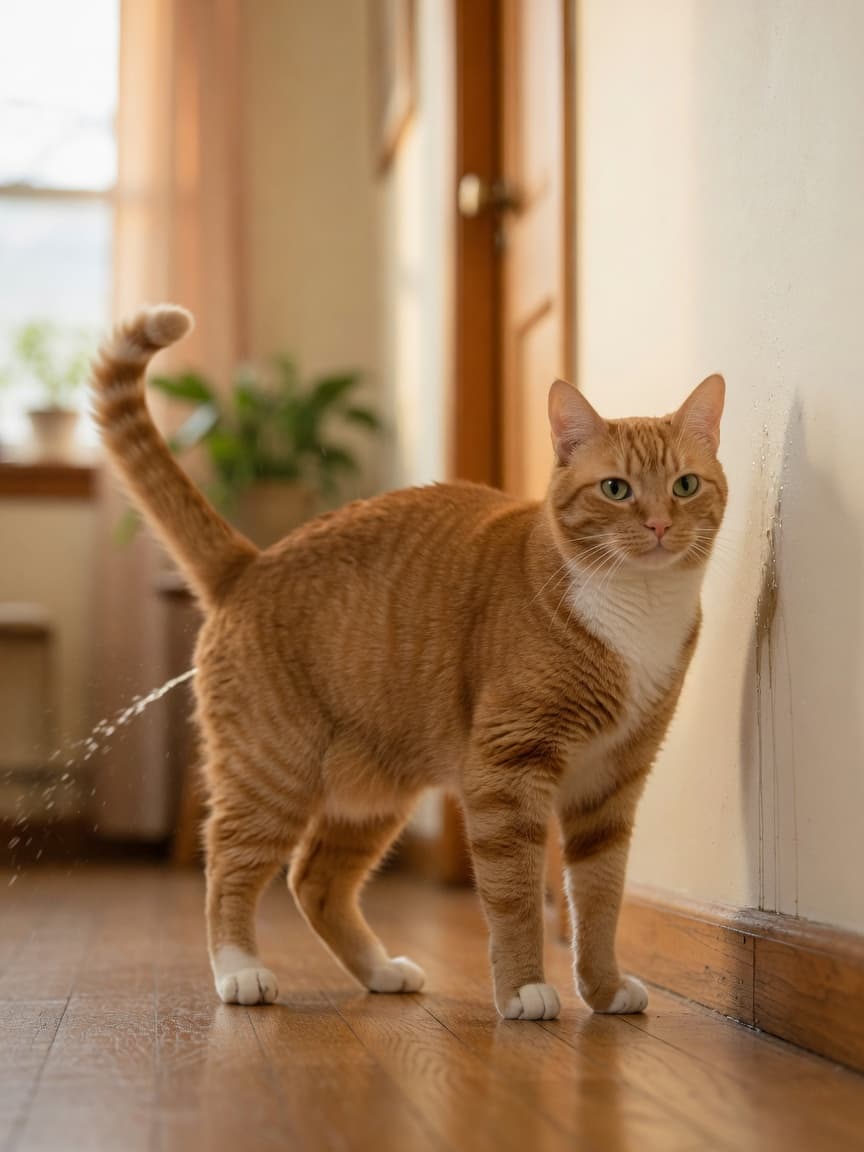
Spraying is a marking behavior. Your cat backs up to a vertical surface — a wall, door, sofa leg, curtain — raises their tail (which may quiver), and releases a small amount of urine in a horizontal stream. The urine is intentionally deposited as a scent signal to other cats.
Inappropriate urination (also called house soiling) is different. The cat squats and deposits a larger volume of urine on a horizontal surface — a floor, a rug, a pile of laundry. This usually signals a litter box problem or a medical issue rather than territorial communication.
Both are worth addressing promptly, but this article focuses primarily on spraying as a marking behavior.
Why Do Cats Spray?
Intact (unneutered) male cats are the most prolific sprayers. Studies show that over 90% of intact male cats spray regularly. The behavior is driven by sex hormones and is deeply tied to territorial advertisement — essentially, the cat is leaving a calling card for other cats in the area.
Intact females also spray, particularly when in heat, to attract mates.
Stress and anxiety are the leading triggers in neutered cats. Common stressors include:
- A new pet or person in the household
- Moving to a new home
- Changes in routine or furniture rearrangement
- Outdoor cats visible through windows
- A new neighbor's cat encroaching on their territory
Multi-cat tension is another major cause. Even cats that appear to coexist peacefully may engage in subtle social competition that leads to spraying. Insufficient litter boxes, shared resources, and competition for prime resting spots all contribute.
Medical causes — UTIs, feline idiopathic cystitis (FIC), bladder stones, and hyperthyroidism — can all cause changes in urination behavior. Never assume the problem is purely behavioral until a vet has cleared your cat medically.
How to Stop Cat Spraying
1. Spay or Neuter Your Cat
This is by far the most effective intervention. Neutering eliminates the hormonal drive behind marking in the vast majority of cats. Research consistently shows that neutering reduces or eliminates spraying in approximately 90% of male cats. For females, spaying resolves heat-related spraying entirely. The procedure is most effective when done early, but neutering adult cats who already spray still resolves the behavior in the majority of cases.
2. Reduce Environmental Stress
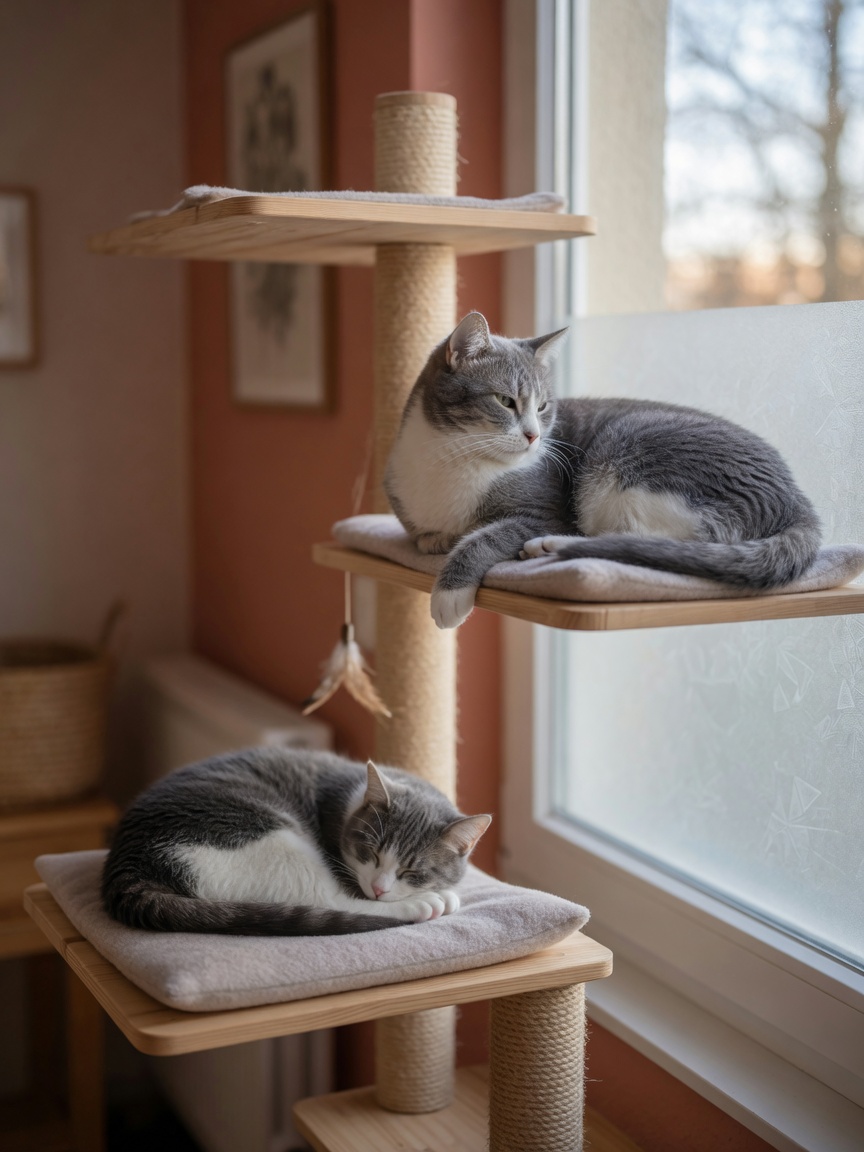
Identify and address whatever is triggering anxiety. If outdoor cats are visible through windows, apply frosted window film to the lower portion of windows. If a new pet has entered the household, introduce them gradually using scent swapping before face-to-face contact. Provide vertical space — cat trees, shelves, and perches — so each cat can claim their own territory within the home.
3. Use Pheromone Diffusers
Feliway Classic (and Feliway MultiCat in multi-cat homes) releases a synthetic analog of the feline facial pheromone cats deposit when they rub their cheeks on objects — a signal associated with comfort and security, not territory marking. Plug-in diffusers placed in rooms where spraying occurs can meaningfully reduce stress-driven marking. Allow 2–4 weeks for full effect.
4. Optimize Your Litter Box Setup
The standard recommendation is one litter box per cat, plus one extra. A two-cat household should have three boxes. Place boxes in multiple locations — not all in the same room. Scoop daily and perform a full clean weekly. Covered boxes trap odors and can discourage use; many cats prefer open trays. Experiment with unscented litter, as some cats find fragranced products aversive.
5. Address Multi-Cat Dynamics
Ensure resources are not clustered in one location. Food bowls, water stations, resting areas, and litter boxes should be distributed throughout the home so no single cat can monopolize access. If specific cats are antagonizing each other, consult a veterinary behaviorist about structured reintroduction protocols.
Cleaning Guide: Removing Spray Stains and Odor
Effective cleanup is critical — residual odor signals to your cat that this is an established marking spot and invites re-spraying.
Step 1 — Find all affected areas. Cat spray is often deposited in spots that are not immediately obvious. Use a UV blacklight in a darkened room to locate all stained areas; urine glows under UV light.
Step 2 — Blot, don't rub. For fresh stains on fabric or carpet, press a clean cloth firmly onto the area to absorb as much urine as possible. Rubbing spreads the stain deeper into fibers.
Step 3 — Apply an enzyme cleaner. Enzyme-based cleaners (such as Nature's Miracle or Rocco & Roxie) contain biological enzymes that break down the uric acid crystals in cat urine — the component responsible for the persistent odor. Saturate the area thoroughly, covering a slightly wider radius than the visible stain, and allow the product to dwell for the time specified on the label (usually 10–15 minutes minimum). Do not rinse immediately.
Step 4 — Blot dry and allow to air-dry completely. For carpet, place a clean towel over the area and weigh it down. Complete drying is essential — uric acid crystals become odorous again when rehydrated.
Step 5 — Neutralize with baking soda (optional). Once fully dry, a light dusting of baking soda followed by vacuuming can absorb any remaining residual odor.
For porous surfaces like unsealed wood or grout, repeated enzyme treatment may be necessary. In severe cases, replacement of the affected material may be the only permanent solution.
When to See a Veterinarian
Consult your vet promptly if: the spraying began suddenly in a cat that has never done it before; the cat is straining, vocalizing when urinating, or producing blood-tinged urine; or behavioral interventions have produced no improvement after 4–6 weeks. Your vet may recommend urinalysis, bloodwork, or a bladder ultrasound to rule out underlying disease. In some cases, anti-anxiety medication (buspirone, fluoxetine) prescribed by a vet can be a useful adjunct to behavioral management.
Key Takeaways
- Spraying is a marking behavior on vertical surfaces; it differs from general inappropriate urination.
- Over 90% of intact male cats spray — neutering resolves it in approximately 90% of cases.
- Stress, multi-cat tension, and outdoor intruder cats are the top triggers in neutered cats.
- Always rule out UTI or other medical causes before pursuing behavioral solutions.
- Use enzyme cleaners — never ammonia-based products — to fully eliminate odor and prevent re-marking.
- Feliway diffusers and optimized litter box setups are effective environmental interventions.
- The litter box rule: one box per cat, plus one extra, placed in multiple locations.
References
- Hart BL, Barrett RE. Effects of castration on fighting, roaming, and urine spraying in adult male cats. J Am Vet Med Assoc. 1973;163(3):290-292. PMID: 4729611
- Pryor PA, Hart BL, Bain MJ, Cliff KD. Causes of urine marking in cats and effects of environmental management on frequency of marking. J Am Vet Med Assoc. 2001;219(12):1709-1713. PMID: 11767921