
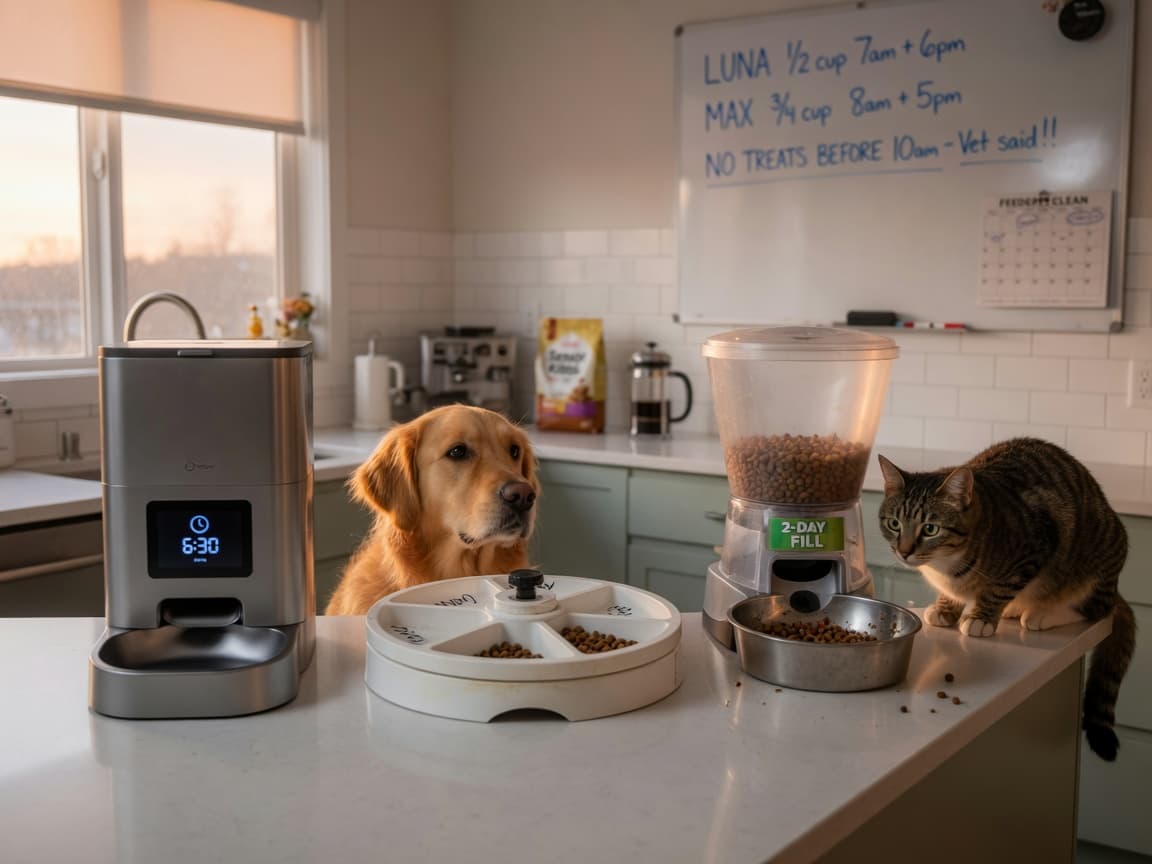
Best Automatic Pet Feeders 2026: Smart & Basic Options
Written by Julia Wrenfield, Pet Wellness Researcher
Updated June 2026 · 7 min read
Automatic pet feeders have moved well beyond novelty gadgets. For households where meal timing is inconsistent — early commutes, long work days, travel — a reliable feeder is one of the most practical investments you can make for your pet's health. But not all feeders are created equal, and choosing the wrong one can mean jammed kibble at 3 a.m. or a larger dog cleaning out the smaller cat's portion before she even wakes up.
This guide covers five feeders across a wide price range, from a $35 rotating tray to a fully app-connected model with a built-in camera. We'll also cover what no one tells you about wet food feeders, why multi-pet households need a different strategy entirely, and the very real medical risk of letting dogs bolt their food unchecked.
The Case for Scheduled Feeding
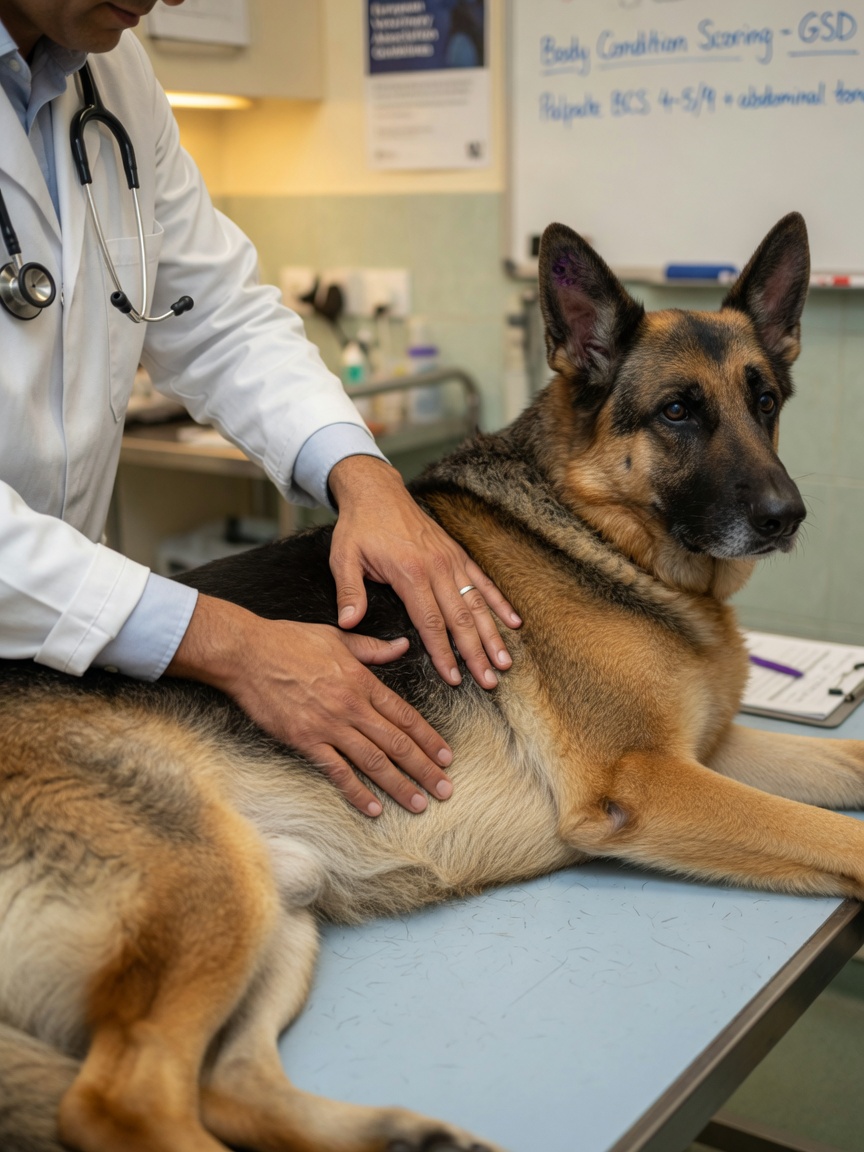
Portion accuracy is the central benefit most owners underestimate. A cat who is 200 calories over her daily needs every day will gain roughly half a pound per month — and lose it almost nowhere near as fast. An automatic feeder dispenses the same measured amount at the same time, every single day, regardless of whether you remembered to feed before leaving the house or came home an hour late.
For dogs, meal timing carries an additional urgency. Large and deep-chested breeds — Great Danes, German Shepherds, Standard Poodles, Boxers — are at elevated risk for gastric dilatation-volvulus (GDV), commonly known as bloat. GDV occurs when the stomach fills with gas and twists on itself, cutting off blood supply. It is fatal within hours without emergency surgery. One established risk factor is eating a single large meal rapidly. Breaking daily food intake into two or three smaller, scheduled meals significantly reduces the volume consumed at any one sitting, which lowers the mechanical risk of stomach distension. Several feeders also offer a built-in slow-feed mode precisely for this reason.
What About Wet Food?
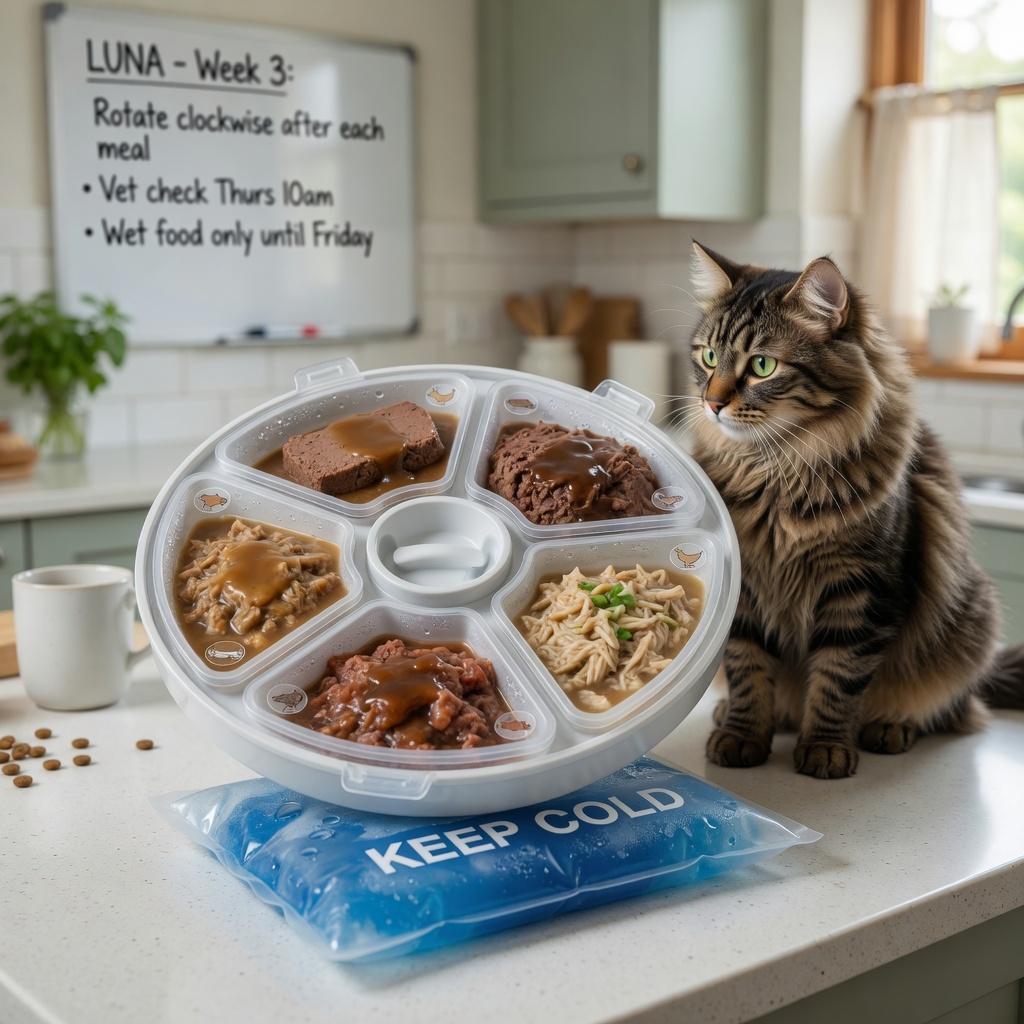
Here is the honest answer most product listings avoid: almost all automatic feeders are designed exclusively for dry kibble, and for good reason. Wet food spoils within two to four hours at room temperature. Dispensing moist food into a bowl that sits exposed for hours creates a genuine food safety risk — bacterial growth, mold, and palatability loss.
The only auto-feeders that work with wet food are the rotating tray models, like the PetSafe 5-Meal reviewed below, and only under specific conditions. These trays use individual sealed compartments. You can pre-portion wet food into each compartment and use an ice pack beneath the tray to keep food at a safe temperature for a short window — typically no more than four to six hours. This approach works for same-day feeding schedules but is not a reliable solution for owners who are away all day.
For pets who require wet food for medical reasons (urinary health, dental disease, kidney conditions), the practical workaround is to use an automatic feeder for dry food during the day and serve wet food manually morning and evening. A second option gaining traction is the fresh-food feeder category — refrigerated units from brands like Whisker — but these cost $200+ and are outside the scope of this review.
Multi-Pet Households: The Portion Theft Problem
If you have more than one pet, you have almost certainly watched one animal finish its food and immediately push the other out of the way. In households with one overweight cat and one that is underweight, this dynamic is not just annoying — it actively prevents you from managing either pet's diet effectively.
The most effective technological solution is microchip-enabled feeders. These units have a lid that opens only when it detects the specific microchip or RFID tag of the designated pet. The Catit PIXI Smart (reviewed below) does not use microchip locking, but dedicated microchip feeder models from SureFeed are worth investigating for households with serious resource-guarding or medical dietary separation needs. For households where the size difference between pets is large enough that a dog physically cannot access a cat's elevated feeding station, elevation alone can serve as a practical barrier.
Power Outages and Battery Backup
An often-overlooked spec is what happens when the power goes out. A purely AC-powered feeder with no battery backup will fail to dispense at the scheduled time during an outage. For pets on strict medical diets — diabetic cats requiring meals timed around insulin injections, for instance — this is not a minor inconvenience. Always check whether a feeder you are considering includes battery backup as standard or requires it as a separate purchase. The PETLIBRO Granary and PetSafe Smart Feed both ship with dual-power options.
The 5 Best Automatic Pet Feeders for 2026
1. PETLIBRO Granary Wi-Fi — Best All-Around Smart Feeder
The PETLIBRO Granary is the smart feeder most people end up with after doing real research, and for good reason. The 5-liter hopper holds enough dry kibble for a week or more for a single adult cat, or several days for a medium dog. You schedule up to six meals per day through the PETLIBRO app, and each meal can be set between 1 and 50 portions — giving you genuine precision rather than the rough cup-and-a-half guesses most bowls involve. Dual power (AC adapter plus D-cell batteries) means feeding continues during outages.
Pros: App reliable, dual power, solid hopper seal keeps kibble fresh, camera model available for around $30 more. Cons: Some owners with large-breed dogs report occasional jamming with oversized kibble pieces; 2.4GHz Wi-Fi only.
Price: ~$80–$120 depending on camera model
2. PetSafe Smart Feed — Best for Dogs, Built-In Slow Feed
The PetSafe Smart Feed holds 24 cups, making it the most practical option for medium to large dogs. Its standout feature is the built-in slow feed mode, which dispenses each meal in smaller increments over a set period — directly addressing the bloat risk discussed above. Twenty-four programmable meal slots per day gives flexibility for pets on complex feeding schedules. The build quality is noticeably solid, and PetSafe's app has years of refinement behind it.
Pros: Slow feed mode, large capacity, strong app, reliable motor. Cons: No camera, 2.4GHz Wi-Fi only, higher price point, no wet food compatibility.
Price: ~$150
3. PetSafe 5-Meal — Best for Wet Food (Short-Term)
This is the only feeder in this roundup that can handle wet food at all. The five-compartment rotating tray holds individual portions that are covered until the meal time arrives, at which point the tray rotates to expose the correct compartment. Used with a slimline ice pack beneath the tray, you can keep wet food reasonably safe for a few hours. It requires no app, no Wi-Fi, and no technical setup — just set the dial and walk away.
Pros: Handles wet food short-term, extremely simple operation, very reliable, low price. Cons: Only five meal slots total (not per day), very small portion sizes, no app or remote control, no battery backup.
Price: ~$35
4. ORSDA 6-Meal — Best Budget Smart Feeder
The ORSDA is a competent budget option for owners who want programmable feeding without committing to a premium price. The LCD display makes programming straightforward without an app, and the voice recording feature lets you record a short message that plays at meal time — a nice touch for anxious pets who respond to their owner's voice. The 4-liter hopper suits cats and small dogs well.
Pros: LCD programming (no app required), voice recording, affordable, reasonable hopper size. Cons: Some reports of motor jamming with certain kibble shapes, build quality not as robust as PetSafe or PETLIBRO, no battery backup on all models.
Price: ~$40–$50
5. Catit PIXI Smart — Best for Cats
The Catit PIXI is designed specifically for cats, and it shows — the footprint is small, the hopper is 1.2 liters (appropriate for a single adult cat), and the app allows up to 12 meals per day, which is ideal for cats who do better with frequent, small meals rather than one or two larger ones. The design is genuinely attractive by feeder standards, and the Catit app is well-reviewed. Not suitable for dogs, and the small hopper means more frequent refilling for multi-cat households.
Pros: Cat-specific design, up to 12 meals/day, clean app, sleek form factor. Cons: Small hopper, cats only, no camera, no slow-feed mode.
Price: ~$60
Comparison Table
| Product | Type | App Control | Camera | Portions/Day | Works For | Price |
|---|---|---|---|---|---|---|
| PETLIBRO Granary Wi-Fi | Smart hopper | Yes | Optional | Up to 6 | Dogs & Cats | $80–$120 |
| PetSafe Smart Feed | Smart hopper | Yes | No | Up to 24 | Dogs & Cats | ~$150 |
| PetSafe 5-Meal | Rotating tray | No | No | Up to 5 total | Dogs & Cats | ~$35 |
| ORSDA 6-Meal | Basic hopper | No | No | Up to 6 | Dogs & Cats | $40–$50 |
| Catit PIXI Smart | Smart hopper | Yes | No | Up to 12 | Cats only | ~$60 |
Key Takeaways
- Scheduled feeding is one of the most effective tools for managing pet weight — over 59% of dogs and 61% of cats are overweight or obese.
- Most automatic feeders are dry-food only; only rotating-tray models (with ice packs) can handle wet food short-term.
- Always choose a feeder with battery backup if your pet has medical dietary timing requirements.
- Dogs at risk for GDV (bloat) should eat from a feeder with a slow-feed mode to reduce rapid intake.
- Multi-pet households with resource-guarding or different dietary needs should consider microchip-enabled feeders.
- The PETLIBRO Granary Wi-Fi is the best all-around pick; PetSafe Smart Feed is best for large dogs; PetSafe 5-Meal is the only wet-food workaround.
References
- Lund EM, Armstrong PJ, Kirk CA, Klausner JS. Prevalence and risk factors for obesity in adult dogs from private US veterinary practices. Intern J Appl Res Vet Med. 2006;4(2):177–186. PubMed PMID: 16870173.
- Glickman LT, Glickman NW, Schellenberg DB, Raghavan M, Lee TL. Incidence of and breed-related risk factors for gastric dilatation-volvulus in dogs. J Am Vet Med Assoc. 2000;216(1):40–45. PubMed PMID: 10638316.
This article contains affiliate links. ForPetsHealthcare may earn a small commission if you purchase through these links, at no additional cost to you. Products are reviewed independently.
Written by Julia Wrenfield, Pet Wellness Researcher