

Are Daffodils Toxic to Dogs?
Updated: June 2026
Daffodils: Spring's Cheerful — and Toxic — Flower
Daffodils are among the first flowers of spring, and their bright yellow and white blooms are a welcome sight after long winters. They are planted by the millions in gardens across North America, Europe, and beyond, and they reliably appear in cut flower bouquets, windowsill pots, and outdoor landscapes every spring. Their ubiquity, combined with the fact that dogs spend increased time outdoors precisely when daffodils are blooming and being planted, creates a significant and regularly underestimated risk.
Daffodils belong to the genus Narcissus, which encompasses over 50 species and thousands of cultivated varieties. All of them are toxic to dogs. The primary toxic compound is lycorine, an isoquinoline alkaloid that causes vomiting by directly irritating the gastrointestinal tract and by triggering the vomiting center in the brain. Additional toxic compounds in daffodils include:
- Galanthamine — a cholinesterase inhibitor that affects the nervous system
- Narcissi macroside and other phenanthridine alkaloids
- Calcium oxalate crystals — present in some parts of the plant, adding immediate oral irritation to the lycorine-mediated toxicity
This multi-compound toxic profile makes daffodil poisoning more complex than single-toxin plant exposures, and more likely to produce a diverse range of symptoms affecting multiple body systems.
The Bulb: Exponentially More Dangerous
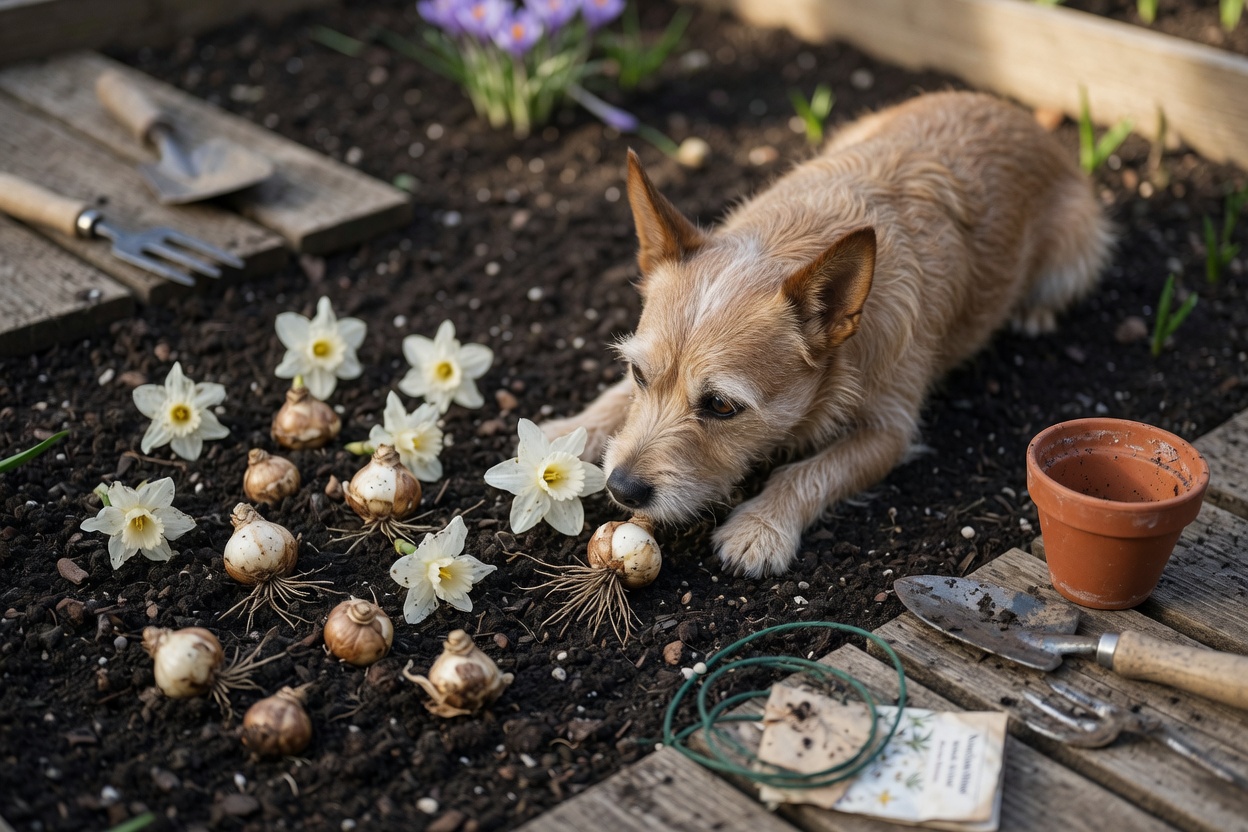
Every part of the daffodil plant is toxic — the flowers, stems, and leaves all contain lycorine and related alkaloids. But the bulb contains these compounds in concentrations far exceeding the rest of the plant. Bulb ingestion is the scenario that veterinarians see most frequently and take most seriously.
Dogs encounter daffodil bulbs in several contexts:
- During spring planting — gardeners may leave bulbs temporarily accessible, and dogs may dig them up
- During autumn planting — when bulbs are being stored or planted for the following spring
- From storage areas — garages, garden sheds, and basements where bulbs are stored may be accessible to dogs
- From freshly dug garden beds — dogs that dig may unearth planted bulbs
- From fallen or discarded plant matter — during garden cleanup
A single large bulb can produce significant toxicity in a small dog. Multiple bulbs — which a dog with unsupervised access to a bag of planting bulbs can easily consume — can cause severe, multi-system illness requiring intensive veterinary intervention.
Symptoms of Daffodil Poisoning in Dogs
The symptom profile of daffodil toxicity in dogs is wide-ranging, reflecting the multiple toxic compounds involved. Symptoms may appear within 15 minutes to a few hours of ingestion, though this depends on the amount consumed and what part of the plant was eaten.
Gastrointestinal symptoms (most common):
- Profuse vomiting — often the first and most dramatic sign; lycorine specifically stimulates the vomiting center
- Severe diarrhea — may be watery and contain mucus or blood
- Excessive salivation and drooling
- Abdominal pain — the dog may whine, guard the belly, or adopt a pain posture (elbows on ground, hindquarters raised)
- Nausea without vomiting — retching, lip-licking
Systemic symptoms (more serious):
- Low blood pressure (hypotension) — the dog may appear weak, shaky, and reluctant to stand
- Tremors or muscle trembling
- Cardiac arrhythmias — irregular heartbeat that can be detected only by auscultation or ECG
- Extreme lethargy and weakness — the dog may collapse or be unable to walk normally
- Respiratory depression — shallow or labored breathing in severe cases
- Convulsions — rare but documented in significant ingestions
The cardiovascular effects — low blood pressure and arrhythmias — are the aspects of daffodil toxicity most likely to become life-threatening. A dog that appears to "just have an upset stomach" after eating daffodil may develop cardiovascular complications over the following hours without obvious warning signs to an untrained observer.
This Is an Emergency: Call Your Vet Immediately
Given the potential for cardiac involvement, daffodil ingestion — especially bulb ingestion — should be treated with urgency. Call your vet immediately, even if your dog is only showing mild symptoms. Do not adopt a wait-and-see approach. Contact the ASPCA Animal Poison Control Center at (888) 426-4435 if your regular veterinarian is unavailable.
When you call, provide:
- The part of the plant eaten (flower, leaves, bulb)
- An estimate of quantity consumed
- Your dog's body weight
- Approximate time of ingestion
- Current symptoms
Veterinary treatment may include induced vomiting (if ingestion was recent and the dog is not already vomiting — lycorine-induced vomiting sometimes means decontamination is less effective), activated charcoal, IV fluid support, cardiac monitoring and management, and anti-nausea medications. Most dogs that receive prompt veterinary care recover, but the prognosis worsens significantly with delayed treatment or large ingestions.
Vase Water and Cut Flowers: Don't Overlook These
Cut daffodils release alkaloids into vase water within hours of being placed in the container. Dogs that drink from flower vases — a surprisingly common behavior — can ingest a meaningful dose of toxin. Similarly, the stems of cut daffodils exude a sticky, milky sap when cut that contains concentrated alkaloids. This sap can cause skin irritation in humans (known as "daffodil itch") and is toxic if licked by dogs.
Keep cut daffodil bouquets out of reach, discard vase water promptly, and wash your hands after handling cut daffodils before petting your dog.
Protecting Your Dog During Daffodil Season
- Supervise your dog closely in the garden during spring when daffodils are in bloom
- Fence off garden beds containing daffodils or use raised beds dogs cannot access
- Store bulbs in sealed, elevated containers dogs cannot reach or knock over
- Never leave dug-up or divided bulbs unattended in accessible locations
- Keep cut daffodil bouquets on high surfaces and discard vase water daily
- Be aware that all Narcissus species — including jonquils, paperwhites, and narcissus — are equally toxic
Key Takeaways
- Daffodils are toxic to dogs — all Narcissus species and varieties, including bulbs, leaves, flowers, and vase water.
- The bulbs contain the highest concentration of lycorine and other alkaloids; bulb ingestion is the most dangerous scenario.
- Symptoms include vomiting, diarrhea, abdominal pain, low blood pressure, tremors, and potentially cardiac arrhythmias.
- Cardiac involvement makes daffodil toxicity potentially life-threatening — treat all ingestions with urgency.
- Call your vet immediately or ASPCA Poison Control at (888) 426-4435 if your dog ingests any part of a daffodil.
- Spring planting and bulb storage periods create the highest-risk windows — supervise dogs closely during these times.
References
- Lampe KF, McCann MA. AMA Handbook of Poisonous and Injurious Plants. American Medical Association, Chicago, 1985. Referenced in: Marvell SI, Smith LJ. "Narcissus toxicity: management and outcomes." Veterinary Record. 2008. PMID: 18708413
- Evidente A, Kireev AS, Jenkins AR, Romero AE, Steelant WF, Van Slambrouck S, Hamel E. "Biological activities of structurally diverse Narcissus alkaloids." Phytochemistry. 2009 Jun;70(8):1032-8. PMID: 19464714