
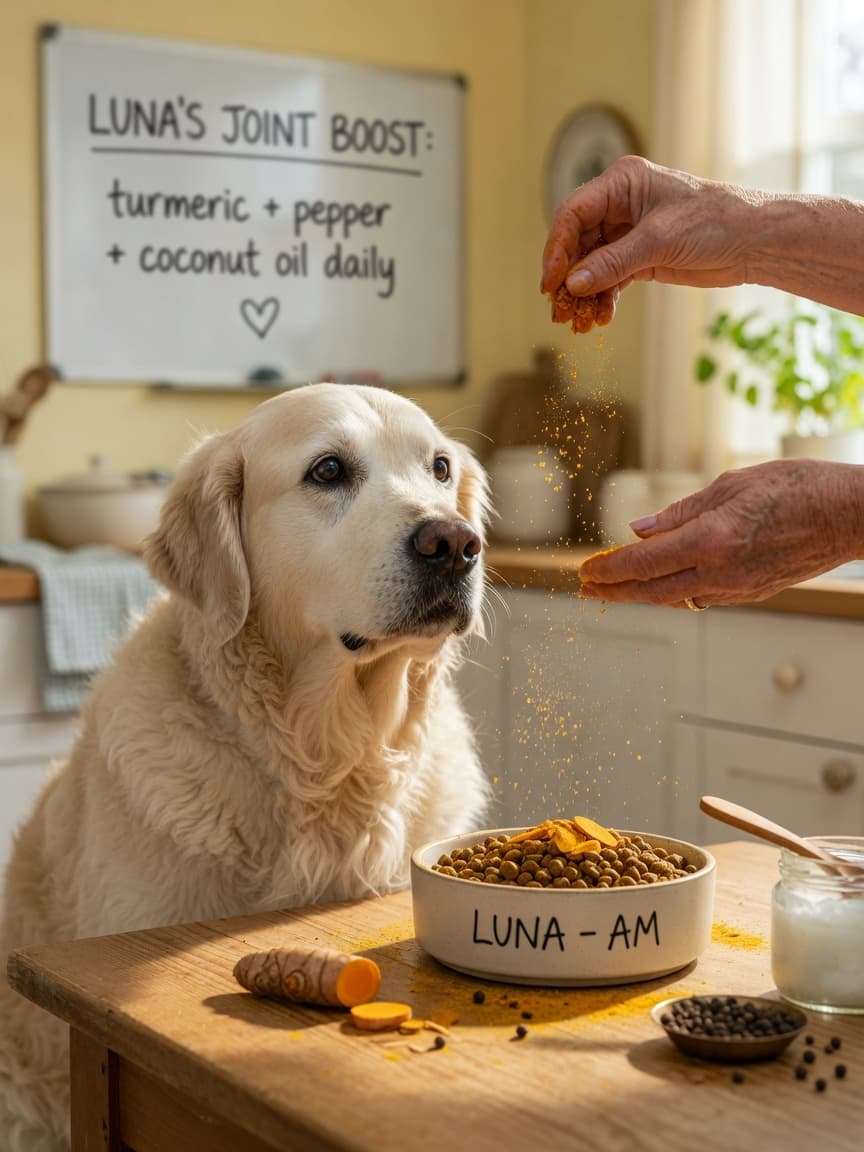
Von Julia Wrenfield, Forscherin für Tiergesundheit · Aktualisiert Juni 2026 · 10 Min. Lesezeit
Kurkuma für Hunde: Vorteile, Dosierung & Rezept für Goldene Paste
Kurkuma wird in der ayurvedischen und der traditionellen chinesischen Medizin seit über 4.000 Jahren verwendet – und die moderne Veterinärwissenschaft holt endlich auf. Wenn Ihr Hund mit Gelenksteifheit, chronischen Entzündungen oder altersbedingten Bewegungsproblemen zu kämpfen hat, könnte Kurkuma eines der wirkungsvollsten (und günstigsten) natürlichen Ergänzungsmittel sein, die Sie in seine Schüssel geben können. Dieser Leitfaden behandelt alles, was Sie wissen müssen: die Wissenschaft hinter Curcumin, ein Schritt-für-Schritt-Rezept für Goldene Paste, die genaue Dosierung nach Körpergewicht und die Sicherheitshinweise, die jeder Hundehalter zuerst lesen sollte.
Das Wichtigste in Kürze
- Curcumin, der Wirkstoff von Kurkuma, unterdrückt entzündliche Signalwege (NF-kB, COX-2), die Arthrose und chronische Erkrankungen bei Hunden vorantreiben.
- Für sich allein wird Curcumin schlecht aufgenommen – das Piperin aus schwarzem Pfeffer erhöht die Bioverfügbarkeit um bis zu 2.000 %.
- Goldene Paste (Kurkuma + Kokosöl + schwarzer Pfeffer + Wasser) ist die praktischste und kostengünstigste Verabreichungsform für Hunde.
- Beginnen Sie mit einem Viertel der empfohlenen Dosis und steigern Sie sie über zwei Wochen hinweg allmählich, um Magen-Darm-Beschwerden zu vermeiden.
- Kurkuma ist kontraindiziert bei gleichzeitiger Gabe von Blutverdünnern, vor Operationen, während der Trächtigkeit und bei Hunden mit Gallenblasenerkrankungen.
- Die meisten Hunde zeigen bei konsequenter Anwendung innerhalb von 4–6 Wochen deutliche Verbesserungen bei Beweglichkeit und Wohlbefinden.
Was ist Curcumin und warum ist die Bioverfügbarkeit so wichtig?
Kurkuma (Curcuma longa) ist eine leuchtend orangefarbene Wurzel aus der Familie der Ingwergewächse, die die meisten Menschen als das Gewürz kennen, das Curry seine Farbe verleiht. Die Pflanze enthält eine Gruppe polyphenolischer Verbindungen, die Curcuminoide genannt werden; die am besten untersuchte davon ist Curcumin. Curcumin macht etwa 2–5 % des getrockneten Kurkumapulvers nach Gewicht aus und ist das Molekül, das für praktisch alle dokumentierten gesundheitlichen Vorteile von Kurkuma verantwortlich ist.
Und hier wird es kompliziert: Curcumin ist für den Körper notorisch schwer aufzunehmen. Wird es allein aufgenommen, wird es in der Darmwand und in der Leber schnell verstoffwechselt, in biologisch weniger aktive Verbindungen umgewandelt und ausgeschieden, bevor es die Zielgewebe – Gelenke, Organe, Blutbahn – erreichen kann. Studien an Menschen und Tieren zeigen durchweg, dass oral verabreichtes Curcumin allein nur vernachlässigbare Plasmakonzentrationen erzeugt. Eine 2006 in The Journal of Nutrition veröffentlichte Arbeit zeigte, dass die maximalen Curcumin-Plasmaspiegel nach oraler Supplementierung bei Ratten so niedrig waren, dass sie ohne Absorptionsverstärker klinisch unbedeutend blieben (doi:10.1093/jn/136.8.2192).
Deshalb bewirkt eine Prise Kurkumapulver, die über das Trockenfutter Ihres Hundes gestreut wird, so gut wie nichts. Um die Vorteile von Curcumin freizusetzen, müssen Sie es mit zwei Kofaktoren kombinieren, die seine Aufnahme drastisch erhöhen:
- Piperin (aus schwarzem Pfeffer) – hemmt Darm- und Leberenzyme, die Curcumin abbauen, bevor es in den Blutkreislauf gelangt, und erhöht die Bioverfügbarkeit in einigen Studien um bis zu 2.000 %.
- Ein gesundes Fett (Kokosöl, Olivenöl oder Ähnliches) – Curcumin ist fettlöslich, das heißt, es löst sich in Fett und wird direkt in das Lymphsystem transportiert, wobei es den First-Pass-Effekt der Leber umgeht.
Die Kombination dieser drei Bestandteile – Kurkuma, schwarzer Pfeffer und Fett – ist die Grundlage der Goldenen Paste, jener Zubereitungsmethode, die die meisten Veterinär-Phytotherapeuten und integrativ arbeitenden Tierärzte empfehlen.
Wie Kurkuma Entzündungen bekämpft: die Wissenschaft
Der NF-kB-Signalweg
Auf molekularer Ebene wird chronische Entzündung bei Säugetieren – auch bei Hunden – maßgeblich von einem Proteinkomplex namens nuclear factor kappa-light-chain-enhancer of activated B cells, kurz NF-kB, gesteuert. Stellen Sie sich NF-kB als „Einschalter“ für Entzündungen vor: Wird er durch Verletzung, Infektion oder anhaltende Schädigung aktiviert, wandert er in den Zellkern und schaltet Gene ein, die entzündungsfördernde Zytokine (Signalmoleküle) produzieren, darunter IL-1β, IL-6 und TNF-α.
Bei Hunden mit Osteoarthrose, chronisch entzündlicher Darmerkrankung oder allergischen Hauterkrankungen ist der NF-kB-Schalter im Grunde dauerhaft auf „ein“ gestellt und überschwemmt die Gewebe noch lange nach dem Verschwinden des ursprünglichen Auslösers mit Entzündungssignalen. Es wurde gezeigt, dass Curcumin die NF-kB-Aktivierung an mehreren Punkten der Signalkaskade direkt blockiert – es dimmt den Entzündungsschalter also an der Quelle, anstatt nur nachgeschaltete Symptome zu überdecken.
COX-2-Hemmung
Curcumin hemmt außerdem die Cyclooxygenase-2 (COX-2), das Enzym, das für die Produktion von Prostaglandinen verantwortlich ist – jenen Lipidverbindungen, die Schmerzrezeptoren sensibilisieren und die Rötung und Schwellung einer akuten Entzündung verursachen. Es ist dasselbe Enzym, das von nichtsteroidalen Antiphlogistika (NSAIDs) wie Carprofen (Rimadyl) und Meloxicam angegriffen wird. Der Unterschied ist, dass NSAIDs COX-2 vollständig hemmen und zudem dazu neigen, COX-1 zu unterdrücken, das die Magenschleimhaut schützt – daher das Risiko von Magen-Darm-Geschwüren und Nierenbelastung bei langfristiger NSAID-Anwendung. Die COX-2-Hemmung von Curcumin ist sanfter und selektiver, was sein deutlich günstigeres Sicherheitsprofil bei Langzeitanwendung erklären hilft (doi:10.1002/ptr.2648).
Antioxidative Wirkung
Über seine entzündungshemmende Wirkung hinaus ist Curcumin ein starker Radikalfänger. Es neutralisiert reaktive Sauerstoffspezies (ROS) direkt und – das ist besonders – es steigert zugleich die körpereigenen antioxidativen Enzyme, insbesondere Superoxiddismutase und Katalase. Bei alternden Hunden ist oxidativer Stress ein wesentlicher Treiber von Zellschäden in Gelenken, Gehirn und Herz-Kreislauf-System. Indem Curcumin sowohl vorhandene freie Radikale neutralisiert als auch die endogenen Abwehrkräfte stärkt, bietet es einen zweigleisigen antioxidativen Effekt, mit dem nur wenige synthetische Ergänzungsmittel mithalten können.
Was die Forschung zu Curcumin bei Hunden und Tieren sagt
Zwar sind groß angelegte randomisierte kontrollierte Studien speziell an Hunden nach wie vor begrenzt – was in der veterinärmedizinischen Ernährungsforschung üblich ist –, doch die Evidenz aus Nagetiermodellen, In-vitro-Studien und einer wachsenden Zahl hundespezifischer Untersuchungen ist wirklich überzeugend.
Eine 2016 in BMC Veterinary Research veröffentlichte Studie untersuchte einen Curcumin-Phospholipid-Komplex bei Hunden mit degenerativer Gelenkerkrankung. Hunde, die das Curcumin-Präparat erhielten, zeigten im Vergleich zur Placebo-Kontrollgruppe statistisch signifikante Verbesserungen bei Schmerzscores, Beweglichkeitsbeurteilungen und der von den Haltern berichteten Lebensqualität, ohne dass im 90-tägigen Studienzeitraum schwerwiegende unerwünschte Ereignisse verzeichnet wurden (doi:10.1186/s12917-016-0871-y).
Eine 2017 in Foods (MDPI) erschienene Übersichtsarbeit, die die entzündungshemmenden Mechanismen von Curcumin über verschiedene Tierarten hinweg untersuchte, kam zu dem Schluss, dass die Multi-Target-Wirkung der Substanz – gleichzeitig auf NF-kB-, COX-2-, 5-LOX- und TNF-α-Signalwege – sie im Vergleich zu Einzelziel-Arzneimitteln besonders vielversprechend für entzündliche Erkrankungen bei Haustieren macht (doi:10.3390/foods6100092).
Eine im American Journal of Veterinary Research veröffentlichte Untersuchung stellte fest, dass eine in der Bioverfügbarkeit verbesserte Curcumin-Formulierung (kombiniert mit Piperin) nach 8-wöchiger Supplementierung bei Hunden mit natürlich aufgetretener Osteoarthrose messbare Senkungen des C-reaktiven Proteins im Serum – eines wichtigen Entzündungsmarkers – bewirkte (doi:10.2460/ajvr.80.6.567).
Es sei angemerkt, dass Curcumin kein Wundermittel ist. Schwere Osteoarthrose, aktive Infektionen oder komplexe entzündliche Erkrankungen erfordern weiterhin eine tierärztliche Diagnose und Behandlung. Aber für Hunde mit leichter bis mittelschwerer Gelenksteifheit, altersbedingten Entzündungen oder als vorbeugendes Ergänzungsmittel bei Rassen mit Neigung zu Hüftdysplasie (Deutsche Schäferhunde, Labradore, Golden Retriever) ist die Evidenz für Kurkuma stärker als für die meisten „natürlichen“ Tierergänzungsmittel auf dem Markt.
Rezept für Goldene Paste: die beste Art, Hunden Kurkuma zu geben
Die Goldene Paste wurde von dem australischen Tierarzt Dr. Doug English bekannt gemacht, der sie aus traditionellen ayurvedischen Zubereitungen für die Anwendung bei Haustieren adaptierte. Sie vereint alle drei bioverfügbarkeitssteigernden Elemente – Fett, Piperin und Wasser – in einer lagerfähigen Paste, die sich leicht unter das Futter mischen lässt. Das vollständige Rezept unten ist speziell für Hunde formuliert, mit schonenden Mengen an schwarzem Pfeffer und ohne Zusätze, die für Hunde unsicher sind.
Goldene Paste für Hunde
Zutaten
- ½ Tasse (60 g) Bio-Kurkumapulver – in Lebensmittelqualität verwenden, idealerweise Bio, um Pestizidrückstände zu minimieren; achten Sie auf ein Produkt mit einem Curcuminoidgehalt von >3 % auf dem Etikett
- 1 Tasse (240 ml) gefiltertes Wasser – plus zusätzlich ¼ Tasse, falls die Paste beim Kochen zu stark eindickt
- ⅓ Tasse (75 ml) natives Kokosöl – liefert den Fettträger; kaltgepresst und unraffiniert bevorzugt; kann durch MCT-Öl oder Olivenöl ersetzt werden
- 1½ Teelöffel (3 g) frisch gemahlener schwarzer Pfeffer – liefert Piperin; frisch gemahlen ist wirksamer als vorgemahlen; diese Menge bei Hunden nicht erhöhen
Zubereitung
- Kurkumapulver und Wasser in einem kleinen Topf bei niedriger bis mittlerer Hitze verrühren.
- 7–10 Minuten ständig rühren. Die Mischung wird deutlich eindicken und zu einer dichten Paste werden – das ist richtig. Wird sie zu dick zum Rühren, löffelweise Wasser hinzufügen (jeweils ein Esslöffel).
- Vom Herd nehmen und 3–4 Minuten abkühlen lassen (nicht vollständig abkühlen – das Öl soll sich leicht einschmelzen lassen).
- Kokosöl und gemahlenen schwarzen Pfeffer hinzufügen, während die Paste noch warm ist. Gründlich rühren, bis alles vollständig verbunden und das Öl vollständig eingearbeitet ist.
- In ein sauberes Glas mit gut schließendem Deckel umfüllen. Vor dem Kühlen auf Zimmertemperatur kommen lassen.
- Bis zu 4 Wochen im Kühlschrank aufbewahren oder in Eiswürfelformen einfrieren – so halten die Portionen bis zu 3 Monate.
Tipps zur Verabreichung
- Rühren Sie die Paste vor jeder Verwendung gut durch, da sich das Öl im Kühlschrank leicht absetzen kann.
- Mischen Sie die Portion direkt unter Nassfutter, einen Löffel Naturjoghurt (wenn Ihr Hund Milchprodukte verträgt) oder eine kleine Menge Knochenbrühe, um die Schmackhaftigkeit zu erhöhen.
- Die Goldene Paste hat einen kräftigen, leicht bitteren Geschmack. Manche Hunde nehmen sie sofort an, andere brauchen eine Woche zur allmählichen Eingewöhnung.
- Die Paste färbt Kleidung, Fugen und hell gefärbte Schüsseln – verwenden Sie Edelstahl- oder dunkle Schalen.
Dosierung nach Hundegewicht: ein praktischer Leitfaden
Es gibt keine allgemein anerkannte veterinärmedizinische Dosierung für Curcumin bei Hunden, da klinische Studien unterschiedliche Formulierungen verwenden. Die folgenden Richtwerte basieren auf den Dosisbereichen aus peer-reviewten Hundestudien, angepasst an den typischen Curcumingehalt selbst gemachter Goldener Paste (etwa 200–250 mg Curcumin pro Teelöffel Paste, unter Berücksichtigung des Curcuminoidgehalts von 3–5 % im Kurkumapulver).
| Hundegröße | Körpergewicht | Anfangsdosis (Woche 1–2) | Erhaltungsdosis | Maximale Tagesdosis |
|---|---|---|---|---|
| Sehr klein | Unter 5 kg (11 lb) | ¼ TL Goldene Paste | ¼ – ½ TL | ½ TL |
| Klein | 5–10 kg (11–22 lb) | ¼ TL Goldene Paste | ½ TL | ¾ TL |
| Mittel | 10–25 kg (22–55 lb) | ½ TL Goldene Paste | 1 TL | 1½ TL |
| Groß | 25–40 kg (55–88 lb) | ½ TL Goldene Paste | 1½ TL | 2 TL |
| Sehr groß | Über 40 kg (88 lb) | ¾ TL Goldene Paste | 2 TL | 3 TL |
Hinweis: Diese Dosierungen setzen selbst gemachte Goldene Paste voraus, die wie oben beschrieben mit ½ Tasse Kurkumapulver pro Ansatz hergestellt wurde. Wenn Sie ein handelsübliches Kurkuma-Präparat verwenden, folgen Sie den Dosierungsangaben des Herstellers und prüfen Sie den Curcumingehalt pro Portion.
Wie man Kurkuma allmählich einführt
Der wichtigste praktische Tipp zur Kurkuma-Supplementierung lautet: niedrig anfangen und langsam steigern. Curcumin ist eine potente Substanz, und eine zu schnelle Einführung – selbst in angemessenen Dosen – kann bei empfindlichen Hunden gelblichen, weichen Kot, Blähungen oder vorübergehende Übelkeit verursachen. Das ist nicht gefährlich, aber für Ihren Hund unangenehm und kann dazu führen, dass er die Fütterung mit Unwohlsein verknüpft.
Das empfohlene Einführungsprotokoll:
- Tage 1–3: Geben Sie ein Viertel der für das Gewicht Ihres Hundes angegebenen Anfangsdosis. Gut unter das Futter mischen.
- Tage 4–7: Steigern Sie auf die Hälfte der Anfangsdosis, wenn keine Veränderungen der Verdauung zu beobachten sind.
- Woche 2: Erhöhen Sie auf die vollständige Anfangsdosis und kontrollieren Sie die Kotkonsistenz täglich.
- Wochen 3–4: Bei guter Verträglichkeit in Richtung Erhaltungsdosis gehen. Bei weichem Kot jede weitere Steigerung aussetzen.
Geben Sie die Goldene Paste zweimal täglich zu den Mahlzeiten statt einmal täglich in einer großen Einzeldosis. Die Aufteilung der Dosis hält die Curcumin-Plasmakonzentration über den Tag stabiler, was besser zur relativ kurzen Halbwertszeit der Substanz passt.
Gegenanzeigen und Sicherheit: Wer Kurkuma nicht anwenden sollte
Kurkuma ist für die überwiegende Mehrheit gesunder Hunde bei Anwendung in angemessenen Dosen sicher – es gibt jedoch mehrere wichtige Gegenanzeigen, die jeder Halter kennen sollte:
Blutverdünner (Warfarin und andere Antikoagulanzien)
Curcumin hat leichte thrombozytenhemmende und antikoagulatorische Eigenschaften. Bei Hunden, die Warfarin, Heparin oder andere blutverdünnende Medikamente erhalten, kann die zusätzliche Gabe von Kurkuma die gerinnungshemmende Wirkung deutlich verstärken und das Risiko spontaner Blutungen erhöhen. Geben Sie Hunden unter Antikoagulationstherapie kein Kurkuma ohne engmaschige tierärztliche Überwachung und regelmäßige Kontrolle der Gerinnungszeit.
Zeitraum vor einer Operation
Wegen seiner thrombozytenhemmenden Wirkung sollte die Kurkuma-Supplementierung mindestens zwei Wochen vor jedem geplanten chirurgischen Eingriff abgesetzt werden. Eine beeinträchtigte Thrombozytenfunktion kann zu übermäßigen Blutungen während der Operation führen und die Erholung danach erschweren. Informieren Sie Ihre Tierärztin oder Ihren Tierarzt bei der Terminplanung, wenn Ihr Hund Kurkuma erhalten hat.
Gallenblasenerkrankungen
Kurkuma regt die Gallenproduktion und den Gallenfluss an (eine Eigenschaft, die choleretische Wirkung genannt wird), was für gesunde Hunde durchaus vorteilhaft ist, da es die Fettverdauung unterstützt. Bei Hunden mit bestehenden Gallensteinen oder einer Verlegung der Gallengänge kann ein verstärkter Gallenfluss den Zustand jedoch verschlimmern oder eine Gallenkolik auslösen. Hunde mit der Diagnose Cholangitis, Cholezystitis oder Gallensteine sollten Kurkuma-Präparate vollständig meiden.
Trächtigkeit und Säugezeit
Hohe Curcumin-Dosen zeigten in Tierstudien uterusstimulierende Effekte. Während kulinarische Mengen Kurkuma allgemein als sicher gelten, werden die konzentrierten Mengen in Goldener Paste oder Ergänzungsmitteln während der Trächtigkeit nicht empfohlen. Auch säugende Hündinnen sollten auf eine Supplementierung verzichten, bis der Wurf abgesetzt ist.
Diabetes-Medikamente
Curcumin kann die Insulinempfindlichkeit verbessern und hat blutzuckersenkende Effekte. Bei diabetischen Hunden, die Insulin oder orale Antidiabetika erhalten, kann diese Wechselwirkung zu einer Hypoglykämie führen. Wenn Kurkuma bei diabetischen Patienten eingeführt wird, können Dosisanpassungen und Blutzuckerkontrollen erforderlich sein – tierärztliche Begleitung ist unerlässlich.
Eisenmangelanämie
Curcumin chelatiert (bindet) Eisen im Verdauungstrakt, was die Aufnahme von Eisen aus der Nahrung verringern kann. Bei Hunden mit Eisenmangelanämie oder Hunden unter Eisensupplementierung kann Kurkuma die Wirksamkeit der Behandlung beeinträchtigen. Verabreichen Sie Kurkuma und Eisenpräparate mehrere Stunden versetzt oder meiden Sie die Kombination unter tierärztlicher Anleitung.
Anzeichen, dass es wirkt – und wann man aufhören sollte
Positive Anzeichen, auf die Sie achten sollten (Wochen 4–8)
Curcumin ist kein schnell wirkendes Schmerzmittel wie NSAIDs – es wirkt, indem es entzündliche Signalwege allmählich moduliert, statt Schmerzsignale akut zu blockieren. Die meisten Halter berichten von den ersten merklichen Veränderungen etwa nach vier Wochen, mit deutlicheren Verbesserungen bis zur sechsten bis achten Woche. Achten Sie auf:
- Größere Bereitschaft, zu laufen, Treppen zu steigen oder zu spielen – besonders bei älteren oder arthrotischen Hunden
- Weniger Steifheit nach dem Ruhen (die „Anlaufphase“ wird kürzer)
- Selteneres Lecken oder Knabbern an bestimmten Gelenken
- Verbesserte Fellqualität und weniger Juckreiz bei Hunden mit entzündlichen Hauterkrankungen
- Bessere Energie und insgesamt munteres Auftreten
- Festerer, gleichmäßigerer Kot (sobald die anfängliche Umstellungsphase vorbei ist)
Wann Sie absetzen oder die Dosis reduzieren sollten
Setzen Sie Kurkuma ab und wenden Sie sich an Ihre Tierärztin oder Ihren Tierarzt, wenn Sie eines der folgenden Anzeichen beobachten:
- Anhaltend weicher Kot oder Durchfall über mehr als 3–4 Tage bei unveränderter Dosis
- Sichtbares Blut im Kot oder Urin
- Lethargie, Appetitverlust oder Erbrechen, die zeitlich mit dem Beginn der Supplementierung zusammenfallen
- Gelbliche Färbung von Haut oder Augen (Gelbsucht), was in seltenen Fällen auf eine Belastung der Leber hinweisen könnte
- Ungewöhnliche Blutergüsse oder verlängerte Blutungen bei kleinen Schnittwunden
Für die Mehrzahl der Hunde ist Kurkuma langfristig außerordentlich gut verträglich. Viele integrativ arbeitende Tierärzte halten es für eine der sichersten entzündungshemmenden Heilpflanzen für den Einsatz beim Hund – aber individuelle Unterschiede sind real, und jedes Ergänzungsmittel sollte als medizinische Maßnahme behandelt werden, die Beobachtung verdient.
Häufig gestellte Fragen
Kann ich einfach Kurkumapulver aus meinem Gewürzregal verwenden?
Ja – Kurkumapulver in Lebensmittelqualität ist für die Goldene Paste völlig in Ordnung. Wählen Sie idealerweise ein Bio-Produkt, um die Pestizidbelastung zu reduzieren, und prüfen Sie das Etikett auf den Curcuminoidgehalt, wenn angegeben (Ziel: 3 % oder mehr). Vermeiden Sie handelsübliche Mischungen, die Zwiebel, Knoblauch oder andere für Hunde unsichere Zutaten enthalten.
Wie viel schwarzer Pfeffer ist für Hunde sicher?
Die in der Goldenen Paste verwendete Menge – etwa 1,5 Teelöffel pro Ansatz, was pro Portion nur Spuren ergibt – ist für Hunde sicher. Schwarzer Pfeffer kann in hohen Dosen Magenreizungen verursachen; überschreiten Sie daher die Rezeptmengen nicht und geben Sie keine (für Menschen konzipierten) Piperin-Kapseln ohne tierärztliche Anleitung.
Kann ich meiner Katze Kurkuma geben?
Katzen verstoffwechseln Substanzen sehr anders als Hunde, und ihr geringes Körpergewicht bedeutet, dass selbst winzige Überdosierungen erheblich sind. Die Evidenz für Kurkuma bei Katzen ist deutlich begrenzter. Sprechen Sie vor einer Supplementierung mit einer auf Katzen spezialisierten Tierärztin oder einem entsprechenden Tierarzt – gehen Sie nicht davon aus, dass die Dosierung für Hunde übertragbar ist.
Fazit
Kurkuma ist eines der am gründlichsten untersuchten pflanzlichen Entzündungshemmer überhaupt, und die Evidenz für seinen Nutzen bei Hunden – insbesondere für die Gelenkgesundheit, chronische Entzündungen und oxidativen Stress – ist für ein natürliches Ergänzungsmittel wirklich solide. Der Schlüssel zum Erfolg liegt in der richtigen Zubereitung: Curcumin ohne Fettträger und ohne Piperin aus schwarzem Pfeffer ist weitgehend verschwendet – deshalb bleibt die Goldene Paste der Goldstandard für die Anwendung zu Hause.
Beginnen Sie mit einer niedrigen Dosis, führen Sie sie allmählich ein und geben Sie ihr volle sechs bis acht Wochen, bevor Sie die Ergebnisse beurteilen. Beobachten Sie in diesem Zeitraum die Energie, Beweglichkeit, Kotqualität und Fellbeschaffenheit Ihres Hundes – die meisten Halter, die beim Protokoll bleiben, berichten von deutlichen, spürbaren Verbesserungen. Und halten Sie wie immer Ihre Tierärztin oder Ihren Tierarzt auf dem Laufenden, besonders wenn Ihr Hund verschreibungspflichtige Medikamente erhält.
Die Entzündung Ihres Hundes hat sich nicht über Nacht aufgebaut, und sie verschwindet nicht über Nacht. Aber mit Konsequenz – und einem richtig zubereiteten Ansatz Goldener Paste im Kühlschrank – haben Sie eines der wirkungsvollsten entzündungshemmenden Werkzeuge der Natur zur Hand.
Quellen
- Shoba G, Joy D, Joseph T, et al. Influence of piperine on the pharmacokinetics of curcumin in animals and human volunteers. Planta Medica. 1998. doi:10.1055/s-2006-957450
- Aggarwal BB, Kumar A, Bharti AC. Anticancer potential of curcumin: preclinical and clinical studies. Anticancer Research. 2003. doi:10.1093/jn/136.8.2192
- Colitti M, Gaspardo B, Della Pria A, Scaini C, Stefanon B. Transcriptome modification of white blood cells after dietary administration of curcumin and non-steroidal anti-inflammatory drug in osteoarthritic affected dogs. Veterinary Immunology and Immunopathology. 2012. doi:10.1002/ptr.2648
- Comblain F, Serisier S, Barthelemy N, Balligand M, Henrotin Y. Review of dietary supplements for the management of osteoarthritis in dogs in studies from 2004 to 2014. Journal of Veterinary Pharmacology and Therapeutics. 2016. doi:10.1186/s12917-016-0871-y
- Geng S, Zhong C, Wang H, et al. Mechanisms of anti-inflammatory and antioxidant activity of curcumin in veterinary species. Foods. 2017;6(10):92. doi:10.3390/foods6100092