
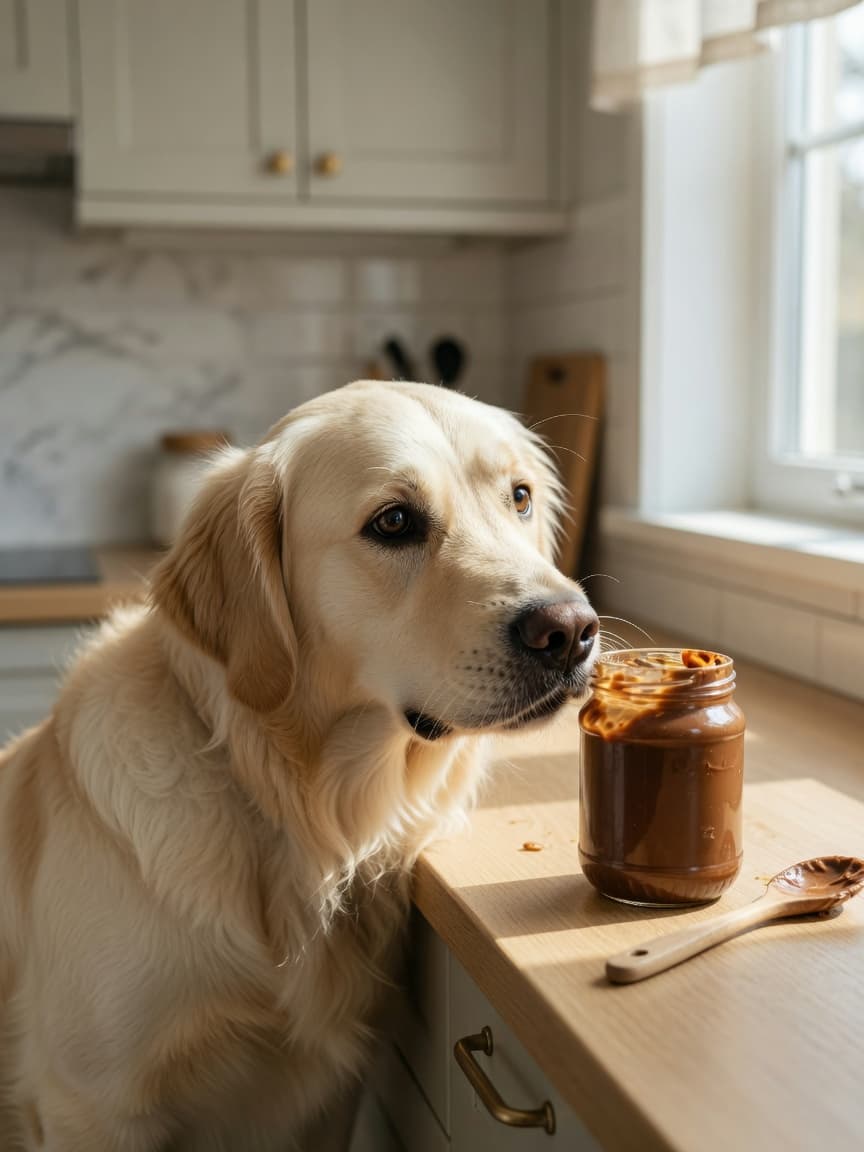
Dürfen Hunde Erdnussbutter essen?
Von Julia Wrenfield, Forscherin für Haustiergesundheit — Juni 2025
Einfache, ungesalzene, ungesüßte Erdnussbutter ist für die meisten Hunde ein sicherer und nahrhafter Leckerbissen. Sie steckt voller Protein, gesunder Fette und wichtiger Vitamine. Allerdings MÜSSEN Sie das Etikett jedes einzelne Mal prüfen, bevor Sie sie Ihrem Hund geben. Einige Erdnussbutter-Sorten enthalten Xylitol, einen künstlichen Süßstoff, der für Hunde tödlich giftig ist.
Xylitol ist ein Zuckeralkohol, der in vielen „natürlichen“, „ohne Zuckerzusatz“ und „kalorienreduzierten“ Erdnussbutter-Produkten verwendet wird. Bei Hunden verursachen bereits kleine Mengen einen raschen und lebensbedrohlichen Abfall des Blutzuckers (Hypoglykämie) und können zu akutem Leberversagen führen. Symptome treten innerhalb von 30–60 Minuten nach der Aufnahme auf. Wenn Ihr Hund Erdnussbutter mit Xylitol gefressen hat, rufen Sie sofort Ihren Tierarzt oder die Pet Poison Helpline an. Warten Sie nicht auf Symptome.
Ist sie für Hunde sicher?
Für die große Mehrheit gesunder Hunde ist Erdnussbutter ein völlig sicherer Snack, wenn sie richtig ausgewählt und angeboten wird. Sie ist seit Jahrzehnten ein beliebter Hundeleckerli und wird häufig verwendet, um Kong-Spielzeuge zu befüllen, auf Schleckmatten zu streichen oder Medikamente zu verstecken. Tierärzte und Tierernährungswissenschaftler sind sich weitgehend einig, dass einfache Erdnussbutter — hergestellt ausschließlich aus Erdnüssen, ohne zugesetzten Zucker, Salz oder Süßstoffe — kein nennenswertes Risiko für Hunde darstellt in angemessenen Portionen.
Die entscheidende Einschränkung lautet pur. Der Markt für handelsübliche Erdnussbutter ist inzwischen voll von „natürlichen“, „gesunden“ und „ohne Zuckerzusatz“-Varianten, die häufig Saccharose durch Xylitol ersetzen. Diese Produkte sehen im Regal identisch aus und werden oft als die gesündere Wahl positioniert. Für Menschen mögen sie unbedenklich sein; für Hunde können sie tödlich sein.
Eine kleine Zahl von Hunden leidet auch unter Erdnuss-Allergien, obwohl dies bei Hunden weitaus seltener vorkommt als beim Menschen. Wenn Sie Erdnussbutter einführen und dies zum ersten Mal tun, bieten Sie eine winzige Menge an und beobachten Sie Ihren Hund 30 Minuten lang. Anzeichen einer allergischen Reaktion sind Nesselsucht, Gesichtsschwellung, Juckreiz, Erbrechen oder Atemnot. Wenn eines dieser Symptome auftritt, kontaktieren Sie sofort Ihren Tierarzt und bieten Sie keine Erdnussbutter mehr an.
DIE XYLITOL-WARNUNG — Vor dem Füttern lesen
Xylitol ist eine der gefährlichsten Substanzen, die ein Hund versehentlich aufnehmen kann, und kommt in Erdnussbutter zunehmend häufig vor.
Beim Menschen hat Xylitol keine wesentliche Wirkung auf den Blutzucker. Bei Hunden löst es eine massive Insulinausschüttung aus, wodurch der Blutzucker innerhalb von 30–60 Minuten auf gefährlich niedrige Werte abstürzt. Dieser Zustand — Hypoglykämie — kann unbehandelt Krampfanfälle, Bewusstlosigkeit und den Tod verursachen. Höhere Dosen schädigen die Leber und verursachen manchmal akutes Leberversagen, selbst wenn die anfängliche Hypoglykämie behandelt wird.
Die toxische Dosis ist sehr niedrig: Bereits 0,1 g Xylitol pro Kilogramm Körpergewicht können eine Hypoglykämie verursachen. Ein einzelner Esslöffel xylitolhaltiger Erdnussbutter kann ausreichen, um einem kleinen oder mittelgroßen Hund ernsthaft zu schaden oder ihn zu töten.
Marken und Produkte, die Xylitol verwendet haben oder von denen berichtet wurde, dass sie Xylitol enthalten:
- Nuts 'N More (bestimmte Geschmacksrichtungen — aktuelle Kennzeichnung stets erneut prüfen)
- Krush Nutrition (Nussbutter-Aufstriche)
- P28 Foods (proteinreicher Erdnussbutter-Aufstrich)
- Viele Eigenmarken-Erdnussbutter-Sorten mit „reduziertem Zuckergehalt“ oder „ohne Zuckerzusatz“
Erdnussbutter-Marken, die weithin als xylitolfrei gelten (Stand 2025):
- Skippy (Originalsorten)
- Jif (Originalsorten)
- Pip & Nut (UK/EU — einfache Sorten)
- Meridian (einfache Erdnussbutter, UK)
- Whole Earth (Original, ungesüßt)
Wichtig: Die Rezepturen der Marken ändern sich. Lesen Sie die Zutatenliste jedes Mal, wenn Sie ein neues Glas kaufen, auch wenn Sie diese Marke schon zuvor gekauft haben. Achten Sie auf „Xylitol“, „Birkenzucker“, „E967“ oder jede Zutat, die auf „-itol“ endet (Sorbitol, Maltitol usw. sind weniger gefährlich, sollten aber beachtet werden). Wenn Xylitol aufgeführt ist, stellen Sie das Glas zurück ins Regal.
Nährwertvorteile von Erdnussbutter für Hunde
Sobald Sie bestätigt haben, dass Ihre Erdnussbutter xylitolfrei sowie arm an Salz und Zucker ist, wird sie zu einem wirklich nahrhaften gelegentlichen Leckerbissen. Das können Hunde davon haben:
- Protein: Zwei Esslöffel einfache Erdnussbutter enthalten etwa 7–8 g Protein und unterstützen den Erhalt und die Reparatur der Muskulatur. Auch wenn sie eine ausgewogene Ernährung nicht ersetzen sollte, ist der Proteinbeitrag für einen aktiven Hund bedeutsam.
- Einfach ungesättigte Fette: Erdnüsse sind reich an Ölsäure, demselben herzgesunden Fett, das in Olivenöl vorkommt. Diese Fette unterstützen den Hautzustand und den Fellglanz und tragen zum Energiestoffwechsel bei.
- Vitamin E: Ein fettlösliches Antioxidans, das Zellen vor oxidativen Schäden schützt und die Immunfunktion unterstützt.
- Niacin (Vitamin B3): Unerlässlich für den Energiestoffwechsel und eine einwandfreie neurologische Funktion. Hunde können etwas Niacin selbst synthetisieren, aber Nahrungsquellen wie Erdnussbutter füllen ihre Speicher bequem auf.
- Vitamin B6: Beteiligt am Proteinstoffwechsel, an der Bildung roter Blutkörperchen und an der Neurotransmittersynthese.
- Magnesium: Unterstützt die Knochengesundheit sowie die Muskel- und Nervenfunktion.
Diese Vorteile machen Erdnussbutter zu mehr als nur einer schmackhaften Belohnung. Durchdacht eingesetzt, liefert sie Mikronährstoffe, die ein vollwertiges Fertigfutter ergänzen.
So bieten Sie Ihrem Hund Erdnussbutter an
Die Art der Darreichung ist ebenso wichtig wie die Menge. Hier sind die wirksamsten und bereicherndsten Möglichkeiten, Erdnussbutter anzubieten:
- Kong oder befüllbare Spielzeuge: Füllen Sie einen Gummi-Kong mit einer kleinen Menge Erdnussbutter, optional vermischt mit Banane oder Naturjoghurt, und frieren Sie ihn über Nacht ein. Das schafft eine langanhaltende geistige Beschäftigung, die Hunde beschäftigt und ruhig hält. Hervorragend geeignet bei Trennungsangst oder für Hunde mit hohem Energielevel.
- Schleckmatten: Streichen Sie eine dünne Schicht auf eine Silikon-Schleckmatte. Das wiederholte Lecken hat eine natürlich beruhigende, fast meditative Wirkung auf Hunde. Besonders nützlich bei der Fellpflege, beim Krallenschneiden oder beim Tierarztbesuch.
- Trainingsbelohnungen: Ein kleiner Klecks auf dem Finger oder ein winziges Ablecken aus einer Quetschtube eignet sich hervorragend als hochwertige Belohnung für komplexe Trainingsverhalten. Weil sie klebrig und aromatisch ist, empfinden Hunde sie als äußerst motivierend.
- Tablettenverstecke: Das Einwickeln von Medikamenten in eine kleine Kugel aus Erdnussbutter ist eine der zuverlässigsten Methoden für Hunde, die Tabletten verweigern. Der starke Geruch und Geschmack überdecken das Medikament wirksam.
Wählen Sie stets ungesalzene und ungesüßte Sorten. Zu viel Natrium kann übermäßigen Durst, vermehrten Harndrang und in großen Mengen eine Natriumionenvergiftung verursachen. Vermeiden Sie Erdnussbutter mit zugesetztem Honig, Schokoladenaroma oder Gewürzen — alles unnötig und potenziell schädlich.
Suchen Sie nach sicheren, tierärztlich empfohlenen Leckerlis für Ihren Hund? Zooplus führt eine große Auswahl an natürlichen Snacks und Schleckmatten, die speziell für die Beschäftigung von Hunden entwickelt wurden.
Hundesnacks bei Zooplus ansehenPortionsleitfaden
Erdnussbutter ist kaloriendicht. Zwei Esslöffel enthalten etwa 190 Kalorien und 16 g Fett. Für einen 10-kg-Hund, dessen täglicher Kalorienbedarf bei etwa 400–500 kcal liegt, stellt bereits ein Esslöffel Erdnussbutter einen erheblichen Kalorienbeitrag dar. Die allgemeine Regel lautet, dass Leckerlis 10 % der täglichen Kalorienaufnahme eines Hundes nicht überschreiten sollten.
Hunde mit Adipositas, Pankreatitis oder einer Vorgeschichte von Hyperlipidämie sollten keine Erdnussbutter erhalten, ohne zuvor einen Tierarzt zu konsultieren, da der hohe Fettgehalt diese Erkrankungen auslösen oder verschlimmern kann.
| Hundegröße | Gewicht | Max. Tagesportion | Ungefähre Kalorien |
|---|---|---|---|
| Klein | <10 kg | ½ Teelöffel | ~15 kcal |
| Mittel | 10–25 kg | 1 Teelöffel | ~30 kcal |
| Groß | >25 kg | 1 Esslöffel | ~95 kcal |
Die angegebenen Portionen sind maximale Gelegenheitsmengen, keine täglichen Zielwerte. An Tagen, an denen Ihr Hund Erdnussbutter erhält, reduzieren Sie die Portion der Hauptmahlzeit etwas, um das auszugleichen.
Kong-Spielzeuge und Schleckmatten gehören zu den besten Möglichkeiten, Erdnussbutter sicher anzubieten. Finden Sie Beschäftigungsspielzeuge für Ihren Hund bei Zooplus.
Hundesnacks bei Zooplus ansehen- Einfache Erdnussbutter ist unbedenklich für die meisten Hunde — wählen Sie ungesalzene, ungesüßte Sorten mit einer Zutat: Erdnüsse.
- Xylitol ist tödlich. Lesen Sie jedes Mal die vollständige Zutatenliste auf jedem Glas. Achten Sie auf „Xylitol“, „Birkenzucker“ oder „E967“. Füttern Sie niemals ein Produkt, das es enthält.
- Erdnussbutter liefert Protein, einfach ungesättigte Fette, Niacin sowie die Vitamine B6 und E — allesamt in angemessenen Mengen vorteilhaft für Hunde.
- Sie eignet sich hervorragend als Kong-Füllung, Aufstrich für Schleckmatten, hochwertige Trainingsbelohnung und zum Verstecken von Tabletten.
- Portionskontrolle ist entscheidend: ½ TL für kleine Hunde, 1 TL für mittelgroße Hunde, 1 EL für große Hunde — Höchstmenge.
- Hunde mit Pankreatitis, Adipositas oder Hyperlipidämie sollten ohne tierärztliche Beratung keine Erdnussbutter erhalten.
- Eine Erdnussallergie bei Hunden ist selten, aber real. Führen Sie sie mit einer winzigen Menge ein und beobachten Sie 30 Minuten lang.
Quellen
- Piscitelli CM, Dunayer EK, Aumann M. Xylitol toxicity in dogs. Compendium on Continuing Education for the Practising Veterinarian. 2010;32(2):E1–E4. PMID: 20473849.
- Dunayer EK, Gwaltney-Brant SM. Acute hepatic failure and coagulopathy associated with xylitol ingestion in eight dogs. Journal of the American Veterinary Medical Association. 2006;229(7):1113–1117. doi:10.2460/javma.229.7.1113.
- Case LP, Daristotle L, Hayek MG, Raasch MF. Canine and Feline Nutrition: A Resource for Companion Animal Professionals. 3rd ed. Mosby Elsevier; 2011. Kapitel 9: Fettlösliche Vitamine und Anforderungen an Nahrungsfett.